Friday, July 19, 2013

The Melton's Part II Census Records

Census records are one of the most useful tools in tracking a family, however, I've learned to be very careful when using this information. To put it simply, census takers made a lot of mistakes. Just recently, I saw one in which a woman's age was listed as 54 and her husbands as 17. Luckily, both appeared in the census records before and after this one and the husbands age should have been 57, instead of 17.

Beginning researchers also make a lot of mistakes when using them as tools, especially in the earlier census records, which do not give relationship to the Head of Household. They assume every child listed in the household is a child of the head of household, which might not be the case. Sometimes extra persons in the home had a different surname, and the census taker just wrote down the first name, so the individual ends up with the wrong surname. I've seen this several times. Or, the census takers hand-writing is so bad, no one can transcribe it correctly. This might be a reason some individuals seemed to disappear for a decade, only to reappear in the same place they were 20 years prior.

Despite all of these obstacles, census records remain a valuable source of information.

In trying to untangle the Melton/Milton family of Stanly and Montgomery Counties, in North Carolina, I took a look at census records to see if they could give us any hint as to the relationships between the individuals.

The first census of the United States was taken in 1790. Prior to that, there were some local methods of counting for tax purposes, tax lists and the such, which varied from state to state. In 1790 neither Stanly or Montgomery Counties existed yet. Montgomery was born in 1799 and his other half, Stanly, which was known in the 1800-1840 census records as "West Pee Dee", was born in 1841.
In 1790, the area that is now those two counties, and several others, were all a part of Mother Anson. There were 5 men and their families listed with the surname Melton in Anson County in 1790: Isham, Jesse, John, another John and Michael. Moore County, very close to Montgomery, was home to Nathaniel, James and Ansel. Randolph, which borders Montgomery to the north, was home to Samuel.

In 1800, Montgomery County, which included the area now known as Stanly, was a year old. The only Melton or Milton enumerated there was John, with one male over 45, one female over 45, with one male under 10 in the home, and 2 between the ages of 10 and 16. He was listed next to Elizabeth Bosworth, or Boysworth. The two families would maintain a close relationship for generations.
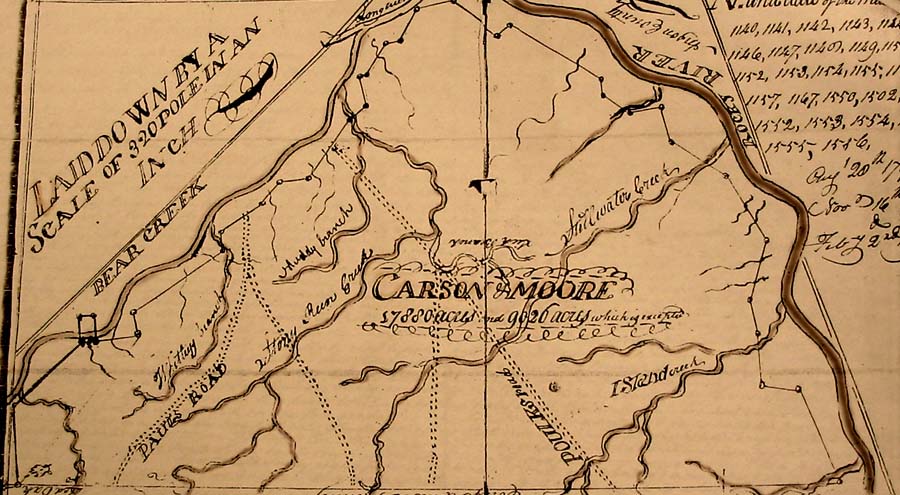

In 1810, there appears a blotted out "Melton" next to a George Lee. This Melton has a female aged 26 to 45 in the household, and 3 males, one 16 to 26 and 2 under 10. This may have been a widow and her 3 sons. Other families living in the area were 3 Marberry's, Thomas, Thomas, William and Bartlet Huckabee, Bennett Soloman, John Kirk, Esq., and Isaac, Alex and Thomas Biles. In a different area, John Milton is there, with one male and one female over 45, and one male 16 to 26. Joseph Milton has one male and one female age 26 to 45, one male 16 to 26, two females 10 to 16 and 2 males under 10. The 'neighbors' give no indication, by known area of settlement of families, of where they may have been in Montgomery County.

There is no 1820 census available for Montgomery County. Montgomery had a problem with Courthouse fires. One of the fires may have been the reason there is no 1820 census.

By 1830, 20 years had passed. Time enough for some of those listed as children to be heads of their own households, or to have moved away. There are 4 households of Melton's in Montgomery County. Living a little further away from the other 3 is John Melton, with one male 20 to 30, one female 20 to 30 and one female under 5. This would have to be John Jr., or John the younger. He is next to my ancestors James Palmer and Jesse Murray. Jesse Murray, I know, lived on Long Creek in the southern part of the county, not far from the Rocky River. Other neighbors, Shankles, Simpsons and Soloman Burris, the younger, seem to suggest the Cottonville area.  

The other Melton's are living near the Kirks and the Forrests, which suggests they are living along the Pee Dee, north of Randalls and near the Swift Island area, where they later were known to have settled.

John, the elder, (due to the ages of the oldest inhabitants in the home), is shown with a male 50 to 60 and a female 40 to 50 in the home, there are also 2 females 15 to 20, 3 males 10 to 15, 1 male 5 to 10, and 2 females under 5. This is a substantial group of persons and definately not all Meltons born by 1820 account for just this family grouping. And an even larger household right next door is led by Betsy Melton, most likley a widow, with both a male and female in the house 40 to 50, 1 male 20 to 30 and 2 females 20 to 30, 1 male 15 to 20, 1 female 15 to 20, 1 male 10 to 15, 1 female 10 to 15, 2 females 5 to 10 and 1 female under 5. A total of 12 persons in the home, perhaps an adult child and their family.

Joseph Melton is not very far, between Thomas Dunn and Thomas Kirk and only 2 houses count away from Peter Winfield II.  The short, but important life of Peter Winfield II

This Joseph will be the one I will refer to as Joseph the elder, although up until this point, he is the only Joseph, another will soon make an appearance. In 1830, he is shown with a female 60 to 70 and a male 50 to 60, perhaps a married couple, with the wife a few years older than the husband, say 61 and 59, maybe. There is also a female 30 to 40, one 20 to 30 and a male 20 to 30, 1 female 10 to 15, 4 males 5 to 10 and 2 under 5. That's a large number of little boys in one household born between 1820 and 1830. All of the Melton's are listed in West Pee Dee, which would become Stanly County.

 1840 was the last census in which the two counties were counted as one, and in which only the heads of households were named. Most Heads of Households were the oldest male in the home, be it father or grandfather or adult son. Some households led by women show an adult male in the home, which may have been an employee and not an adult son, or it could have been a home wherein the mother still conducted most of the business as a widow, and the son had not yet taken title to the property.

By 1840, the number of Melton households had increased from 4 to 5, all within close proximity to each other. These last two censuses also had persons enumerated in a way that further divided them, and this is something I will refer to in later posts on these families. There are designations as F, M. FS, MS, MFC, and FFC, meaning female or male (white), female slave, male slave, female free colored, male free colored. While the existence of Indians as a tribe settled in this area by then, had been long gone, some families, living like those of European decent, still occupied the state, and still do. One family designated as Free Colored, was that of Richard Hedgepeth, whom I learned some time ago from a researcher, had been verified as being Native American. By 1840, some of the Melton children classified as Mulatto, or near black nor white, had been born.

Joseph Melton the elder, is shown with both male and female 60 to 70, a female 40 to 50, another 30 to 40, a male 20 to 30 another 15 to 20 and another 10 to 15. John Melton, the elder is shown still next to Thomas Biles, who has an adult female and 3 children in his home that are "FC". So is the family of Gabriel Bell, who also appeared in the 1830 census.

John the elder has an older couple in the house, male 60 to 70 and female 50 to 60, a male and a female 20 to 30 and 5 persons under 20. Henry Melton makes his appearance this year as a young couple 20 to 30 with a girl under 5 in the home. He lives near Dr. Kron. Both John and Joseph, the youngers live near William Boysworth and near a number of Kirks, but all in the same area as the other Melton's. Joseph has an adult couple between 20 and 30 and a girl under 5. John the younger has a couple between 30 and 40 and a girl 10 to 15 and another 5 to 10.

Next, I'll be looking and comparing the records after 1850, in which Montgomery and Stanly are separate, and women and children are named with ages.


Thursday, July 18, 2013

Untangling the Melton's Pt I

In attempting to discover what became of the children from Stanly County born in "Shades of Gray", first, I wanted to find out who they were exactly. Who were their mothers, and how were the persons of the same surname,  and the men they were bound to, connected to the children or their mothers.

The first family I am looking into is the Meltons or Miltons. The name is shown inter-changeably in records.

The Meltons in Stanly County were a singular family. Land transactions have helped to connect a few of them together. They seem to have been a small family in the beginning, related to the Lees, Boysworths, Kirks and Perry's, with overlapping generations. A few of the Melton brothers, as in the comparable Murray family, seemed to have been dominant, Henry H. and David.

I started with the court records that listed the children. These are the children listed and any adults associated with them.
1841
-Allen Melton, age 18, bound to William Boysworth until 21.
- Robert, son of Polly Melton, brought to court to be bound.
-Elbert, son of Charlotte Melton, brought to court to be bound.
1845 Elisah H Milton bound to William Boysworth.
1846 Mary Caroline Milton bound to Benjamin L. Whitley until age 18.
Margaret Melton bound to John Perry until age 18.
1850 George Milton age 7, living with James Hinson and Nancy Milton Hinson.
1847 Henry Melton bound to John Perry.


There were court actions involving adult Meltons in the 1841 to 1850 court proceedings, as well, that show connections to each other and other families:
-Henry Melton on the Insolvent list
-William Boysworth (land transaction) to William Davis - proved by John Melton.
-Joseph Melton - Insolvent.
-Last Will and Testament of James Cox proved by Joseph Melton.
-Special Letters of Administration granted to John G Forrest on Feb. 16, 1846 on estate of John Melton, Sr.
-John G Forrest, appointed administrator of the estate of John Milton, Sr. William Forrest and Alpha Swaringen, standing bond.
-H. H. Melton - juror
-James Melton -patrol
Mary Melton - land transaction to David and William Melton.
Joseph Melton- land transaction to David and William Melton.
Stephen Foreman, defendant, with Henry Melton, Roland Forrest, Robert Melton and SFL Morton.
Joseph Melton allowed to prove attendance.
 1850 District 1 Captains for Patrol: R. Melton, H. H. Melton.

There were several instances of Melton's or Milton's being called for jury duty or serving as bondsmen.
These adult Milton's were as follows: David, William, Robert, Joseph, James R., John Sr., John Jr. and Henry H or H. H.

The Stanly County Register of Deeds office also offered a great source of information on the Meltons. Some transactions seemed to be regular sales or transfers of land from neighbor to neighbor, or a sale to move. Others offered indication of relationship, especially creating a list of  the 'heirs of John Melton'.

-June 25 1847 Mary Melton "a single woman" to David and William Melton "my brothers".

-Feb.  1, 1847 Joseph Melton to David and William Melton, land on Mountain Creek, "which is the lands of John Melton, Sr., deceased and Joseph being lawful heir of deceased."

-Feb 20, 1846 James Hinson and Nancy Hinson to David Melton and William Melton "which are part of lands of John Milton, Sr. being heirs of John Melton". ..being located on Mountain Creek.

- May 13, 1851 John Boysworth to David Melton - Almond Boysworth's corner, William Davis's line, John Meltons corner, 150 acres.

-Nov 8, 1854 H.H. and R. S. Melton to E. Hearne and J. R. Melton. Henry H. and Robert S. securities in the Salisbury branch of the Cape Fear Bank in the sum of $750.00.  .....on the waters of Jacob's Creek, H. H. Melton resides adjoining William Forrest and W. F. Nash. 100 acres on the PeeDee River known as the William Davis tract.


Book 34 Page 438 - Division of the lands of Jonathan Boysworth: 1) James 2) Almond 3) Mary 4) William 5) Caswell 6) John 7) Elizabeth 8) Nancy Milton.

In the marriage records, most of the marriages are of members of the younger generation, children of the adults mentioned in the court records. The court records and deeds seem to indicate a Mr. John Melton Sr., who had the following heirs: John, Jr.,  Joseph, James R., Henry H., David, William, Mary and Nancy Hinson. A Robert was named as the son of Polly in the P's and Q's. The Robert mentioned in the land records could have been a different Robert, or the same. Polly was a nickname for Mary in those days, so the Mary, heir of John Melton Sr., was probably the Polly, mother of Robert. Next I'll look at the census records and see if they can pull some things together.

Tuesday, July 16, 2013

The Father of Rowena Lee Davis

I had made the mistake earlier in my research of the Davis family, of accepting already existing research as fact.

As Rowena Lee had married into the Davis family, with James M. Davis, the brother of my 3rd Great-Grandfather, Henry Davis, both sons of Job, and she was not a direct ancestor in my family tree, I had no reason to research further and had just accepted the popular opinion that she was the daughter of the renown "Rocky River Bill" aka William Lee.

However, this was wrong.

Stretching out my research of the Davis family has helped a great deal. My first discovery was the land left to Eliza Jane Davis from John Lee and witnessed by another Davis brother, E. W.

The Mystery of Eliza Jane Davis

I knew this girl had to be a member of the family and sought to determine exactly who she was. I determined that she was the oldest daughter of James and Rowena Davis.

While that document did not clarify the relationship between John and Eliza Jane, another I have discovered has. Certainly great-uncles and even complete strangers can transfer 'property' to someone, but between a Grandfather and Grandchild makes much more sense.
And he was her Grandfather. While Rocky River Bill and John Lee were certainly from the same 'set' of Lees. Brothers, I believe, John Lee was the father of Rowena Lee Davis. The will of James Lee mentions a grand-daughter named Rowena, but that Rowena was a good generation or two younger than our Rowena.

The document that proves this is from the Stanly County, North Carolina Register of Deeds, dated February 27, 1851.

"John Lee to James M. Davis
State of North Carolina

Know all men by these presents that I, John Lee of the County of Anson the state aforesaid for the natural love and affection which I have for  my son in law James M. Davis of the County of Stanly and State aforesaid do give and bequeth unto him one negro woman named Lucy about forty years old also three negro boys, one by the name of Wade about twenty years old, one by the name of Tom about seventeen years old, one by the name of Jack about fifteen years old, to have and to hold as his own.......seal this 12th day of November 1850 in presense of Abraham Hinson, M. F. Davis.

John Lee (seal)
Stanly County, proved in court by the oath of Abraham Kimrea and ordered to be registered.
Registered the 27th of Feby, 1851   R. Harris clerk    S. S. Stone Regr. 

As distasteful as this document is, is it still a document of historical fact, and shows that John Lee was the father of Rowena Lee Davis, not his kinsman and probable brother, Willilam Lee. The following is a link to the will of Robert Lee, who mentions his beloved brother John Lee, as well as sons John and William, among others. As this will is from 1766, the John Lee above, father of Rowena was most likely John the son, not John the brother. John is such a common name as to be most annoying while doing research. There were far too many of them.

Will of Robert Lee from Angelfire, Benjamin Thomas research


These early families from the Rocky River are rampant through the blood of current generations of this area. If anyone knows more on the illusive Lee and Randle families of Virginia and then Anson and Montgomery Counties, please contact me.


Sunday, July 14, 2013

Lost Children born in Shades of Gray

This photo was made in Louisiana and the caption was a confusing one. These little girls were born into slavery. They obviously don't fit the stereotype that we, in our age, would imagine for slave children. I found this photo at mulatto.org. This was labeled a propaganda photo, one that abalitionists had chosen to get their point across. They had chosen very light-skinned, Caucasian-appearing children to show how racial mixing had created white slaves. They dressed the children finely and made a series of photos. The children were not dressed like this on a daily basis.

 I chose this photo to illustrate my  post about 'lost children' from  Stanly County, North Carolina who were born in "Shades of Grey". These girls, however, probably came into the world in the most imagined way of 19th century racial mixing. They were born to mothers who were slaves. Louisiana was notorious for a mix of persons who were multiracial and then the multiracial daughters became the most sought after consorts for wealthy men who kept separate families from their legally-bound ones, until, after a few generations, the children showed no trace mixed heritage, but appeared completely Caucasian.
A mixed-race family that worked on a tobacco farm.


The children of Stanly County came a different route, one not popularly touted by persons interested in mixed-race studies, or by African-Americans to explain the occurrences of lighter colors of hair, skin, or eyes in their families. They came from a source that is common today, but not thought of as having existed during the 19th century, or prior to the Civil War, in particular.

While reading the Abstract of the Minutes of the Court of Pleas and Quarters of Stanly County, 1841-1850, in search of mention of my Third Great-Grandfather, Henry Davis, I found several mentions of children brought to court to be bound out, that had captured my attention. How did these children come into existence, I wondered, and what became of them? Certainly some of them grew up. Did they marry and have descendants? Did they head out west never to be heard from again? And, if they married and had families, who did they marry? What would their descendant look like today?

The number of entries were astounding. More than a dozen families were identified. The Murrays were one in my own family tree. Mariah Murray had died leaving 7 children identified as mulatto. While Mariah's siblings and parents were identified as white, her children were identified as mulattos. In research, I had found the course of 2 of her children, Albert and Lydia Adeline. Those two had taken similar courses, at first, but then divergent. Albert and Lydia Adeline had both moved to Cabarrus County, North Carolina, after being released from the state of being 'bound' to intact families in order to learn a trade. Often, the only trade these children learned were to be labored to death. Sometimes, 'bound' children became members of the family, however, and treated as one of the 'borned' children.

Albert and Lydia Adeline lived near their mother's sister Sophia, who had married Nelson Samuel Whitaker. Albert married his cousin, Mary Ann Whitaker, daughter of Nelson S. and Sophia. In one census, living right next door to her parents, both Albert and Mary Ann, with the first of their children, were identified as black, while her parents and siblings were identified as white, and that was a 'taint' that Albert had ran from. With the names and ages of the children matching, knowing I had the right Albert and Mary Ann Murray, I had traced the family to South Carolina, where they had moved around between counties a bit, Albert buying a farm in Chesterfield county, and his family being considered white. In the records, Albert had identified his mother as 'Mariah Murry' and his father as an unknown man named Henry Wilkerson.

His sister Lydia Adeline had two children named John and Jenny. On John's two marriage licenses and on Jenny's one, both identified their father as a man named Pink Carpenter and their birthplace as Stanly County. I found Pink Carpenter, a young white man, who lived near Lydia Adeline when she was still a 'bound' teenager. She was in her early teens when her two children were born and Pink Carpenter died a young man. She would marry a man named Adam Faggott in Cabbarrus County, who was not a white man, being identified in different records as mulatto or black, but by then, she was older and they would have no children together. Albert died a white man, his sister died a black woman.

Further research showed that the Murrays were of Scottish and Native American decent, so they were not entirely white, and the Native American part of them was not pure, but instead, tri-racial, having mixed for generations with both British Isles and African descended persons.

Priscilla Murray Aldridge, my second-great grandmother, and sister of Mariah and Sophia, had an illegitimate child after the death of her husband Garner. This child was the daughter of a man with the surname "Love", whose family was labeled mulattoes, but were free prior to the Civil War. The area, in which they lived in 1850 was 50% labeled such a way and Richmond county history has them as "Croatans" that had came from neighboring Scotland and Robeson Counties to work in the turpentine industry. Today, the Croatans are known as Lumbee.
Washington, District of Columbia. Group in front of Christian Commission storehouse
This is concerning the other persons listed in the records, other than the Murrays, however.

The children I found, were mentioned in the earliest pages of these records. If I go through the entire book, I am sure I might find more.

The term "bind" was meant to mean, "to indenture as a servant." Some poor persons who could not afford their children, had them bound out themselves, in order for the child to learn a trade and to alleviate the parent of the burden of care and education of the child. However, most bound children fell into one or two categories. One, orphans, or half-orphans. Mothers were not so much allowed care of the children on their own. Women in the 19th century had no rights and little right to property and few prospects of careers or self-support. They had to rely on fathers, husbands and later sons or sons-in-law, or even perhaps, brothers, uncles or nephews. Women who were widowed often attempted to marry relatively soon, often to much older men, in order to keep their family together.

Orphaned children who were set to inherited property were often appointed guardians and caretakers, instead of being bound, who would readily take them on to control the benefits of the property. Children who were not heirs would be bound to intact families as servants or apprentices.

Two, illegitimate children. When county officials learned that unmarried women had children, they would order that these children be brought into court, no matter the race, to be bound out. Prior to the Civil War, children born into slavery would just became slaves, and were not the concern of the courts unless being sold or as part of an estate settlement.

The children brought to court to be "bound out", were freeborn children, whether white or otherwise.

These entries are from the Stanly County court soon after its inception in 1841:

May Session, 1841

Allen Melton, a boy of color, aged 18, to be bound to William Boysworth when he enters bond. 

August Session, 1841 

Sheriff to bring to next term of court:

Eliza, Whitson and Wincie, colored infant children of Tilda Shankle.
Robert, infant child of Polly Melton
Elbert, infant chile of Charlotte Melton
John E. Soloman, colored boy, now living with Edmund W. Lilly. 

November session 1841, second day:

Indentures:
Eliza and Whitson Shankle were bound to William Biles
Winsey Shankle was bound to Truxton Kirk
Franklin Randle was bound to Edmund Lilly

Did any of these children show up later in these court records?

Yes, on an earlier page:
John W. Soloman, sheriff to bring to court next term to be bound out. 

May Session, 1850

Edmund Lilly brought into court a free boy, Frank, son of Betsy Randle, bound to him as an apprentice and surrendered him to the court and bond cancelled  except for $25 to be paid to boy Frank upon his arrival at age. Frank to be bound to W.H. Randle for balance of term of his Indenture upon his entering into bond to pay the boy $100 when he comes of age. 

And later:
A free mulatto boy, Frank, son of Betsy Randle, previously bound to E.F. Lilly, now bound to W. H. Randle who enters into usual bonds with condition to pay Frank $100 upon his arrival at age.

Earlier:

November, 1841
Sheriff to bring into next  court colored child , Franklin Randle, son of Elizabeth Randle (widow) to be bound out. 

As for the Milton or Melton children:

Elisha H. Milton bound to William Boysworth, gave usual bond-filed. (recall that Allen Melton was also bound to William Boysworth).

Feb. Session 1846

Mary Caroline Melton bound to Benjamin Lindsey Whitley  until she attain the age of 18- vide bond filed. 

Nov. 1846 Margaret Melton bound to John Perry until she shall attain the age of 18 years. 

Nov 1847 Henry Melton bound to John Perry who entered into bond and obligated himself to give said Henry Melton one suit of clothes and $10 when he shall have attained the age of 21. 


Name:Margaret Milton
Age:8
Birth Year:abt 1842
Birthplace:North Carolina
Home in 1850:Smiths, Stanly, North Carolina
Gender:Female
Family Number:703
Household Members:
NameAge
John Perry43
Margaret Perry45
Lewis C Perry22
Silva Perry19
Caswell Perry18
Margaret Milton8
Henry Milton6
Elizabeth Perry70
Elizabeth Perry85


Now, onward to discover who these children were exactly, how were they related to others persons of their surname in the county. Who was Tilda Shankle, Elizabeth "Betsy" Randle, Charlotte Melton and Polly Melton? How were the Melton children related to one another? Who was William Boysworth and John Perry, to whom they were bound. Was W.H. Randle related to Frank or his mother Betsy? Did these children disappear from records or can any of them be traced into adulthood?

Some of them could be found in the 1850 census. Others can not.

ame:Elbert Melton
Age:25
Birth Year:abt 1825
Birthplace:North Carolina
Home in 1850:Albemarle, Stanly, North Carolina
Race:Mulatto
Gender:Male
Family Number:839
Household Members:
NameAge
Wm Volentine31
Elbert Melton25
Elisha Melton
Age:10
Birth Year:abt 1840
Birthplace:North Carolina
Home in 1850:Albemarle, Stanly, North Carolina
Gender:Male
Family Number:845
Household Members:
NameAge
John F Stone43
Nancy Stone48
Mary H Stone21
Lucy A Stone17
Adam W Stone16
Sarah C Stone14
Damarias Palmer16
Elisha Melton10
Whitman Milton
Age:15
Birth Year:abt 1835
Birthplace:North Carolina
Home in 1850:Freemans, Stanly, North Carolina
Gender:Male
Family Number:156
Household Members:
NameAge
Thos Biley32
Caroline Biley25
Martha Biley4
Tistia Biley2
Whitman Milton15

me:George Milton
Age:7
Birth Year:abt 1843
Birthplace:North Carolina
Home in 1850:Albemarle, Stanly, North Carolina
Gender:Male
Family Number:950
Household Members:
NameAge
James Hinson48
Nancy Hinson47
Sarah Hinson21
Adaline Hinson19
Larry Hinson16
George Milton7
Margaret Hinson5
Rebecca Hinson3
Robert Blalock50
Nancy Blalock30

Name:Franklin Randle
Age:18
Birth Year:abt 1832
Birthplace:North Carolina
Home in 1850:Centre, Stanly, North Carolina
Race:Mulatto
Gender:Male
Family Number:32
Household Members:
NameAge
Mathew J Waddill29
Mary Waddill24
Julia F Lilly7
Cornelia Lilly4
Franklin Randle18
These were free-born non-white children born prior to emancipation. They were children almost ignored by current history. They were non-white children born to white mothers. A sector of the population wholy if not partially ignored by history. Children lost in shades of gray.