Showing posts with label genetic memory. Show all posts

Friday, July 15, 2022

The Man in the Mist


The old man trudged determinedly by the creek, his head bent downward, studying the path, his pace rapid and purposeful. A walking stick kept pace in his right hand, but his gait was steady and knowledgeable. He was neither short nor tall and his build was broad of shoulder and stocky. He bore a long gray beard that trailed off at the end, unshorn. He wasn't in the winter of life yet, not shaky from the nearing grave, but he was in autumn and just begining to feel the coming frost. For a brief second he looked up, at the hill beyond or something far in the distance. Just for a moment, then he returned to his trek and disappeared into the mist.
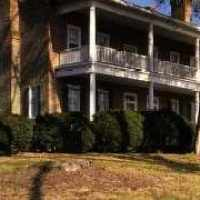

Home of Col. Alexander Erwin near Morganton, NC


There are two television shows that deal with genealogy that I love to watch when I can; NBC's "Who Do You Think You Are", and Dr. Henry Louis Gates's "Finding Your Roots". They air intermittenly and infrequently, so I don't catch them all, but I've seen enough of them. Frequently the guests; celebrities, artists, athletes, journalists, are fortunate to discover places their ancestors lived, toiled, farmed and walked upon the earth and visit the exact spot. Without fail, they mention a connection to the place, a feeling of belonging, as if the earth recognizes their DNA.

 I know what they are talking about. I've felt that. Whether it be the streets of Albemarle, North Carolina, the banks of the river at the old Davis Ford, the old Alexander Erwin manse at Quaker Meadows near Morganton, NC, what's left of Green Level in Marlboro, South Carolina, the grounds of Rocky River Presbyterian Church in Cabarrus County, NC, the town of South Hill in Mecklenburg County, Virginia or the Village of Skeffington in Leceistershire, England, I have felt the oneness with the earth, the genetic memory of the place, the feeling of home.
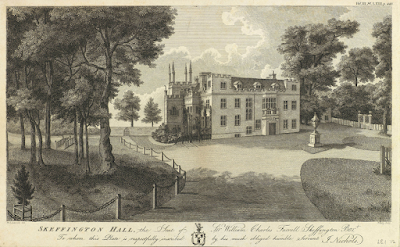

Skeffington Hall in Leicestershire, UK


I knew who the old man was whom I had seen that early spring morning. I don't believe he knew me. He seemed more of an echo, a resonance, a replay. He was Henry Davis and he was trudging along Cloverfork Creek north of the oldest part Albemarle, NC and now within its city limits. As genetic memory,or the recall of ancient dreams, or however one may label it, has happened to me multiple times, it no longer confounds or confuses me. I simply accept it and feel blessed by this gift. There are places where I have never been before where I can stand and feel at home, or remember, if you can call it that. Sometimes, I know why, at other times, I do not and on those occasions, I am driven to find out why.

Recently, I was contacted by a 'middle distant' cousin, one I could immediately indentify the connection to, but not a 1st or 2nd cousin. With this cousin came treasures, and this is why I blog. Many people possess items from their ancestors and others possess knowledge of those ancestors, or other items that the other doesn't have. When connections are made, the wealth is shared, be it knowledge, documents or pictures. Over the years, it has fascinated me how those that migrated away sometimes know so much more than those who remained in place. It's like they treasured the knowledge of where they came from because they were moving away, and passed that knowledge on to their children and grandchildren while the ones who stayed saw no reason to record information, to label photos or preserve documents, because they were still here.

This cousin had portraits of Henry Davis and his wife Martha Palmer Davis, passed to her from someone else, no doubt related. I could not wait to see them.


And there before me was the man in the mist.


And his second wife, Martha, my 3rd Great Grandparents.


Henry Davis was born in 1806 along the Rocky River on the southern border of what is now Stanly and Anson counties. He was pertinent in establishing the new government of Stanly County when Montgomery County was divided in half with the Yadkin / Pee Dee River as its boundery. By virtue of his offices and involvement in establishing a new county seat within 50 acres on the old Hearne property along Little Long Creek, he had purchased property nearer to town to be able to participate and be closer to the area, along Cloverfork Creek.

At some point along the way, Henry lost his way, his faith, his spirit. He was buried at the John Lee Cemetery in Anson County, just the other side of the Rocky River where he grew up. John Lee was the father-in-law of Henry's brother, James M. Davis. James had taken over a mill and a mine there, along Richardson Creek. I had the priveledge of visiting there not too long ago.

Henry's parents, Job and Sarah Winfield Davis, had both been born in Mecklenburg County, Virginia and settled along the Rocky River when they were young and died and are buried in Stanly County, NC. His descendants live now, all over the country and truthfully, all over the world. Some of us are still in Stanly County. 

I see you Grandpa Henry.


Sunday, August 17, 2014

My Fascination with the Trading Ford


The above postcard is a photo of the old Mill near Trading Ford, which was one of the earliest settlements in this part of the state, located on the Yadkin River between present day Rowan and Davidson Counties in North Carolina. It was called "St. John's" and was owned during the time of the Civil War by Peter Hairston, of whom and whose family, owned great portions of Rowan, Davie and Davidson counties and in particular the massive plantation that was Coolemee. A few of the Hairston plantations still exist and are maintained. One particularly lovely one is located off of Hwy 801 going from Davie into Davidson.
Mr. Fred Morgan
As of recent, I have been enraptured by the books and writings of a local Stanly County journalist, legend  Fred Morgan. Morgan worked for the local newspaper, The Stanly News and Press, known affectionately as "The SNAP". He was also an astute observer of human behavior, a collector of colorful characters and a seeker of local folklore. He was attracted to ghost stories, and tales of unusual happenings. His many books include some of these stories, names mostly changed to protect the guilty, but on a historical level, he occasionally mentioned folks who did indeed exist. Like Boss Kennedy, who saw a ghost along a wagon road. John Boss Kennedy was an actual Stanly County/Union County resident. Another was Tom Marks, whom Mr. Morgan referred to as "The King of the Narrows" and as a known moonshiner.

I am a direct Marks descendant and Tom Marks was a relative, although I do not exactly know how. I believe he might have been either a brother or a cousin of my Great, Great, Great Grandmother Tabitha Marks Solomon. I can't find any significant research done on the Marks family and there are two lines of thought on Tabitha's maiden name. I stick with the Marks line of research for two reasons. One: because of the thick connection between her husband, the Rev. William Solomon and the Marks families in legal transactions and through other sources, like the store ledge of Daniel Freeman which shows William Solomon on multiple occasions, making purchases with or for members of the Marks family, particularly Benjamin F. Marks. Two: Simply because of a gut feeling. It just feels right. I feel the connection. And this takes me back to Fred Morgan.

In several of his stories, he mentions following a road or ending up in a place because of a gut-feeling or perhaps a physic lead or an other-worldly leader. I simply call it genetic memory.

It's been proven that elephants have genetic memory. If they can, why not higher developed species, such as humans.

It's this psychic connection, or genetic memory that keeps me connected to Trading Ford. The first time I drove Long Ferry Road from Davidson County to Rowan, going through Spencer to Salisbury and following I 85, but staying off of that God-forsaken highway, I came to an area where I was overtaken by a feeling of digress. Eerily taken back to another era, a feeling like I'd been there before, when I never had. Like a portal, emotionally and psychically to the past. Of course, I never left my vehicle physically or mentally. It was just a feeling. But something draws me there.

At the time, I did not know I was at Trading Ford, but after I crossed, and arrived in Rowan, there were signs that cleared the air and I knew I was in the general location of the old community.


Piedmont Wanderings Blogspot: Trading Ford

The above site gives a marvelous history of the area of Trading ford, complete with maps, and tracts of the families who lived around it. Wondering what bit of genetic memory might lead me back to the connection I feel with Trading Ford, I've settled on it having to be the Russells.

My Russell line comes from the same branch of my family as does the Marks line.

Martha Margaret Russell (1848 - 1903) married Frank Washington Mauldin (1850 - 1925). They were the parents of Wincy Ann Mauldin who married Walter Jonah Mauldin. Jonah was the grandson of Tabitha Marks Solomon. Jonah and Wincy were the parents of my maternal grandmother.

Martha is the daughter of Aaron G. Russell, son of Asa Russell, son of Aaron Russell, which is as far back as I can go with that. Aaron (abt 1770 - 1844) left a will in Stanly County. He was born in North Carolina.Could he be a son or descendant or relative of the Jane Russell seen in the early land records around Trading Ford, a neighbor of James Kennedy? We know the Davidson/Rowan county Kennedy's made it down to Stanly County (and Anson/Union). The above mentioned Boss Kennedy was a grandson of theirs.

The tingles I get crossing Trading Ford says its a possibility. Thank you Mr. Morgan for allowing me acknowledged access to my genetic memory.


Saturday, March 23, 2013

Lot 23

On the wall in the Margaret Johnson History Room, in Albemarle, North Carolina is a framed, color-blocked copy of an ancient map circa 1841, where the town of Albemarle has been layed out in blocks. This map is not yet available online or in photographic copy. The above scan is as good as it gets.

The wonderful thing about this plot map is that it has the lots of the new town, some occupied, other not, labeled by Lot.

In the Register of Deeds office, I had discovered that Edward Winfield Davis, the second sherriff of Stanly County, and his wife, Rebecca Hathcock Davis, not only lived on the family farm along the Rocky River, in the Southern part of the county, but also purchased a Lot in the new town of Albemarle.

Much like his father and mother had purchased land in the town of Fayetteville, Cumberland County, North Carolina on Hay Street in 1825, selling it to his half-brother John W. Howell, in 1844, when they were getting too old to make the trip from below Cottonville, NC  in Stanly  to Fayetteville. The trip is now a little over two hours by vehicle. I can only imagine how long it took by horse and buggy or stage coach.

Lot # 23 is the second lot on the right turning right from South Street on to Second Street. After making a copy of the map, I went to trace out the area where the house would have stood in the later days of the 19th century. It is now the building that houses the Stanly County Sherriffs Department, right beside the Courthouse, which was built in the early 1970's, if I can remember correctly.
Image of 2007.38.224, Photograph, Cabinet: Nora Spinks
A Miss Nora Spinks walking down Second Street during the time the E. W. Davis family had a house there. 

When I was a child, this building housed the local Sears store. It was mainly a catalogue store with appliances and was a very busy business. We loved Sears. We loved the catalogue. It was the closest thing to ordering online that we had in the 70's.

All I can do is look at the lot and imagine. No trace is left.
A.C. Huneycutt Home
Lot 23 would have been directly across the street from the Lutheran Church, pictured above from an old archived picture courtesy of the Stanly County Museum.


I don't know who believes in genetic memory, but not long ago, I was walking through Chuck Morehead Park with our two white German Shepherd Dogs, Coco and Roxy, and I had an image of a stocky built, graying man, with a bit a bow or a limp in his step, as if he had once suffered from an injury, like falling from a horse, but not one enough to slow him down. He was not too tall, but not very short. He was concentrated on the ground, his mind deep in thought, and walking quickly, his arms gathered behind him. His light-brown hair was more brown than gray, but age was gathering upon him. He was surveying this land he had purchased along Cloverfork Creek. It was early spring and the wildflowers were already collecting among the grass. He was thinking how safely up the hill that rose from the creek that it would be safe to build a building without danger of flooding.
Second Street
Second Street in the early part of the twentieth century.


The man was Henry Davis, my great, great, great grandfather. He could have passed for a 60 year old today, but he was 48. He had a lot on his mind, like the impending war that he would have to participate in, and which would cause the end of his life.

The above is a satellite view of Cloverfork Acres in Stanly County.

From gazing at Lot 23, I could imagine a narrowly built Federalistic style house with a wide front porch garnished with intricate lattice. But it was imagining...I am not sure if a photo exists with this house on it. But I know where it sat, thanks to the above map.
Funeral of John S. Efird
The house would have sat directly across the street from the first white house beside the church and probably looked very much like it.


Sunday, December 9, 2012

Ghosts of Lives Past

They say a picture is worth a thousand words. This haunting photo was a purchase I made recently from a little shop in Gold Hill, North Carolina, just a few minutes up the road from Stanly County. The shop was called "Jane's Thangs" and the owner's husband had made this photo on a trip near Abbington, Virginia.

Gold Hill is a restored historic gold mining town, began during the North Carolina Gold Rush, that many people have forgotten about. I went there during the recent event, 'Lighting of the Fall Fires'. Gold Hill is the kind of place you want to visit often, there is something for everyone.

This photo captivated me.

I can hear the voices of children playing and laughing just looking at it. I can imagine a large farm family full of work and woe and love and laughter, on the porch and in the yard, a mother looking caringly out a window, a father coming home, tired from the fields, looking for his supper.

To me, it's beautiful for more than the flowers. Long ago, some one built this structure to house a family.

I believe in genetic memory. If elephants can have it, why can't we. Dreams that are so real, they are more like memories. Traveling and getting the feeling that you've been here before, and logically knowing that you haven't. Could genetic memory account for that? Can we remember places and times our ancestors lived?
The way I am drawn to historic settings and certain areas of the state and the country, I believe this is true.

My trip to Virginia last year felt like home. I am descended from Virginians. Could the reason I was drawn to this picture mean a genetic memory captivated me?