

St. John's Lutheran Church is a very modern looking structure nestled among the rolling hills of Cabarrus County, North Carolina's northwest side, near Mount Pleasant, a small town near the Cabarrus/Stanly County line. It hosts a thriving congregation and remains active in the community, but its contributions to the area, and surrounding counties of Stanly, Rowan and even Mecklenberg are much more.

There are a few attributes of St. John's that make it unique among churches. One is the tall obelisk that is the centerpiece of a lovely planter and garden circle next to the church, in honor of Rev. Adolph Nussman, the first Lutheran missionary and minister in North Carolina, who came to North Carolina from German at the behest of a few local men who went all the way to London to ask permission of the King to have a teacher and minister sent their way from Germany.

Secondly, they have a separate Heritage Building constructed near the church and cemetery, to contain historical records and artifacts, due to their very ancient history.
Thirdly, it's the only church located along the N.C. Civil War trails.
But lastly, among its many treasures, is it's large, rambling cemetery. As you pull up to the church, the tombstones closest to the church look like any normal cemetery, but as you advance downhill, you begin to notice something unusual. First, the stones get "rustier", older, mold-covered, weathered. They also get fewer, although the graves are evident by indention, the stones have eroded away. There are sporadic monuments, modern additions to replace the destroyed and eroded original stones, in honor of ancestors who left thousands of descendants. And then the most unusual surprise, the most ancient of the surving monuments engraved in German, not English.
 |
| Tombstone of Friderich Bleiler (1753-1806) The evolution of a name. |
 |
| Tombstone of Daniel Pleiler. The name would eventually become the Anglicized "Plyler." |
A small farming community in Stanly County located along the route between Mt. Pleasant and Albemarle bears the name of the family Plyler. Tombstones at St. John's reveal the evolution of the German name "Bleiler" to "Pleiler" and eventually, the Anglicized "Plyler". This family is just one who can trace their roots to the Germanic Lutherans who settled along Dutch Buffalo Creek.
 |
| Several beautiful old farming homes remain in the area. |
History books record that the first settlers in the area that is now known as Cabarrus County were "Germans who settled along Dutch Buffalo Creek". The buffalo, who have long been decimated and driven from the area were real. Even notes in my own family research left by travels and in land records identify property as being "near the old buffalo ford". The "Dutch" part is incorrect. It referred to the German settlers and was the English version of the German word "Deutsch".

These settlers were Germans who came to the Carolina Piedmont via Pennsylvania and the Great Wagon road, which traversed Cabarras and Stanly Counties. The represented two faiths, two churchs, The Lutheran Church and the German Reformed Church. At the point of German Settlement along the Piedmonts many creeks, these stripling congregations united, the earliest of them said to have arrived about 1728, and by 1745, at least, had constructed a small log building that served the dual purpose of school and meeting house known as "The Dutch Buffalo Meeting House. Served by traveling ministers and local lay pastors, the congregation was the parent church of both St. John's which was erected in the same general area, and The Bethel Reformed Church in Stanly County, which became the The Bethel Bear Creek United Church of Christ.
 |
| Reconstructed Meeting House located within the cemetery. |
The Germans settlers expanded within the area and are responsible for the proliferation of German oriented family names in southern Rowan County and northern Stanly County as well.

Barringer, Rhinehardt, Pless, Artz, Misenheimer, Isenhour, Barnhardt, Blackwelder, Cline, Link, Ridenhour, Herlocker, Lentz, are just a few of the names that proliferate county names, places and mailboxes.
With some, you can witness the transformation from the German original name to the modern rendition of it that can sound completely English, like Lang to Long and Braun to Brown. The "Bieber's" gave rise to the Beaver family and the "Boast's" to the Bosts, Fegert became Faggart, Gutmen became Goodman, Haus became House, Leideher became Leitecher became Lytecker and Litaker. The very English sounding "Moose" originated with the German "Moos", which meant moss and had nothing to do with a large, antlered North American relative of deer.

The crossroads town of Richfield in northern Stanly County, just a few miles down Highway 49 from Mount Pleasant, began as a place called "Ritchie's field" for the family who owned a farm in the area. The evolution of this family name is also clearly seen in the St. John's cemetery. From Rietchke to Reutschi to Ritshee (as in John George Ritshee 1759-1823) to the modern versions of Ritchie and Ritchey.

Oddly, some names changed little, as in Misenheimer, the name of a tiny college town in Stanly County just north of Richfield bordering Rowan County. Rowan, with her equally ancient Upper and Lower Organ churches boasted a strong Germanic presence in her southern and western borders while along her northern and Yadkin river borders, enjoyed a more Cosmopolitan mixture, expecially in her largest city of Salisbury, which began as an area of trade from the Native American originating Trading Ford along the Yadkin, at one time the western most city in North Carolina. Early records of Salisbury citizenship show names of English, Scotch-Irish, Moravian, German, Portuguese, Spanish and other European origins.

The Yadkin - PeeDee River and its eastern border with the transitional Montgomery County which changes from Sandhills on one end to Uwharrie Mountains on the other brought in Scotch-Irish from the sandhill area and English and Welsh travelers along the river routes as well as other Virginia and Pennsylvania migrants along the Great Wagon Road, so that the various ends of Stanly County became populated by people of different origins, languages, dialects and religions. For the first generations, it appeared that the Germans intermarried pretty strictly within their own ranks. It is said when church leaders from Organ Church in Rowan and Buffalo Creek Church in Cabarrus traveled to Europe seeking a minister of the word and teacher of primary education, the Cabarrus County representative stood for 60 families.

Within a short time as the different little pockets of settlers became more connected and interacted with each other, they became strictly Amercans, dialects dissolved into the Carolina farming culture dialect and people from different churches and different countries of origin intermarried.
 |
| Alzey, Germany. Origins of the Starnes family |
While my mother's family for the most part, descended from Virginian Methodist Episcopals while my added dash of German roots came from a Second Great-Grandmother on my Dad's side, whose own Great-Grandfather was among these Cabarrus County Germans Lutherans and who married an Irish descended Presbyterian from the Mint Hill area of Mecklenburg County. It must be remembered that Cabarrus, itself, was a part of Mecklenburg County in earlier years.
 This monument in the St John's cemetery is in honor of my ancestor, Captain John Starnes. I call this post simply "John", both in honor of the church, St. John's and also in honor of my Great, Great, Great, Great, Great, Great Grandfather, Captain John Starnes, a John in a sea of Fredericks.
The origin of our particular branch of Starnes were German Palatines named Staring (pronuncition estimated as "Stah-rentz) and evolved into Starigs, Starens, Sternes, and eventually Starnes.
Many prior researchers have situated our branch of the Starnes family as thus:
Three brothers (isn't it always three brothers), Adam, Valentine and Nicholas Staring, along with wives, children and other family members in an extended familiar and neighborly connected group, arrived in New York Harbor from the Alzey area of Germany in June of 1710.
Adam had a son named Frederick, who was about 10 years old at the time. They settled in New York and Frederick would grow up there and marry Mary Goldman, daughter of Conrad Goldman, another German immigrant. These Germans were known as "Palatines".
Wikipedia explanation for German Palatines
The above link explains more of whom the Palatines were. The family lived in Herkimer, New York until about 1733, that is when they began their slow, but deliberate migration into the North Carolina Piedmont.
 |
| Old Street scene of Herkimer, New York |

Records indicate that the family settled briefly, but not permanently, in Pennsylvania, maybe to load up, connect up and supply up for their inevitable journey, but by 1740, seven years later, they were in Southwestern Virginia.
Frederick the First, son of Adam, and his wife, Mary Goldman, had sons, Valentine, Frederick Jr. and Joseph. Frederick Jr was the father of Captain John Starnes, who was born around 1745 in Augusta County, Virginia.
Facts are few and theories many on the bustle of the second and third generations of Starnes and their time in Virginia. But between a few sparse records, connecting dots and horrific historical events, I believe a relatively accurate portrait of the generations, connections and family overlaps can be discerned.
| Augusta County, Virginia |
The Genealogies of Virginia Families shows the interaction and connections between another German family who also play into the Starnes ancestry.
Genealogies of Virginia Families: From Tyler's Quarterly ..., Volume 1
The Gerlach family originated in Saxony, Germany and arrived in London, England via Holland, where two older brothers, Conrad and Johann Christopher "Christian" Gerlach, arrived with their families in 1709, sons of Hans Gerlach and Anna Maria Kummer. They were found in a refugee camp for Palatines known as St. Catherine's Palatine Camp. Conrad arrived there in 1710 at age 49 with his wife and 4 children, daughters aged 16 and 11, sons aged 7 and 5. Christian arrived in 1710 with his wife and 9 year old daughter. This was a tent camp full of disease and hard conditions. Conrad lost his wife Margrite Ottilla Stikraad there, along with at least one child and his brother Christian lost his wife Anna Margarethe and daughter. The remaining family members made it to New York by 1712.
Conrad settled in New Jersey. In America, the Gerlach name become Carlock among some descendants and Gerlock among others. . Johann Christoper, twelve years younger than Conrad, had a more colorful future. He was a well educated graduate of Heidelberg University in Germany. Arriving in New York as a widower, tradition has it that he married a young Native American woman, or one that was half Native. Their descendants were described as "swarthy". He got along well with the Native Americans and recieved a Land Grant known as the Stone Arabia Patent, an Indian title of thousands of acres. He died in New York in 1764 at the age of 86.
The youngest brother, David, was born in 1674. two years younger than Johann. He did not arrive in America at the same time or in the same way as his older two brothers. Still a son of the same parents, Hans Gerlach and Anna Maria Kummer, David avoided New York, supposedly from his older brothers sage advise, and arrived either in Virginia or Virginia by way of Pennsylvania in 1725. He is characterized as a man of some wealth, being found operating a Shenandoah Valley Trading Post in 1741. He is taxed as a resident of Augusta County, Virginia between 1746 and 1762, at which time he is recorded as elderly and feeble. Tradition has it that he and his family lived in Holland for awhile before coming to America. His wife died during the passage after giving birth to their youngest daughter, who survived. His trading post was at a place called Brock's Gap and he dealt with the members of the Washington family while there. David died in 1763 at age 89.
 |
| Brock's Gap, Virginia |
The following are listed in the book as children of David Carlock and wife.
HansChrist (John Christian) Carlock born 1718 in Saxony, Germany. Died before 1800 near Sulpher Springs, Virginia. Migrated as a child to Virginia about 1725 with his family and married Sarah Whitman Jr. in Augusta County, Virginia. He served as a Churchman and Soldier while living in Augusta County, Virginia and served in both the French -Indian War and the Revolutionary War. His wife Sarah, died in 1833 at her daughter's home in Illinois.
Caroline Carelock, born in 1717 in Saxony. Married Frederick Sternes or Starnes. Paid taxes as a widow in 1782 in Rockbridge County, Virginia.
Frederick Carelock, born 1720 in Saxony, Served as a Constable in Augusta County, Virginia in the 1740's, moved to Mecklenburg County, North Carolina before 1775. His children migrated from North Carolina to Alabama, Tennessee, Illinois, Oklahoma, Arkansas and Texas.
Conrad Carelock, born in 1723 in Holland, also served in the American Revolution and received a landgrant from King George III of England for service in the French-Indian War. Resided in Augusta County, Virginia and married Mary Starnes in 1745. The couple had no surving children and in his will, Conrad left his estate in 1811 to his nephews, Adam and Samuel Starnes.
Catherine Carelock born on the Atlantic ocean in 1725 on the trip to America. Her mother died shortly afterwards. She would marry a Whitman, brother of her sister-in-law Sarah, who married John Christian Carlock.
Now, a sixth child, not listed in the book, is given as Mary Carlock or Gerlach. Supposedly either Mary or Caroline married Frederick Starnes Jr. and one of them married his brother, Joseph Starnes.
The records and proof of this is shady. The Carlock connection is undeniable, what is safest to say is that one of the daughters of David Carlock married Frederick Starnes, Jr. and was the mother of Captain John Starnes.
 |
| Map of the Holston River from History of Augusta County, Va |
Records:
1746, February 12, Court of Augusta County, Frederick Starnes Sr and Mary Starnes witnesses in a case involving George Gabriel.
1746, Oct 30 Augusta County, Survey Book, "A survey of 500 acres on the West side of Woods River known as The Old Starnes Place", suggests the Starnes had arrived far prior to this date. This is likely where John Starnes was born in 1745.
1750 Jacob Goldman's will, Executors: Frederick Starnes and Goldman's daughter, Mary.
1750 Will of Frederick Goldman, Augusta County, Virginia, Frederick Starnes and Humphrey Baker executors.
1753, August 22, Frederick Starnes recieves a patent for 85 acres on Crab Creek, a branch of the New River.
1753, November 24 A road ordered from Samuel Stalnakers on the Holston River to James Davis's. Samuel Stalnakers is Overseer, Workers, James Davis and sons, Frederick Carlock, George, David and Conrad Carlock, Frederick Starnes, Jacob and Adam Stalnaker, Jacob and Henry Goldman, Isaiah Hamilton, Hamilton Shoemaker, Timothy Coe, Humphrey Baker and son, George Stalnaker, Adam Andrews, Mathias Sarch, Michael Hook, Martin Counce, Michael Mires.
1755 Frederick Starnes Sr. shot by Shawnee Indians at Draper's Meadow. Escaped with an injury. On May 3, 1755 a Shawnee attack left 5 dead and several injured at the Humphrey Baker settlement. This may have been the same attack which injured Frederick Starnes. In October 1754, a prior Shawnee attack had left 3 dead including John Goldman.
1756 Frederick Sr. named as Augusta County Commissioner. His duty was the purchase of beef for the militia.
1756, November 9. A road ordered to be built from Adam Harmon's to the River,...Adam Harmon, Overseer, with these workers, George Draper, Israel Lorton and son, George Harmon, Thomas Looney, Jacob Harmon and three sons, Jacob Castle, John Lane, Valentine Harmon, Adran Moser (Moose) , Humberston Lyon, James Skaggs, Humphrey Baker, John Davis, Frederick Staring (Starnes) and two sons.
1758, Feb 12, Appraisal of Captain James Patton's estate. Frederick Starnes listed in bills due the estate.
1759 On a list of members of the South Carolina militia during the Cherokee expedition, Adam, Joseph and Leonard Starnes as well as George Carlock, a cousin.

1767, March 18 On a petition of Frederick Starnes (a list of names) a road to be built from Vance's to Ingels Ferry (Ingels Ferry being operated by the infamous Mary Draper Ingles and her husband, known for her kidnapping by the Shawnee in 1755 and making her way precariously back home about 5 months later, a journey of a month and a half) to Peak Creek on the north side of New River.
1767 July 15, The estate of James Carty appraised. Frederick Starnes one of the appraisers.
1768 Frederick Starnes sells to George Teater a tract of land at Crab Creek. This is the land Frederick Sr received a patent on in 1753. Tested by W. Ingles, William Davis, John Taylor, John and William Buchanon,
It appears Frederick Sr. died about 1768. Jr and Sr stop being used in records to indicate father from son. The same year, Frederick Jr. sells his property at the Horsehoe (riverbend) of the New River.
1770 Frederick Starnes (Jr.) named as Constable for Holden River.
1771 March 21, Settlement of James Patton's estate recorded. Frederick Starnes listed among purchasers of property.
1774 Sons and Grandsons of Frederick Sr fight in the Battle of Point Pleasant against Chief Cornstalk and the Shawnee under the command of Captain William Christian.
June 1, 1774 Frederick Stern (Starnes) in present day Smyth County, Virginia. 176 acres on Middle Fork, Clapboard Cabin branch,
June 1, 1774 Frederick Sterns 238 acres on Lick Run, adjoining Hanschrist Carlock and Conrad Carlock.
June 2, 1774 Thomas Sterns (brother of Frederick) 78 acres on Lick Run, Middle Fork.

1782 Catherine Carlock Whitman, widow, paid taxes for 6 head of Cattle in Rockbridge County, Virginia.
Date 1782, at the same time Caroline Carlock Starnes, widow, paid taxes for 6 head of cattle, also in Rockbridge County, Virginia.

The Starnes family's trouble with the Native Americans had begun when they lived in Pennsylvania. Their brief tenure there after leaving the Mohawk Valley of New York found them, in the company of other settlers including family members from the Goldman and Carlock families, on the banks of the Juniata River in Pennsylvania. This was not a heavily settled or safe area. It encompassed lands belonging to the Delaware Indians, who appeal to William Penn and had the settlers removed.
 They then continued south into Virginia where they settled in another troublesome spot along the Middle Fork of the Holston River. They lived near what is now Chilhowie, Virginia and in 1755, Frederick came under armed attack by a ban of Shawnee Indians. He fired back, was wounded, and lived to tell the tale. His son Captain John was then 10 years old.
Twenty-five years later, John's brother, Jacob Starnes was in Kentucky, assisting Daniel Boone with the building of Boonesboro. Frederick Jr., his brother Joseph and Joseph's son Joseph Jr. and son-in-law Michael Moyer, ventured from Washington County, into the wilderness and came under final attack by a group of 25 to 30 Indians, who fired upon them. They were about 25 miles from Boonesboro near a place called Blue Lick Springs. The only member of the team of four to escape was Joseph, Jr. who said they kept after him for a mile, but he sought shelter by running through cane and brush.
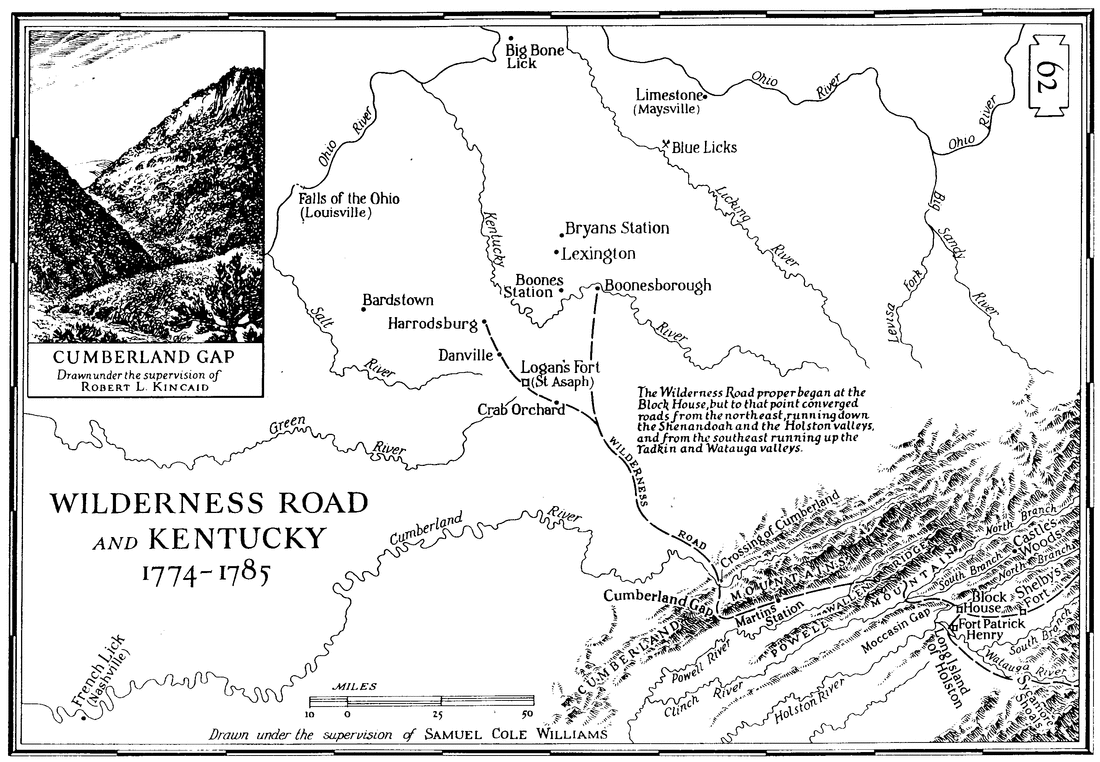 |
| Map shows the location of Boonesborough, Blue Licks, the Wilderness Road and Holston River in the lower right of the map. |
This event was known in Kentucky history as "Starns Defeat". It is marked by Historic Marker along a highway now. It is supposed that Frederick Sr died during the 1760's in Virginia. It may have been this event that caused most of the remaining Starnes family to migrate to Mecklenburg County, North Carolina. Some remained and populated the surrounding counties of Cabarrus and Union in North Carolina, or across the border in Lancaster and York in South Carolina. Jacob Starnes, the brother who was closest linked to Daniel Boone remained in Kentucky. Several would later leave North Carolina and migrate to Georgia or Tennessee. Captain John Starnes joined the group of Lutheran Palatinate in the rolling hills of Mecklenburg, now Cabarrus County, North Carolina.
Frederick Jr. must have felt heavily or with a premonition that the journey he was about to undertake was one of danger. He wrote a will before he left. My 7th Great Grandfather, Frederick Starnes Jr. died on April 5, 1779. The only survivor, Joseph Jr. would move first to Mecklenburg County, North Carolina with the rest of the family and then to Burke County, where he remained. A Captain William Whitley is said to have found the remains of the Starnes family. From Bayless Hardin ed. Whitley papers, Volume 9 "Starns Defeat was in March (actually April) of 1779. Frederick Starm (sic), Joseph Starm and Starm (actually Michael Moyer, Starnes son-in-law) was killed Blue Licks now Madison County. I buried them Frederick eyes were taken out by the birds. Joseph Starms foot I could not find and the other Starms was cut to pieces he being quite opulent & his heart taken out". A harrowing image for a descendant to imagine.
The Will of Frederick Starnes Jr. was proven on May 18, 1879 in Washington County, Virginia.
"In the name of God Amen, I Frederick Starns of Washington County in the Commonwealth of Virginia being of perfect health, praised by God for his mercies, make constitute this to be my last will and testament as followith~~I give and bequeath to Mary my well beloved wife one black mare which I had from my son Jacob Starns and her saddle likewise her thirds of all my estate~I likewise give and bequeath to my son David, thirty pounds Virginia and ever child younger than him twenty five pounds like money-and the remaining parts of the estate to be equally divided amongst all my children (first paying all my just debts)."
John Starnes was born in Augusta County, Virginia about 1745. About 1770, he married Margaret Specht, daughter of Dewalt and Barbara Specht. The Specht name, also German, would become Speck.
Because of the conflict of the Indian Wars, John, his mother, and many other of his family and neighbors came to settle in a safer German settlement on Dutch Buffalo Creek, in the part of Mecklenburg County, North Carolina, that would become Cabarrus.
A young man, he quickly became a leader in the community, by 1778, the year before his father's death, he became a Captain in the militia and served as a Justice for the Court of Pleas and Quarters for Mecklenburg County.
John had a brother named Frederick (who died in 1816) as well as Leonard, David and possibly Adam.
He named his oldest son Frederick, who lived in Union County, and died in Cabarrus County in 1855. This is the Frederick who left the widow Motlina or Magdalena.
The following are generally noted as the children of Frederick Starnes, Jr. and Mary Carelock Starnes:
1745-1780 (Battle of Kings Mtn, Cherokee County, SC) John Starnes. Married Margaret Speck.
1750-1812 (Rev. War Soldier, Indian fighter, Associate of Daniel Boone) Jacob Starnes. Married Elizabeth South. Resided in Kentucky. Died in Louisiana.
1752-1782 (Died in the Battle of Blue Licks, KY) Valentine Starnes
1755-1800 Conrad Starnes. Married Margaret Brown
1757-1807 Charles Starnes. Married Catherine "Caty" Beaver
1758-1833 David Starnes. Married Barbara Starnes, a cousin.
1765-1816 Frederick Starnes III. Married Mary Fisher

These younger Starnes lived in Mecklenburg County, North Carolina, primarily in the areas that later became Union and Cabarrus Counties.
The 1790 census shows: Mecklenburg County, North Carolina:
Widow Starnes (on the same page as Frederick and George "Kerloch", Charles and Conrad Starnes and other members of the Dutch Buffalo Creek Congregation).
The Household Consisted of 6 members: 1 male over 16, 1 male under 16 and 3 females.
This is believed to be Mary Carlock Starnes.
James Starnes, 1 single male
Charles Starnes, a household of 3, 1 male over 16, 1 male under and 1 female.
Conrad Starnes, a household of 9, 1 male over 16, 3 under, 5 females.
David Starnes, a household of 5, 1 male over 16, 3 under, 1 female.
Frederick Starnes, a household of 4, 1 male over 16, 3 females
These last four, Charles, Conrad, Frederick and David, were the brothers of Capt. John Starnes. It is unknown where the young man, James, fits in. He was probably a nephew of John.
There was another Frederick Starnes in Pendleton District, South Carolina. This is thought to be the son of Leonard Starnes, a brother of Frederick I and 1st cousin of our Fred Jr.
Joseph Starnes, the first cousin of Captain John Starnes and survivor of Starnes Defeat, was found in York County, South Carolina. With his cousin, he had fought at the Battle of King's Mountain, but had survived.
In a Petition dated March 22, 1778, of Mecklenburg County residents protesting an act that would had allowed enormous land purchases, are found the names of Peter and Adam Starnes. Peter also fought at the battle of King's Mountain and eventually relocated to Tennesee, and finally back into Virginia. He was a grandson of Frederick and Mary Goldman Starnes via their son Thomas, who is barely mentioned, apparently dying young, but leaving 3 sons, Peter, George, and John. Adam Starnes was the nephew of Conrad Carlock and named in his will along with his brother Samuel. Adam is found in Mecklenburg County records as early as 1760 and would relocate his family to Grainger County, Tennesse, along with other areas of Tennessee and dying about 1833.
The 1800 census
The 1800 census saw a boom of Starnes families listed in the area, as the sons of John and his brothers came of age. Other members of the family had also drifted down from Virginia and Kentucky and most of these wanderers would keep the moss off by migrating west into Tennesee or Southward into South Carolina, Alabama and Georgia as well. They liked a good fight and they liked to blaze trails.
Listed in the "Salisbury, Mecklenburg District" were:
David-family of 9
Frederick- 6 children, 2 adults
Jacob with 2 younger adults and 2 children, a boy and a girl
Jacob with 2 younger adults, one small boy and an older woman, perhaps a grandmother.
John, assumed to be Captain John's son John Jr.
Joseph, over 45, Joseph Jr, Captain's John's cousin who would move to Burke County and give his deposition in 1832
Nicholas, with a large household including 6 adult males and 7 total people over 25, including his wife. 12 total. This is thought to be the son of Joseph Sr and brother of Joseph Jr. who married Sophia Cress in 1791 and died in Mecklenburg County in 1816.
Charles, with a family of 6
Frederick, this one with 2 adults, 3 boys and 1 girl under 10. One Frederick is assumed to be the brother of John who passes away here in 1816 and the other his son, who lives until 1855.
Joseph, a younger Joseph with a family of 4
Notably, there is also a Benjamin Starnes in nearby Iredell County, an Evan Starnes in Salisbury/Guilford area, and a Margaret Starnes in Fairfield District, South Carolina.
They afterwards became a very prolific family. Several would cluster in Union County, some returning later to Cabarrus.
Below is a listing of the estate of Captain John Starnes:

Not with intent to tarnish the Patriotic and Historic contributions to history of my and many others ancestors, the record of Judge and Captain John Starnes is not without a hint of controversy and scandal.
In the State Records of North Carolina, Volume 14, pages 468 and 469, a clause is found,
"Captain Starnes, the Governor complains, hath committed a late barbarous and cruel murder on the body of a certain Michael Crissman after charging him with being a Tory as an excuse to take his land." The record is dated November 25, 1780. Because of the death of John Starnes in battle, the matter was not pursued further. But if he had lived, it appears my ancestor may have went to trial on murder charges. "
This is the information I've been able to find on Michael Crissman of Rowan and Cabarrus counties in North Carolina.
Supposedly born in the 1730's and one of the Palatine immigrants to America. He arrived in 1748.
1780 A Mr. Clark, who supposedly was the brother of the Mr. Clark of Lewis and Clark fame, kept a diary in which the murder of Michael Crissman was noted. It stated that he was lynched along Dutch Buffalo Creek, for being assumed a Tory because he refused to fight against the British. A Captain John Starnes was blamed for ordering the lynching. His land was confiscated. Clark ordered the land return to the "Christman" heirs and it was in 1784.
 November 25, 1780 A letter of Complaint and a Petition for the return of the property was presented to a General Butler.
 In January of 1784, Michael Christman's estate was settled, his widow, Elizabeth is listed as an Administratrix along with Leonard Garver and George Rice as bondsman.
Later, Michael Christman, Jr. sells his portion of his father's land to his brother George.
December 15, 1787 Michael Christman and wife Elizabeth sell to Andrew Cruze, 223 acres on Buffalo Creek (Cabarrus County). This would have had to have been Michael Jr. His wife is given as Elizabeth Wydner.
George Christman married Elizabeth Hagler and later relocated to Scott County, Illinois. He attained the title of Captain himself. They became the parents of 14 children, the first 9 being born on Dutch Buffalo Creek, the 10th being born in Lancaster County, South Carolina, and the last four being born in Kentucky before they finally landed in Illinois. One son, Charles, became a Mormon and founded an enormous Polygamist family.
As far as his family, his wife is given by descendants as Elizabeth Seitz (Sides) and three children are known, the brothers Michael Jr. and George, and a sister Margaret who married a Reynolds.

Whether or not Capt John Starnes had Michael Crissman "dragged from his bed and hanged" because he was thought to be a Tory or because he just wanted the man's land, is a source of possibly endless debate. The fact he died himself, shortly afterward puts a lid on that can of worms.
As a Starnes descendant, of course I will take the side of my ancestor, who saw the man as an enemy, obviously, as Starnes was in no need of more land. He had gained a huge Virginia grant from his childless uncle, Valentine, and sold this property before locating to North Carolina.
John was proven to be a son of Frederick by his Uncle's will. Below is the Find-a-Grave listing for Valentine Starnes and includes a transcription of his will leaving "Item to my brother Frederick's oldest son John, a hundred acres of my land upon Juniata".
Also of note in the 1761 will, their beloved father Frederick was still alive and left a suit by Valentine.
Find a Grave and Will of Valentine Starnes.
It will take me a while more, I am sure, to untangle the can of worms involving all of the Cabarrus and Union County Fredericks. One of the biggest mysteries being the mother of Frederick Fincher Starnes, my third Great Grandfather. While his marriage to his second wife lists his parents as "Fred and Sally Starnes", his marriage license or bond to his first wife Mary Bynam, has not been located.
His father was married to Elizabeth "Bettie" Thompson by 1850 and Finch was without doubt the son of that Frederick, living beside him in 1860 and nominated as "Sr." and "Jr." and relocating afterward from Union to Cabarrus County together and fending for his youngest, probably half-siblings after Fred's death.

So to find who was Sally, and to add to the mystery, Nathan T. Starnes, who resided in Stanly County, also lists "Fred and Sally" as his parents on his marriage license to his last wife. Nathan T. Starnes is usually pegged as a son of Frederick and Motlina, the father having died in 1855 and being the son of Captain John. Finch would marry the widow of John C. Starnes, one of Nathan T. Starnes sons, as his second wife. How were they related?
It will obviously take some more digging into Union County records, and possibly Cabarrus ones as well, in hopes to shed some enlightenment on these mysteries.
My current theory as far as who Finches mother was, concluded Fred Sr. (or 5th, however you look at it) must have had a first wife named Sarah aka Sally, and she may have even been a Fincher, a family that did live in the Union County area.
Stay tuned. This darkness needs a bit more e
| a |
| a |


