Showing posts with label oakboro. Show all posts

Wednesday, July 23, 2025

Adventures in Oakboro Part Deux


As this is my third attempt to chronicle my visits to, or near some Oakboro area, or rather, Big Lick Township, area family cemeteries, I've decided to again, break one post up into multiples, as the ghosts of the past are fighting being brought to light. Or seriously, there must be a gremlin attached as the post has been twice deleted. 

My last post introduced the reasons for my trip, a desire to connect with and view, the area these longgone folks lived on, walked on and died up on. I told of two cemetery visits, to the Hatley Grove Primitive Baptist Church, and to the Ledbetter Family Plot. 

After leaving the old Plantation and Resting Ground of Alfred Ledbetter, I sought the Hinson Family Burial Grounds, home to the most ancient of Hinson arrivals to Stanly County, and the resting place of William M Hinson, father of Telitha Jane Whitley Springer, whom I've been researching for weeks now. 

Set among a virid sea of green and gold in the rolling hills of southwest Stanly County near the Rocky River, the road to the Hinson cemetery is gated from visitation. Located off old Sandbar Road, in an absolutely breathtakingly beautiful rural setting, the Hinson cemetery is located close to the river on private land. 
The oldest interment in the Hinson Cemetery dates back to the 1840's and the most recent, the early 1900's. The Hinsons will come to play in several future posts. It's a hop, skip and jump from the Ledbetter lands and closer to the Rocky River. As in most of these old family plots, many graves are unmarked, or the stones no longer legible. Among the ones that are, there lies a Mullis and a Tucker, among the Hinsons. I'm not a Hinson, and it's a beautiful area, but I felt no real connection to the place. 

After leaving Old Sandbar, my next destination was the Brooks family resting place. Located down a long dirt path, and no longer accessible by Brooks Road, from the other end, as it was long ago, the Brooks plot is also in a clandestine setting, blocked by a gate from public access. 
Located on a picturesque family farm, among sundappled rows of corn, rolling wind-kissed grasses that bend in the breeze, the Hinsons rest in the warmth of quiet peace. A clip from Find-a-Grave shows them in a nearly tropical setting 

My biggest surprise in the visit to the first four locations was the close proximity they were to each other, walking distance, so to speak, especially for the 19th century. There's no wonder for the intermarriage and interaction between the collection of families. Above is a pond fed by a stream, that I believe may have been Stillwater Creek. The Brooks family grounds lie over near Island Creek, while the Ledbetter lands were closer to this, the Stillwater. That corresponds to the 1844 entry of a 100 acre tract by Alfred Ledbetter, just after the county was created. That doesn't mean he just moved to or purchased the land then, just that he laid claim to it in the new body of government. His tract adjoined that of Hezekiah Whitley and Isham Whitley, and three years later, Nancy Whitley, whom I believe to have been Isham's  widow and perhaps a Hatley by birth. 


These intertwined folks didn't live in Oakboro, why Oakboro didn't even exist. They lived several miles below where Oakboro is now, closer to the river, but not upon it. Nineteenth Century deeds claim they lived along the Austin Road. The landscape has changed dramatically over the decades, and the streams somewhat, but the Austin Road is not the Austin Road, as it now exists, nor close to it. There is a possibility it may have connected to the westernmost end. 

The Austin Road was named for the family of my distant ancestor, Regulator Bryant Austin, a clever rebel who hid from the British after the Battle of Alamance, in the years before our independence from Britain, along the Rocky River. Eventually, a posse was sent for him, and he was discovered, but escaped capture credited to the use of good Bourbon. 


That portion of road seemed to have transformed, generally, into the Coble Mill Road by about 1920, and is known as Highway 205 today. In the above portion of the C. B. Miller map of Stanly County, circa 1900 -1910, I've highlighted the general vicinity of certain families in the middle 1800's, as best as I can deduct, from what I've learned so far. 

Lilac denotes the Coble's;
Green, the Hinsons;
Blue, the Ledbetters;
Orange, the Brooks and 
Yellow, the Hatleys.
Of course there were overlaps and 'others' who lived there, by purchase or rent or employ.


To gage how far away from Oakboro this is, I've encircled the dead town of Big Lick in Orange. The railroad failed to be built through the heart of Big Lick, leading to its demise. A Post Office was built a few miles south of Big Lick and was originally named Furr City by a Mr. Furr. A town began to grow there, and a railroad stop was created, but the railway didn't like the name, and renamed it Oakboro, which has now absorbed what was Big Lick. The new town is roughly in green. The blue line is the trail to the Ford, be it Austin, Ledbetter or Coble. The yellow area is where the people I've been investigating lived.


When I was about twelve, the youth group of my church, which was in Albemarle, was gifted the use of an old family farmhouse on their property, as a clubhouse or meeting place. The kids, most of whom were older teens, did quite a bit of the work getting it cleaned up and fit for this usage. I will never get over the drama of stepping on a stack of two by fours and feeling the soft crunch underneath that turned out to be a mouse. 


Two families dominated the church family, three or four generations of them, the Davis family (mine), and the Chandlers. There were several more, Furrs, Scott's, Hinson's, Coleys, Rabon's, Baucom's, Burleson, Holt, Kepley, Loflin, Eddins, Vanderburg, Trexler, Talbert, Burris, Buntings and many others. I had several first and second cousins in the Youth group. While I don't remember where the house was, I recall it was in Oakboro and had belonged to the Chandlers. Today, I found the Chandlers that it must have been, and the mouse memory returned in terrifying crunchiness.


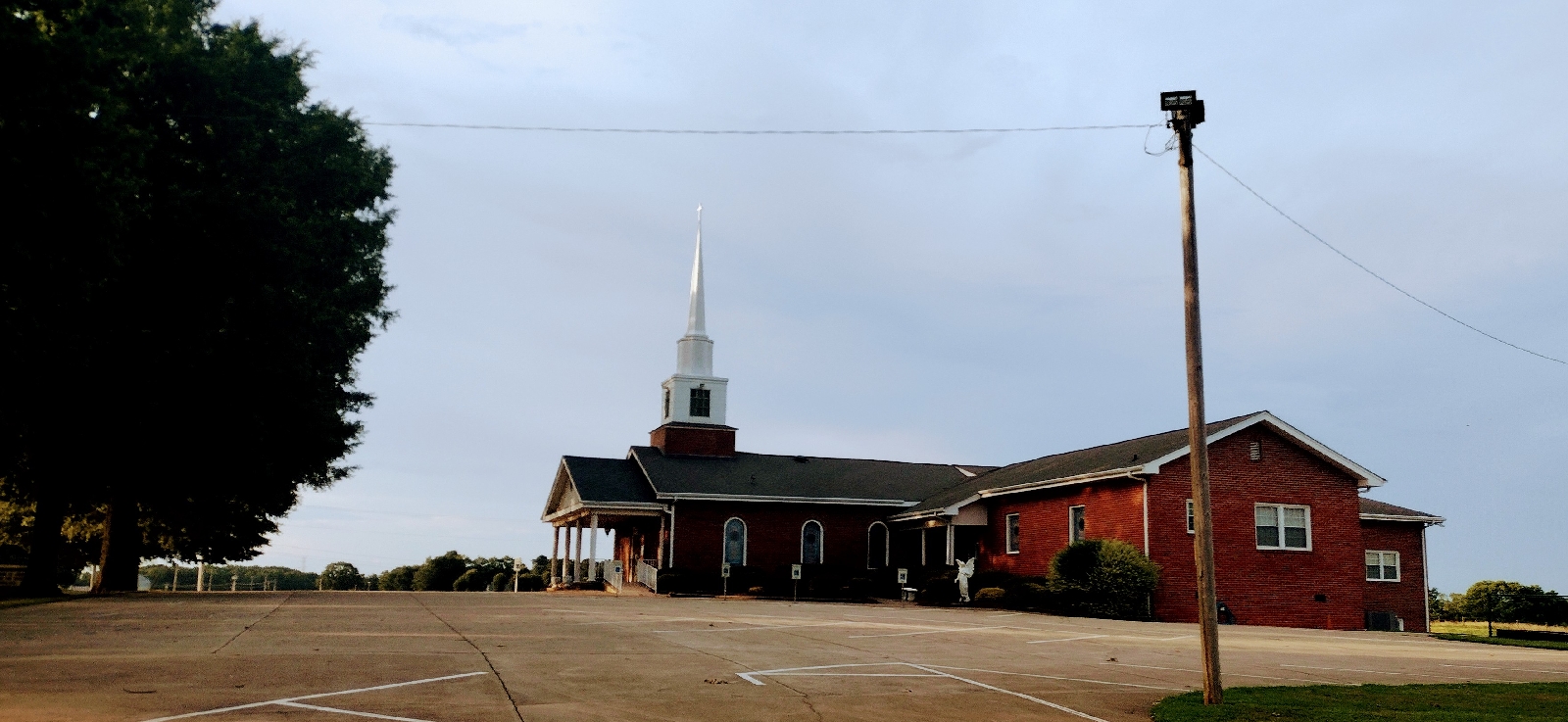
Mineral Springs Baptist Church sits on the corner of Hwy 205 and Mineral Springs Road, several miles south of Oakboro. To give one an idea of how close the areas I have mention in this, and in my previous post, Adventures in Oakboro Part One, the above map shows Mineral Springs in the top right corner. The road leading into 205, just above it and then trailing southwest from it, was Ledbetter Ford Road, where the Ledbetter Family Cemetery is found. Down the road a little way on the right, neat the bottom of the screen, is Old Sandbar Road, where the road to the Hinson Family plot leads off of. Just below Sandbar, to the left, runs Howard Road. The former Hatley Grove Primitive Baptist Church sits off of Howard Road, and where it dead ends, leads to the old Brooks Family Burying Ground. This was a close and connected neighborhood. 


Mineral Springs is an active and modern congregation. The Congregation dates back to 1845, and instead of reiterating its history in my words, I am just including the history the Church itself details on its website, below.


Our History

Mineral Springs Baptist Church was constituted in the year 1845. It was a member of the Pee Dee Association from 1845-1856. It was received into the Rocky River Association in 1872. In 1876 it was received into the Stanly Association.

The first building to be used by Mineral Springs Baptist Church was a one room log structure which was located one mile east of the present location. The second building, which was a large wooden building located at the present sight, was destroyed by strong winds. It was used from 1917-1927. The third structure was built in 1928. It was a seven room brick building with wings which were used as Sunday school classes. The church building was dedicated in 1930. In 1976 Mineral Springs remodeled and added to the old sanctuary a choir loft, baptistry, and a large educational building which included a new fellowship hall. The new structure was dedicated in 1977.


A more peaceful and ephemeral setting could not be found to serve as the resting place of God's people. A wooden cross leads into the front of the cemetery, with Old Glory waving overhead just beyond at a Soldiers Memorial. Cotton ball clouds paraded by in a variety of shapes underneath the wispy brushes of        . Can you see the pig and the puppy dog?


In the turn of the century C. B. Miller map, above, I have circled Mineral Springs in yellow. A variety of roads and paths swirl around it. Predictable surnames camp around the church location, Hathcock, Honeycutt, Austin and Brooks. The road that plows right through the name of the church must have been what would follow the general path of Hwy 205, and at that time was known as Coble Mill Road. A road that crosses below it has several Hinson's as its occupants and may have been the original path of what is now Old Sandbar. W. F. and W. R. Brooks were apparently large landholders in the area at that time and a road on the right might have passed near the old Hinson Cemetery. Above the name of W. R Brooks was the Hinson School. On the right edge of the map, east of the church, we can see where Jones Church and Jones School stood. The Smith's Grove Congregation, which is located between Aquadale and Oakboro along Hwy 138, claims to be the descendants of the Jones Hill Congregation. A Whitley cemetery actually located within the town limits of Oakboro, claim to have been the Jones Hill 


Despite its early beginnings, most of the burials at Mineral Springs seem recent, or at least 20th and 21st Century internments. There were several familiar names and even family members buried here. The black marble stone above is the marker for Joe Lowder, former Sheriff of Stanly and if I'm not mistaken, he also served as Mayor of Oakboro. Joe was a cousin of mine, his mother and my Dad were first cousins, making us second cousins. So, this was a familiar and familial place. 


As with Hatley's, the march of time can be seen across the layout of the grounds, with newer markers giving way to older ones near the back, so one can the the forward progression of the plots, and that they had begun further away from the church. 


A wide variety of local families have attended this church. These stones show Howard, Little, Thomas and 


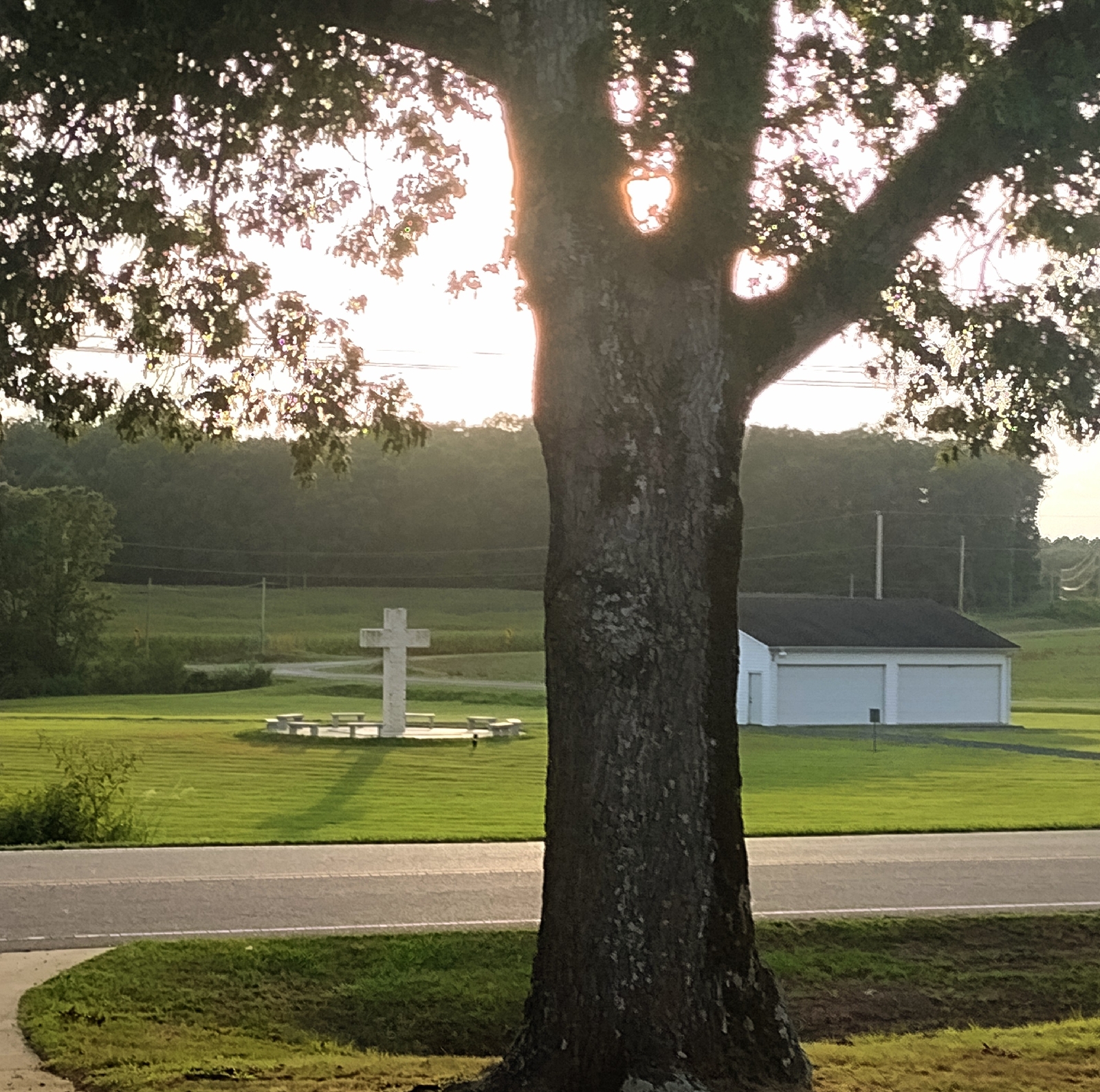
The cemetery has grown so much, that an extension has been arranged in a lovely setting across the street. To the left of the white cross surrounded by benches, out of range of this photo, is a group of graves adorned with flat markers, for easy mowing. 


I found a Chandler grave and knew this must have been the Chandlers who attended Pilgrim Holiness/ Albemarle Wesleyan Church in the 1970's and donated an abandoned house on their property to the Church Youth Group. A member of the family donated a picture to his profile on Find-A-Grave, and although it is a younger version, it is most definately the Mr. Chandler that I remember.


My Uncle married into this same Chandler family, and they have a very interesting genetic heritage. One of them, when they still dwelt in Chandler's Grove near the Montgomery/ Davidson County border, before moving to Stanly County, had went west, to the mountains of North Carolina, and there found a bride with the surname Bell. This bride was from a group of dark, mountain people, a mix of indigenous and other. They returned to his home in time and this bride passed her olive-skinned genes down to this particular branch of Chandlers. 


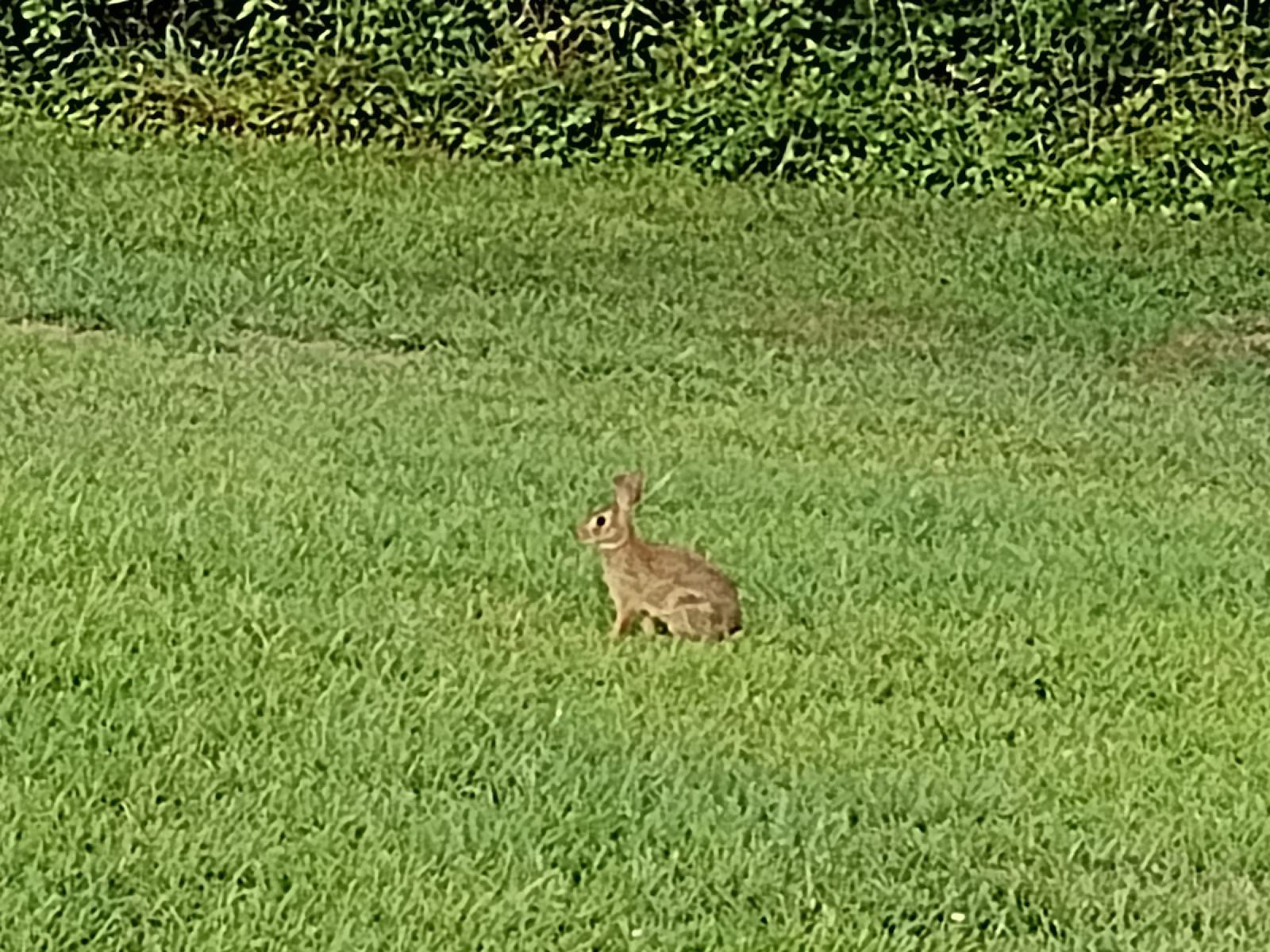
The cemetery is a place of peace and repose for other occasional visitors who also showed up during my visit.


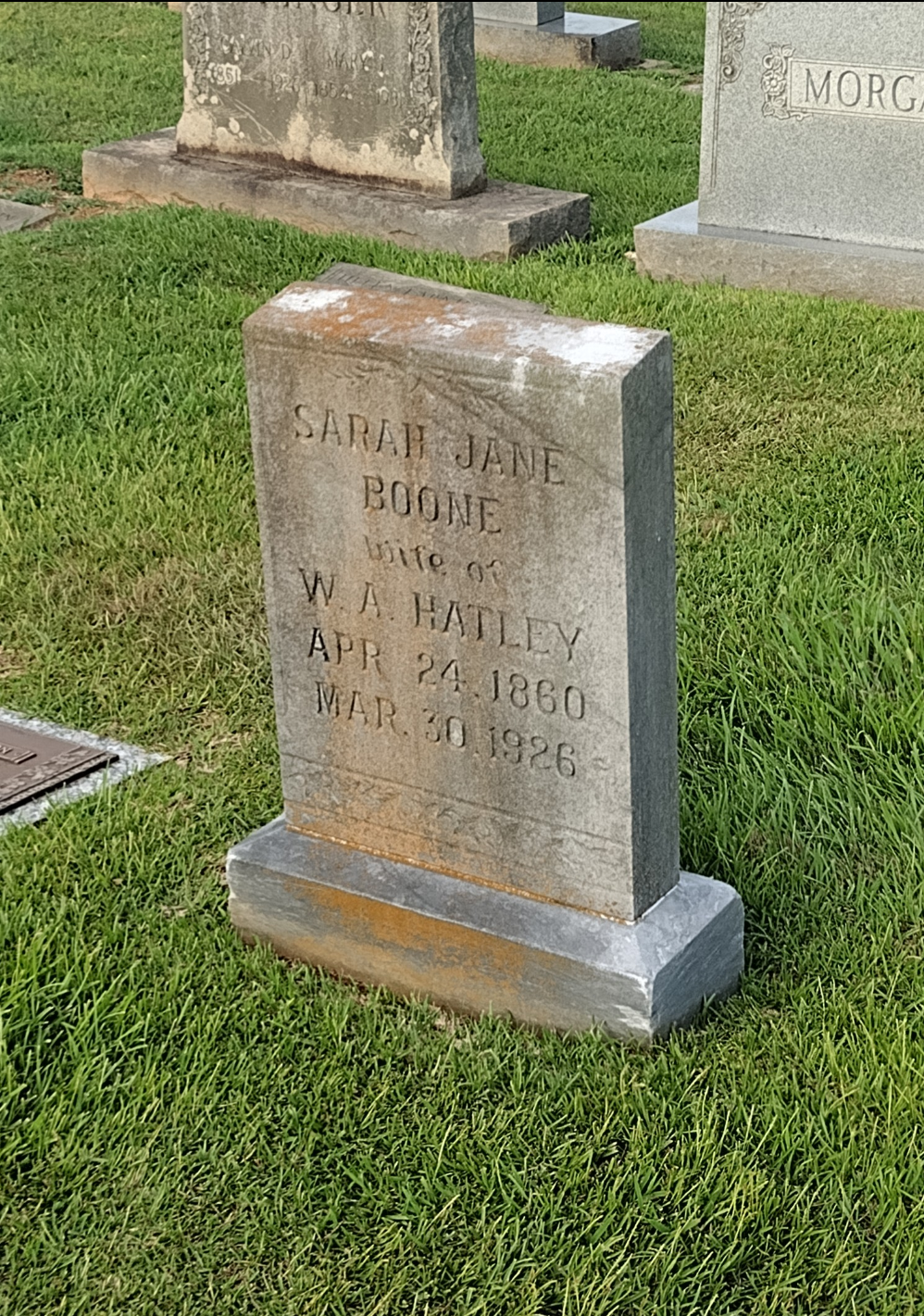
Sarah Jane Boone Whitley's stone caught my eye. She was the wife of W. A. Hatley, and I don't have to guess to know who her parents had to be. An early member of the Boone family settled in early Stanly Count area around Big Lick. After his wife died, he married Martha Murray and moved to Allegheny County northwest of Stanly in the Foothills of the Blue Ridge. On son remained in the Oakboro area. One of his sons married my Great Grandfather's oldest sister, Mollie. This must have been his aunt, as they were the only branch of that family to remain here. 


No surname adorns this rugged looking monument, but the front is smooth and bears the name "Harris". This is the stone for Daniel Jefferson Harris and wife, Julia Hatley Harris.


This serene resting place contains the remains of several individuals I've encountered in this arm of my research, and obviously their children or grandchildren. The names still ring of the same names seen in the ancient deeds of this area upon the inception of the County. Hinson, Brooks, Hatley, Ledbetter, Whitley, Barbee, Smith, Furr, and many others, worshipped and lived in this area.


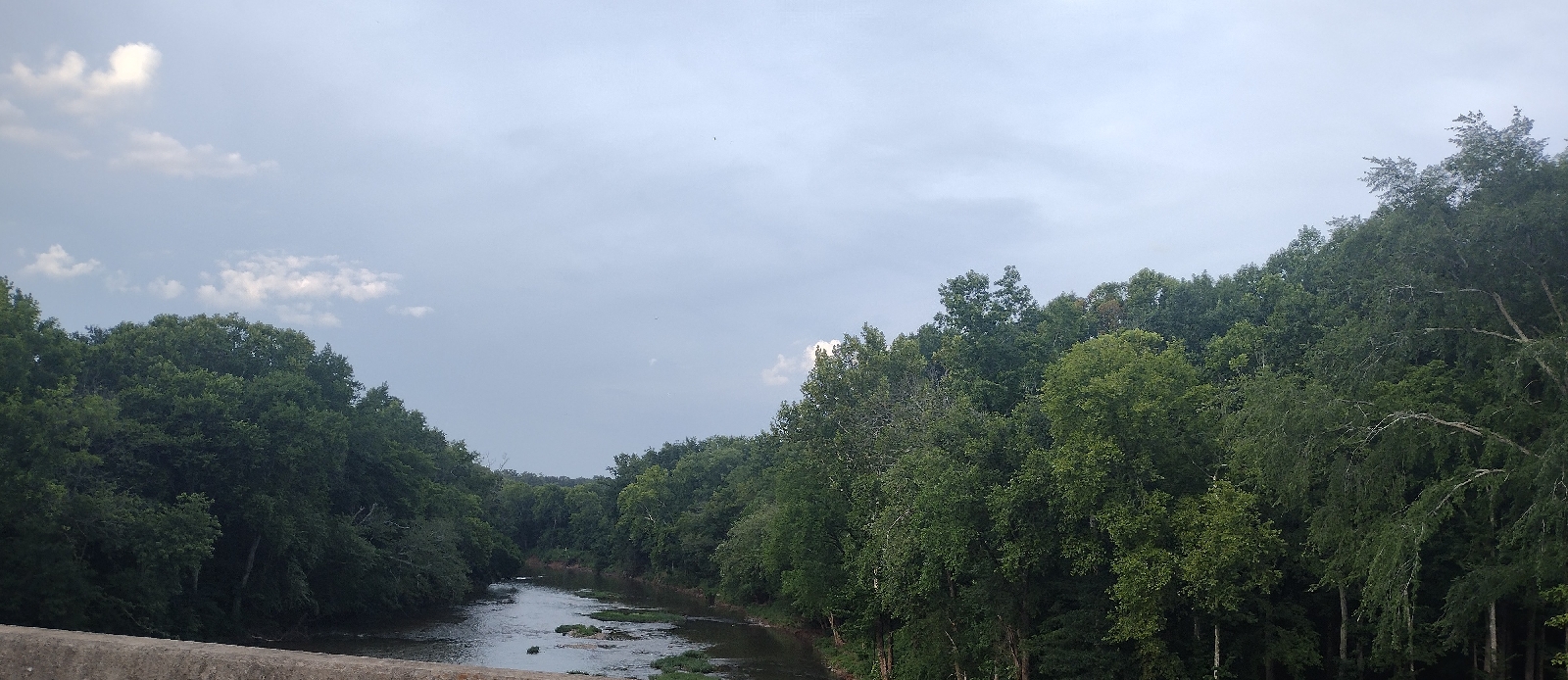
The next stop was the crossing of the Rocky River itself. On the other side is Union County and the Union/Anson County line. The families who lived in this area near the river were very close to these other counties and several of them crossed over and settled there. As five of Hezekiah Whitley's are unaccounted for after they grew up, I would not want to think they all died young. Possibly Martha, but the other four, Mary, Adaline, Elizabeth and Sarah, were all of marriageable age when we see them no more. As close as they lived to these other counties, I wonder if the mystery of their fates can be found there, instead.


And, there, a brief glimpse of the Old Rocky itself, the slow, shallow stream that brought settlement to this part in the early years. Exodus Whitley was here at least by 1772, while it was still part of Anson and before the Revolution. 


Right after crossing over, you find the sign and road of Pleasant Hill Baptist Church. One of the Whitley daughters is buried there. On paper, it looks to be a distance, but it's literally right across the river. 

This concludes this arm of my adventures in Oakboro. Next will be the last of the trilogy, a look for the two Whitley cemeteries themselves. 

Sunday, July 20, 2025

Adventures in Oakboro Part One

This Building is an Oakboro icon from my earliest memories of it.


Although I wasn't born in Stanly County, NC, I grew up here. My roots in this places go deeper than our quest for Independence from Brittain. My family ties to the Rocky River are many, be it those of my Paternal Grandfather in Almond, Furr and Big Lick Townships, or my Maternal Grandfather's in Tyson Township, or my Paternal Grandmother's on the Cabarrus end of it. If you'r counting, that's three out of four grandparents, having family ties to the Rocky River.

However, I, myself am a city girl. I grew up in the city of Albemarle, if you can really call it a City. It's a small city, larger than a town. We had readily close merchantiles, restaurants, gas stations, a hospital, trash service, swimming pools, YMCA, parks and sidewalks, four or five elementary schools, a courthouse, police department and Sheriff Department Headquarters, and a fire station in each neighborhood. We even had Malls, two of them! As a kid, I didn't know much about the western part of the county or the small towns therein.

Oakboro was where we went for their annual and quintessential July 4th celebration. Recalling the long trips down the curvacious Saint Martin Road, awash with the spicy scent of its lush fields of corn and silo, dotted with the occasional picturesque cottage festooned with seasonal flowers and the brick ranch farmhouses that sit far back off the road with front lawns large enough to host their own Olympics. Arriving in the rustic little town for the annual parade of floats and firetrucks, bands, clowns and beauty queens and cowboys on horseback, with red, white and blue over every person, building and vehicle. This would be followed with food, music, contests, and carnivals, ending in the most brilliant display of fireworks to amaze young eyes.

Stanfield was the two stop-light town stuck in a time warp, decades behing the rest, so much so its nickname is "Standstill". I bear fond memories of going there to this historic and iconic general store, adrift in the fusty scent of old wood and sweet pipe tobacco, where one could find the stiffest, but most durable denim overalls, perfect for ferel children to play in, because they never wore out. 

Locust was the crossroad community we drove through on the way to Charlotte, with a one block business district down the left side of the road. That Locust has long faded away. Now all of these quiet, quaint western county communities have been infected by the harried, perilous, amphetmine- driven, amorphic virus that is the city in the previous sentence. Hoards of former Big City residents, especially those with young families, are chosing to commute upon the Speedway track into the inner realm of the gravitron, and raise their family in a familial, collogquial safety, than in the perilous buzz adrift with predatory vermin. Some parts are unrecognizable. 

When researching a particular family or individual, I like to put foot to ground, if possible, to get a sense of where they walked, farmed, lived and died. To connect with the essence of past existences, so to speak. I did this a year ago at Stonehenge. You must be still and breathe deeply, block out all distractions and allow the place to take over, peeling the layers of time away. Allow yourself to connect to the essence and exitance of the spot of earth in a distant and different era, and bring your genetic memory to the forefront. My brother must have thought me strange, and I acknowledge that I am, having discovered as much at about 10 years old. With that experience, I can verify that we did, an extremely distant time ago, connect back to that place and the people who dwelt there. 

My first "Oakboro" stop was at the Hatley Grover Primitive Baptist Church and Cemetery. I say it that way because these places were not in Oakboro. They were actual quite a distance from it, south towards the river, but not on the river. Oakboro just happens to be the closest place with a name.


The Church Building, although well kept, had obviously not hosted an active congregation for many a year. The cemetery was a different story.  It's been lovingly maintained and is still actively in use. The place is easily seen from the road, but the drive to it is a little precarious. 


The place has been kept up, with freshly mown grass. Unfaded, new looking fake flowers gave proof of  recent visitation. Some stones ever professed 21st century interments. Called Hatley's Grove because it was in the center of a the lands of a large group of Hatley family members, I'm sure, descendants of the Hardy's and the Hastens, the Oakboro area boasts similar congregations. Barbee's Grove is an active, modern congregation, began among a cluster of the Barbee family. Smith's Grove, similarily, which claims to have begun as the Jones Hill Congretion, an area and a church named on an old map I've recently viewed, is nestled among a hive of one branch of the Smith family.  


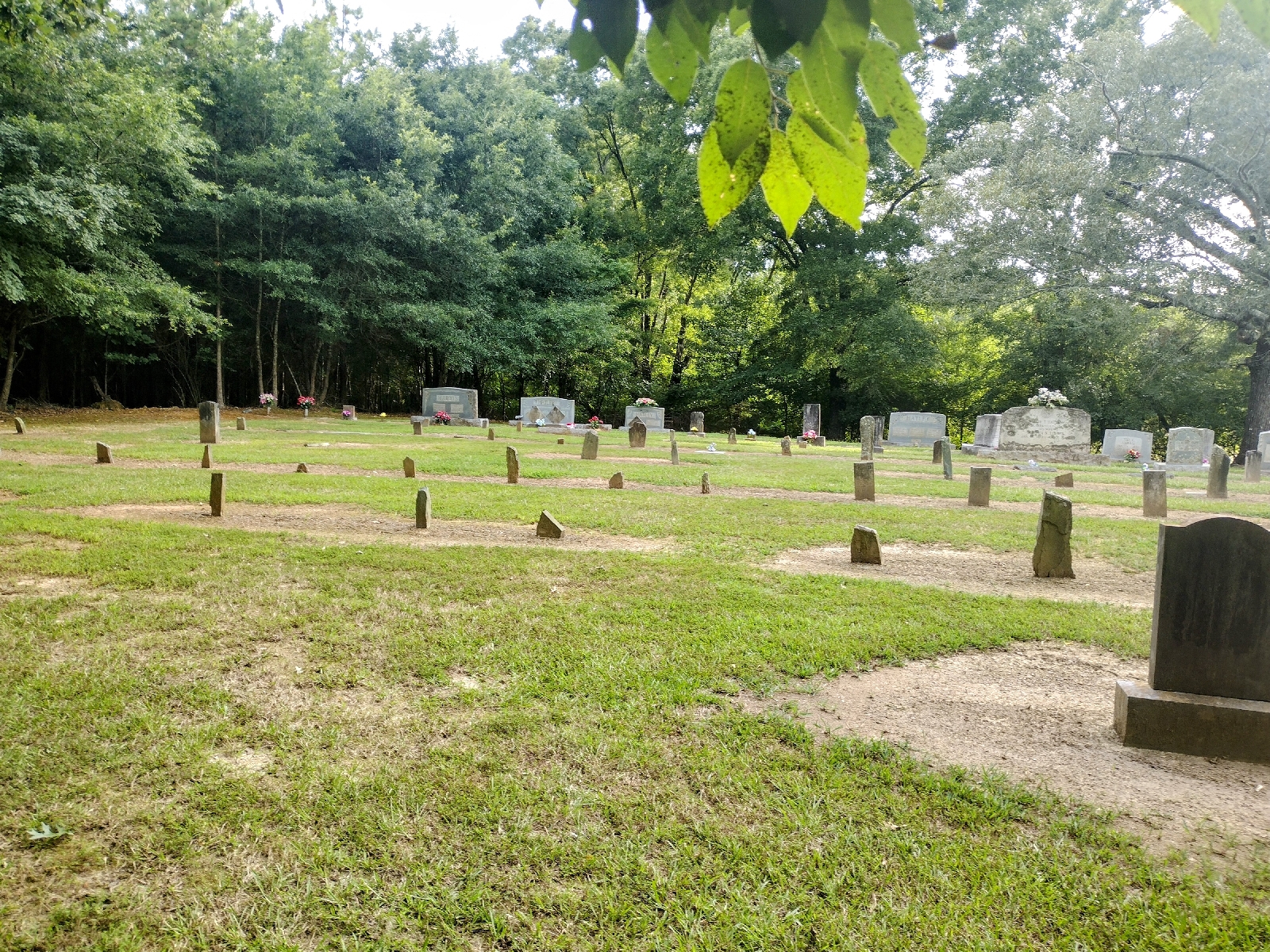
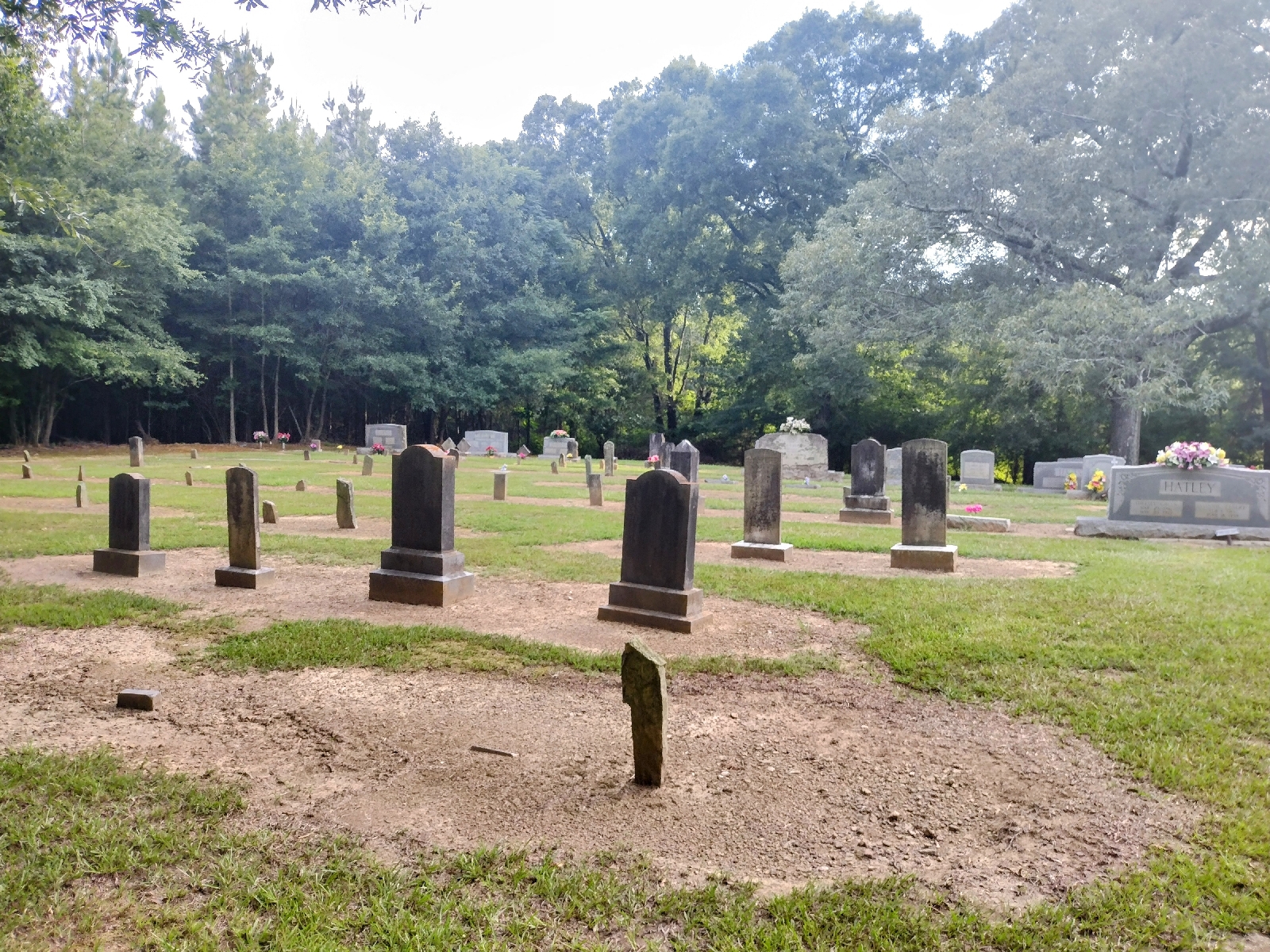
While the front of the cemetery is still in use and the interments fairly recent, the back of the lot tells a different story. This Hatley dominated spot is near 200 years old. Slate markers jut out of the ground like jagged shark's teeth. Few are legible, many are unmarked. 


Of the legible stones, the oldest date back to the 1860's, like that of Farrington Hatley, who passed in 1865, and L. A. Bird in 1863. There were a few names other than Hatley's there. This is where Caroline Whitley, daughter of Hezekiah Whitley is buried, and perhaps others of his family, their markers fading or gone. There seems to be a definate Hatley connection to this branch of Whitleys. 


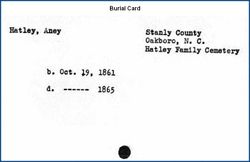
This cemetery card is for a little girl named Aney who died at about 4 years old. There are Harris', a few Springers, and I've mentioned the Birds, all who lived in the area. 


Above, the modern grave of another Hatley child. 

I happen to be a Hatley descendant. Old Hardy,  (1765-1838), was my Fifth Great Grandfather.

Although the Hatley Grove plot was the best kept of the inactive congregations or family cemeteries I have visited in recent weeks, it was also the spookiest. Inevitably, those of us bitten by the genealogy bug will be found hustling about in old abandoned cememteries. I've been in many, but they never loose their ability to creep me out. The worst is take a step in plush grass that sinks a few inches deeper than the previous step.


 An old man dwells there, although he prefers to present a younger version of himself, despite having lived a long life, even by todays standards. He seems very protective of the place, in a kindly way. Bright-eyed and light-haired, he had an easy demeanor and a squarish jaw, like many of the early Whitleys. There was another man there too, who lurked at the edge of the manicured plot. He seemed dark and sulky. It felt as if he didn't belong, slender and bent, like a weathered  twig, he wore a thin,  stubbled jaw and an ominous scowl. He stayed at the back, adjacent to the nearby house, across from the church building.


Leaving Hatley's behind, my next stop was the Ledbetter Family Cemetery. 

Located on the aptly named, Ledbetter Ford Road, this old family burying ground is also easily seen from the road. While not as manicured as the Hatley place, this ancient plot is also tended to and groomed, and sheltered under a small grove of ancient cedars. Located on a rise, off of the road that was probably unpaved a few years back, this is the resting ground of Alfred Ledbetter and his family.


A modern monument has been placed by descendants in front of his original, decaying one.  This area was his plantation, this is where he lived, raised a family, tilled the soil and joined with it in death. Alfred Ledbetter entered 100 acres along Stillwater Creek in 1844, in the newly minted County of Stanly. His entry bordered that of Hezekiah Whitley, and Isham Whitley, which adjoined each other, and Nancy Whitley, after Isham. 


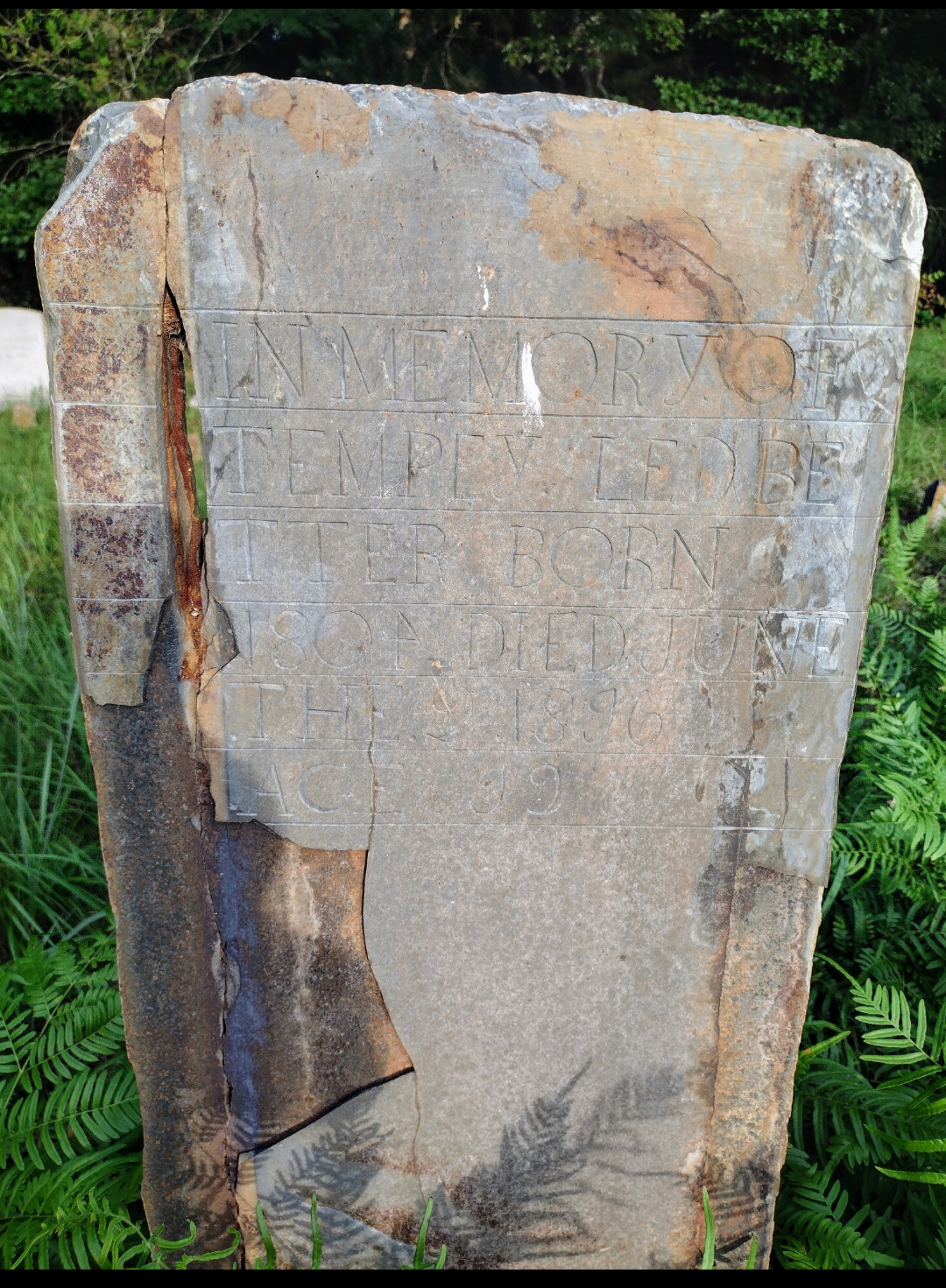
Set among  verdant ferns and grasses, above is the original stone of Alfred Ledbetter's wife, Temperance Jane Tucker Brooks Ledbetter. Previously married to a Brooks, who died in 1829, Tempy married Alfred around 1830, as their first child was born in 1831. 

A beautiful and peaceful resting place in a pastoral setting, the Ledbetter plot dates back to at least the 1840's. A good number of  Brooks are buried here as well, having intermarried into the Ledbetter family. There is also the grave of James Thomas Turner, an unrelated man, who witnessed the Will of Alfred Ledbetter, but died at the young age of 23 before it was probated. I wonder what his connection to the Ledbetters was. Could he have been a farmhand or employee? And what tragic incident ended his young life at the beginning of manhood?


The Ledbetters and the Whitleys lived along the Austin Road, as it existed in that era, a path south to the river and through the Bryant Austin family lands. I am not a Ledbetter, and have no genetic connection to them, but Tolitha Jane Whitley Springer, one of the people I have been researching, lived with them when she was 14 years old, as is seen in the 1870 census. 


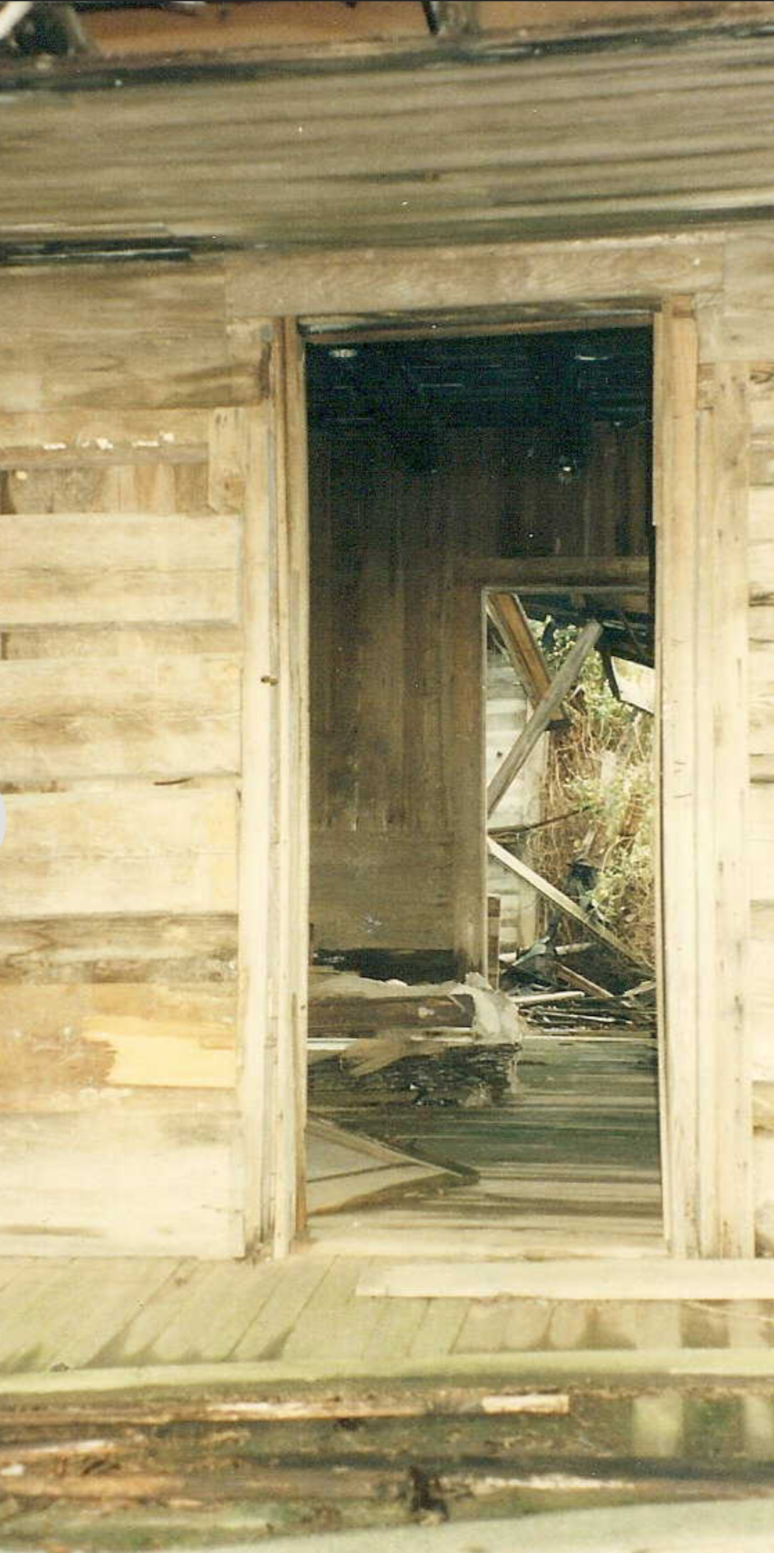
The Ledbetter homeplace is still standing, if barely. Above is the front entrance, shared to Alfred's profile by Richard Crotwell. That's a sturdy American build right there. The existence of Alfreds' lands helps me get a sense of where the lands of Hezakiah and Nancy Whitley may have been.


What tales these old conifers could tell, if we could understand their language. How many generations have they seen pass below their branches? How many footprints have their detritus covered up after decades of growth and shed?

My trip to Oakboro will continue in my next post. 

Thursday, July 17, 2025

Coming to Light


Talitha Jane Whitley was never a mother and her mother, Mary, was never a wife. So, without descendants, it appears I'm the first person to breathe life back into Talitha Jane's existence, or to wonder who she was.  

The ignominy of unwed pregnancy any time before the hippie era, has been the source of many a genealogical conundrum. I know I'm not the only person who wondered "Who was she married to?", when she wasn't married at all. That was the case of Mary Whitley of Big Lick Township in Stanly County, NC, or "Austin Road Mary". 

Big Lick, a little town named for a large natural salt lick, seemed to be a regular haven for such illicit relationships. I'm not sure of the reason why. Was it the families themselves, the atmosphere or the addititudes, or lack of a bounty of little white churches or fire and brimstone preachers? Can't say, and not saying it didn't happen elsewhere in the county, or in the surrounding counties. It did. Big Lick seemed to have an epidemic of it, however.


I may have came across the above document before, without knowing who the individuals were. It stated that Mary Whitley, a single woman, had been delivered of a child, which child was a 'bastard' and could become chargeable to the county. She named William Hinson as the father and an order was given to the Sheriff to apprehend him and bring him to the next session of Court. The order was dated October 29, 1855. 

There were as many Hinsons in Stanly and other nearby countries in the 1850's as there were Whitleys, but when it came to a young woman in a very rural setting before the arrival of the railroad, it was all about location. As to which William Hinson could have been the father of her child, the question turns to, was there a William Hinson of the compatible age in close proximity to Mary?


The answer to that last question is, yes, there was. Shown above, in the 1860 census, is Mary, with her mother, Nancy and brothers, Pinkney, Taylor and Hardy, married, above them. Listed below is the Sampson Hinson family, with a young married family, headed by a William Hinson, below them. 

This would have been five years after the Bastardy Bond, in which Mary had named William Hinson as the father of her child, which would be a daughter she named Telitha Jane, who was born about that time. 


William being married in 1860 would not have been out of the ordinary. As his child was one year old, he probably married around 1857 or 1858, after his day in court. It was more common than not that a single man, brought to court on charges of fathering a child out of wedlock, would turn around and marry, not the mother of his child, but a "good girl", suspectedly a virgin, as his wife. 


Ten years earlier, five years before the court case, we find Nancy and her children under one roof, in the same place, but under a different name. They were Whitley's, but here they were Hatley's. The times I've seen families under the wrong name; it was one of three circumstances. Either it was a transcription error, where the handwriting was so illegible, it had been transcribed as something else entirely. Or in the case of someone who had multiple surnames due to unmarried parents, who were sometimes seen with their father's name, and at other times, with their mothers. In other instances, a married woman with children by a first husband, would have children show up only by their first names, causing them to be given the stepfather's name in the record. This was none of those instances. I've even seen people's names written in reverse order, last name first instead of vice versa, and so their given name be listed as their surname. 

Nancy was in the right order with the wrong name, or was it? I get the feeling the census taker asked her what her name was in a way that she responded with her maiden name instead of her married name, and that she actually was a Hatley. It makes a lot of sense based on where she lived, and other circumstances, including the naming of her children. They are shown living next to Alfred Ledbetter, who I know had property that connected to, or adjoined, theirs. His family continued on the next page. 


At the top of the above page, are the remainder of the Ledbetter's, ending with John Brooks. There are a few Austins, (they lived along the Austin Road, after all, a road my distant cousin and talented researcher, George, informed me now embodies Highway 205), after which is the home of Sampson Hinson, and at this point, his son William is a teenager living in his parents' home, instead of beside it. The page was ended by the family of Nathan Safely, a family that will play a part in my next post. 

So, five years later than the above, William Hinson would have been about 22 or 23. Mary Whitley about 25 or 26. The slight age difference would not have mattered. Mary have already been a compromised woman, 'deflowered' so to speak. Her youngest 'brother', Zachary Taylor Whitley, was born in 1849, the year Zachary Taylor became President of the United States. Mary was about twenty at that time. Her mother Nancy, born about 1798, would have been about 51 or 52 when he was born. I believe it was much more likely that Mary was the mother of Taylor than Nancy was, especially considering that Nancy was a taxable landowner, or a widow, by 1847, two years before Taylor was born. 


I don't know where the little girl, Talitha Jane Whitley, was in 1860. She may have been in her grandmother's house, with her mother, and they hid her. Or she may have been bound out or given temporarily to a neighbor or relative to raise. Her first appearance is in the home of next-door neighbor, Alfred Ledbetter, in 1870.


Telitha Jane is 14, by then. This was during the days of the falling ashes, or the recovery from the Civil War. There were orphans and half-orphans everywhere, things seemed down-right lawless at times and illegitimacy exploded as widows and orphaned girls, with no power or property, reached out to, or were taken advantage of, by the remaining men in the community in order to survive. Many of us with deep Stanly County roots descend from these surviving families. 


At this same time, ol Billy Hinson was in his same spot in the Big Lick fields, growing more crops and having more babies. He had fought in the Civil War at this time, and was one of the fortunate ones to make it home, but not unscathed.


William Hinson enlisted in Co K 28th Regiment, North Carolina Infantry. He was taken prisoner in May of 1864. He was sick in the Lychburg hospital at some point, but escaped being wounded. William came out of the War pretty fortunate. 


1880


NameMary Whilly
Age60
Birth DateAbt 1820
BirthplaceNorth Carolina
Home in 1880Davidson, Iredell, North Carolina, USA
Dwelling Number249
RaceWhite
GenderFemale
Relation to Head of HouseSelf (Head)
Marital StatusMarried
Father's BirthplaceNorth Carolina
Mother's BirthplaceNorth Carolina
OccupationHousekeeper
Cannot WriteY
NeighborsView others on page
Household members
NameAge
Mary Whitley60
Teletha Jane Whitley24
William A. Whitley17

By 1880, Mary Whitley had followed her brother, William Pinkney Whitley, up to Iredell County. There were several families from the Oakboro and surrounding area who removed to Davidson, Iredell County. I've already explored one branch, the family of Civil War Casualty, Adam Whitley, in my post The Informant.
Another Whitley family who relocated to Iredell County was the widow and younger children of John Whitley, one of the older generation of Whitleys, including a son named William, which made the chase even more confusing. I covered Jane, widow of John, and her family, in my previous post called The Courage of the Calla Lillies . Even Nathan Safely, who we saw lived next to William M. Hinson in 1860, removed to Iredell County and is buried at Mount Mourne. I desire to uncover the magnetism of Mount Mourne for Stanly County residents after the War. What was the draw?

Mary's age was exagerated by a decade in the 1880 census. She was born closer to 1829, making her more like fifty. She had another and final child on April 8, 1868 in Stanly County. She and her baby boy were hiding somewhere in Stanly Couny in 1870, I'm pretty sure. Jane and her brother, William Alexander Whitley, would stick together like glue for the rest of their lives. His father remains unknown at this moment in time. Due to the age difference between he and Jane, I doubt that William M. Hinson was also his father. There is a gap in the bonds during this time, so I don't know if that mystery can be overturned. 


NameJane Whitly
GenderFemale
Marriage Date12 Dec 1882
Marriage PlaceIredell, North Carolina, USA
SpouseAlex Springer
Spouse GenderMale
Event TypeMarriage

Mary and her two children had traveled to Davidson with her brother William Pinkney Whitley. Sometime in the later part of the 1860's, he married Margaret Malinda Springer, widow of Israel Springer, another Civil War casualty. Israel and Malinda had a son, John Alexander Springer, in 1861. It  was Israel who started this tangent. I had begun with Tuckers and Hinson, fell into the Springers, and did a complete belly flop into the Whitley's. Alex and Jane were married on December 12, 1882, in Iredell County, NC.


1880 William Hinson family.


In 1880, William M. Hinson and his wife, Mary Ann Hathcock Hinson are still raising their large family in the Big Lick area of Stanly County, NC. They are living beside Allison Whitley and his family, a distant relation of Mary. The family ended with Elizabeth Jane Hinson, shown as a two-year-old in this record.

There is no more information on Mary Whitley.  We can postulate that she left her earthly body behind in Iredell County, sometime before the turn of the century as she made her way to her heavenly home. Her two children were at this time in Davidson, Iredell County, living side by side.


The census excerpt above shows Rebecca, the wife of William Alexander Whitley, leading their host of children, while her husband was listed on the previous page. After the last Whitley child are John Alexander Springer and wife, Telitha. It's a bit difficult to read, but the 1900 is one of the worst. 


1900 William Hinson was still alive in 1900 to welcome a new century. He was an aged man, and his days were numbered. 


At this time, Bill is 68 and Mary 64. Three children are living with him, Ellen, who never married and Abigail, who hadn't yet. His youngest son, Boston, would remain with his parents and take care of them until their dying day. He would be well rewarded. 


William M. "Bill" Hinson passed away on July 3, 1905, at the age of 71. Knowing his health was failing, he penned his Will on August 26th, 1910, seen above. He gave all of his land and personal property to his youngest son, Doctor Boston Hinson, aka "Boss", with the stipulation that he keep taking care of himself and his wife, Mary, the mother, until their deaths. He left all of his other children a nominal one dollar apiece. A dollar was worth much more then than now, but still probably a bit of shock for the Hinson younglings. 


NameWilliam M Hinson
GenderMale
Birth Date6 Aug 1833
Death Date3 Jul 1905
CemeteryHinson Cemetery
Burial or Cremation PlaceBig Lick, Stanly County, North Carolina, United States of America

William M. Hinson was buried at the old Hinson Cemetery off of Sandbar Road, out of Oakboro, NC. I have never been there; however, it is said to be very near the Rocky River.


Above is a photo of Bill's tombstone, from Find-A-Grave. I find it ironic that the photo that preserves his memory online was taken by a Jane Whitley, the name of the child he left out of his Will completely and possibly his mind. Most men of this era were of the opinion that they had no responsibility to their children born outside of the bonds of marriage, beyond what the courts forced of them in the early years. A few men embraced their children, married or not, Bill was not one of them, apparently. 

His children with Mary Hathcock Hinson, Hathcock being another name often associated with Whitley's, were: 

1859-1944 Winna Caroline Hinson Walters (Marion Craig Walters). Polkton, Anson County.
1861-1921 John Irvin Hinson (Married Mollie Liles and Nancy Gurley) Settled in New Salem, Union.
1862-1949 Laura Ellen Hinson, unmarried, Buried at Smith's Grove Church Cemetery.
1865-1916 Mary Malinda Hinson Love (Gustavus Beauregard Love) Albemarle, Stanly County.
1867-1918 Rufus A. Hinson (Julia Huneycutt and Sarah A. Simpson) Charlotte, Mecklenburg.
1872-1942 Adam Franklin Hinson (Lydia Adeline Simpson) Buried at Pleasant Hill, New Salem, Union
1873-1923 Abigail Hinson (William Wesley Meggs) Buried at Edwards Family Cemetery, Anson.
1874-1954 Doctor Boston "Boss" Hinson (Cora Cagle) Buried at Mineral Springs Church, Oakboro
1878-1952 Elizabeth Jane "Betsey Hinson (Lindsey Alexander Burgess) Mineral Springs Church. Oakboro.


Mary Hathcock Hinson lived until 1914. The 1910 census listed her, and her yet unmarried children, on Coble Mill Road in Big Lick Township. This would probably have been the Bill Hinson Homeplace.

In 1920, only Boss and Ellen remained and this time they were placed on Brooks Road.


Coble Ford Road

In an attempt to place the location of the family, I went to the historic maps from the NC Archives, found online. Above is a clip from the historic overlay map, showing some modern features over a 1916 Soil Survey map of Stanly County. I can't place where the Mill was, but as it was on the river, or perhaps a creek, the location of the "Coble Ford" could be a good guess. The old map shows a road that roughly follows Hwy 205, and crosses the river at Coble Ford, near the present Oakboro Blueway. You can see a Hinson School up the road, and several paths that lead down to the river. 


 Ledbetter Ford

In comparison, the Ledbetter Family Cemetery is located off Ledbetter Ford Road, which makes sense. This was the Ledbetter Family that the family of Nancy Whitley lived next to, her land bordered theirs, and where Telitha Jane Whitley is first found living with at age 14. On the above map, you can see an old road closely following the current Ledbetter Ford Road, with the old road continuing down to the Rocky River, and crossing it at Vance's Ford, near the mouth of Island Creek. The ford literally crosses at the Island in the Rocky River I'm speculating that Island Creek was named for.


Brooks Road

A portion of the Brooks Road, mentioned as the location of Boss and Ellen Hinson before he married Cora Cagle, with whom he had one child, still exists outside of Oakboro. On the old map, it follows along, but seems to stop at an old road that traveled from an old road that branched off of what is now Oak Grove Road down to the Morgan Mill on the Rocky River. Today it stops at Buster Road, but on the far right, one can see the mark of the Brooks family cemetery.


Hinson Cemetery, described as being off Old Sandbar Road, very near the Rocky River, is where William M. Hinson was buried along with his parents, and others of his family. It was also above the Coble Ford.


Hatley Grove Church where Caroline Whitley is buried. On the above map, one can see where the now abandoned Hatley Grove Church, which wasn't called Hatley Grove for nothing, was located near the dead end of the present Howard Road. 


Talitha Jane Whitley Springer and her husband, John Alexander Whitley, would move to the Mt. Ullah Community in Rowan County by 1910


A beautiful area, the family found there, with nieces, Mary, 22 and Louisa 5, living with them, daughters of her brother, William Alexander Whitley. Louisa's mother, Rebecca Helms Whitley, died three days after the little girl was born. It appears she was given to the Springers to raise, as Alex Whitley already had his hands full with the older children. Mary, unmarried, may have moved in to help with the baby, or either she didn't approve of her father marrying her mother's young sister, which he did three years later, adding to more children to his clan. 


1920 finds the new compiled family, still in Mount Ullah. 


Mary, now 30, and Louisa, now 14, are still with them. When Louisa marries, Jane Whitley Springer has passed on, but her Uncle J. A. Springer is the guardian who gives permission for her marriage to Clarence Thomas Wensil, in Cabarrus County, as she was underage. Louisa would change her name to the more sophisticated "Louise", but kept her maiden name as 'Whitley', despite listing the Springers as her parents.


Talitha Jane Whitley died so soon after the 1920 census, that she must have been ill when it was taken. She died the last day of February in 1920 at the age of 64 of heart trouble. It only tells us that the Undertaker was in Mooresville, but not where she was buried. Her husband Alex would live another three years. 

Talitha Jane Whitley may not have given birth, but she did raise a child. Not having descendants, no one had looked for her, but thanks to the discovery of her father-in-law being married, and no one seeming to know, I found Jane. I know who her parents and grandparents were, I know where she lived. I don't know where she was buried, but at least she is now remembered. I hope she can rest in peace.