As this is my third attempt to chronicle my visits to, or near some Oakboro area, or rather, Big Lick Township, area family cemeteries, I've decided to again, break one post up into multiples, as the ghosts of the past are fighting being brought to light. Or seriously, there must be a gremlin attached as the post has been twice deleted.
My last post introduced the reasons for my trip, a desire to connect with and view, the area these longgone folks lived on, walked on and died up on. I told of two cemetery visits, to the Hatley Grove Primitive Baptist Church, and to the Ledbetter Family Plot.
After leaving the old Plantation and Resting Ground of Alfred Ledbetter, I sought the Hinson Family Burial Grounds, home to the most ancient of Hinson arrivals to Stanly County, and the resting place of William M Hinson, father of Telitha Jane Whitley Springer, whom I've been researching for weeks now.
Set among a virid sea of green and gold in the rolling hills of southwest Stanly County near the Rocky River, the road to the Hinson cemetery is gated from visitation. Located off old Sandbar Road, in an absolutely breathtakingly beautiful rural setting, the Hinson cemetery is located close to the river on private land.
The oldest interment in the Hinson Cemetery dates back to the 1840's and the most recent, the early 1900's. The Hinsons will come to play in several future posts. It's a hop, skip and jump from the Ledbetter lands and closer to the Rocky River. As in most of these old family plots, many graves are unmarked, or the stones no longer legible. Among the ones that are, there lies a Mullis and a Tucker, among the Hinsons. I'm not a Hinson, and it's a beautiful area, but I felt no real connection to the place.
After leaving Old Sandbar, my next destination was the Brooks family resting place. Located down a long dirt path, and no longer accessible by Brooks Road, from the other end, as it was long ago, the Brooks plot is also in a clandestine setting, blocked by a gate from public access.
Located on a picturesque family farm, among sundappled rows of corn, rolling wind-kissed grasses that bend in the breeze, the Hinsons rest in the warmth of quiet peace. A clip from Find-a-Grave shows them in a nearly tropical setting
My biggest surprise in the visit to the first four locations was the close proximity they were to each other, walking distance, so to speak, especially for the 19th century. There's no wonder for the intermarriage and interaction between the collection of families. Above is a pond fed by a stream, that I believe may have been Stillwater Creek. The Brooks family grounds lie over near Island Creek, while the Ledbetter lands were closer to this, the Stillwater. That corresponds to the 1844 entry of a 100 acre tract by Alfred Ledbetter, just after the county was created. That doesn't mean he just moved to or purchased the land then, just that he laid claim to it in the new body of government. His tract adjoined that of Hezekiah Whitley and Isham Whitley, and three years later, Nancy Whitley, whom I believe to have been Isham's widow and perhaps a Hatley by birth.
These intertwined folks didn't live in Oakboro, why Oakboro didn't even exist. They lived several miles below where Oakboro is now, closer to the river, but not upon it. Nineteenth Century deeds claim they lived along the Austin Road. The landscape has changed dramatically over the decades, and the streams somewhat, but the Austin Road is not the Austin Road, as it now exists, nor close to it. There is a possibility it may have connected to the westernmost end.
The Austin Road was named for the family of my distant ancestor, Regulator Bryant Austin, a clever rebel who hid from the British after the Battle of Alamance, in the years before our independence from Britain, along the Rocky River. Eventually, a posse was sent for him, and he was discovered, but escaped capture credited to the use of good Bourbon.
That portion of road seemed to have transformed, generally, into the Coble Mill Road by about 1920, and is known as Highway 205 today. In the above portion of the C. B. Miller map of Stanly County, circa 1900 -1910, I've highlighted the general vicinity of certain families in the middle 1800's, as best as I can deduct, from what I've learned so far.
Lilac denotes the Coble's;
Green, the Hinsons;
Blue, the Ledbetters;
Orange, the Brooks and
Yellow, the Hatleys.
Of course there were overlaps and 'others' who lived there, by purchase or rent or employ.
To gage how far away from Oakboro this is, I've encircled the dead town of Big Lick in Orange. The railroad failed to be built through the heart of Big Lick, leading to its demise. A Post Office was built a few miles south of Big Lick and was originally named Furr City by a Mr. Furr. A town began to grow there, and a railroad stop was created, but the railway didn't like the name, and renamed it Oakboro, which has now absorbed what was Big Lick. The new town is roughly in green. The blue line is the trail to the Ford, be it Austin, Ledbetter or Coble. The yellow area is where the people I've been investigating lived.
When I was about twelve, the youth group of my church, which was in Albemarle, was gifted the use of an old family farmhouse on their property, as a clubhouse or meeting place. The kids, most of whom were older teens, did quite a bit of the work getting it cleaned up and fit for this usage. I will never get over the drama of stepping on a stack of two by fours and feeling the soft crunch underneath that turned out to be a mouse.
Two families dominated the church family, three or four generations of them, the Davis family (mine), and the Chandlers. There were several more, Furrs, Scott's, Hinson's, Coleys, Rabon's, Baucom's, Burleson, Holt, Kepley, Loflin, Eddins, Vanderburg, Trexler, Talbert, Burris, Buntings and many others. I had several first and second cousins in the Youth group. While I don't remember where the house was, I recall it was in Oakboro and had belonged to the Chandlers. Today, I found the Chandlers that it must have been, and the mouse memory returned in terrifying crunchiness.
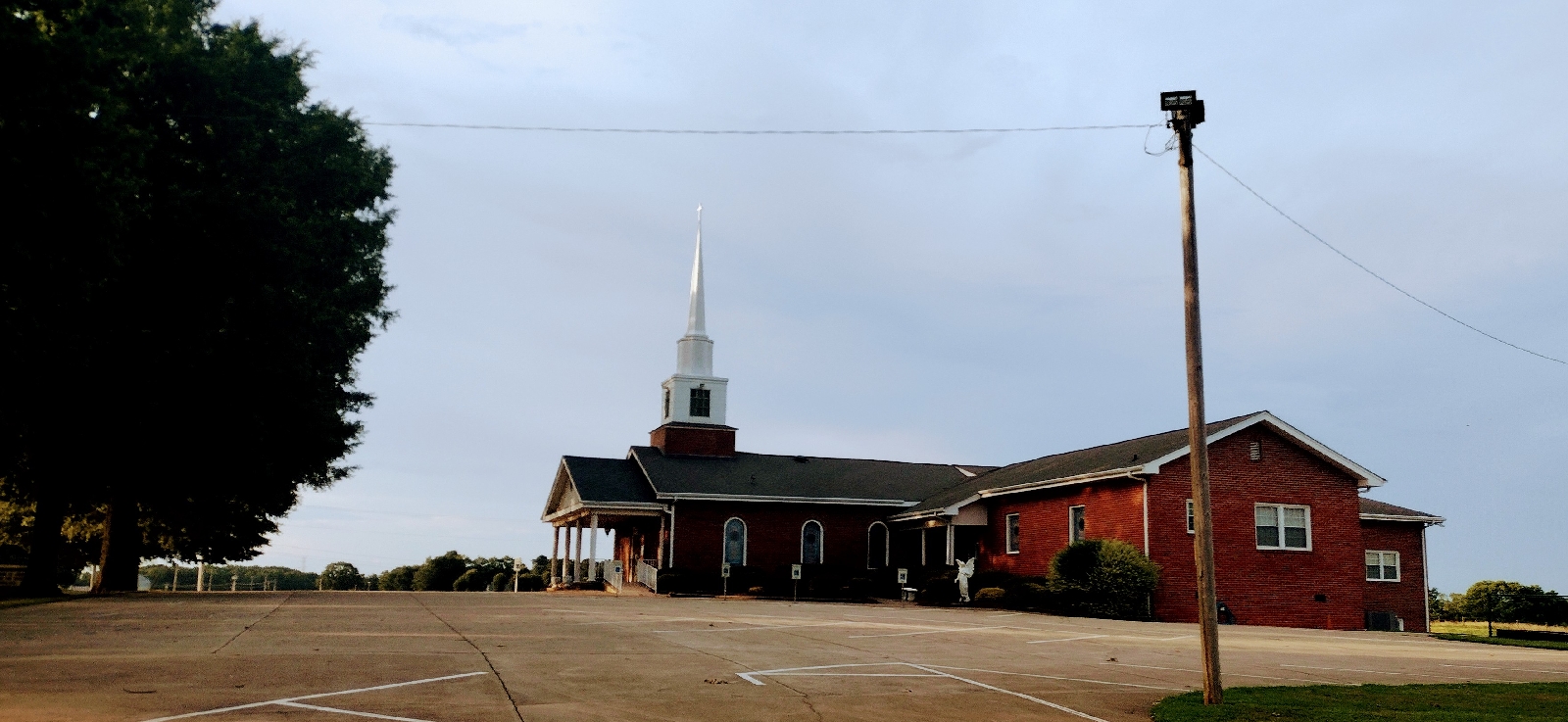
Mineral Springs Baptist Church sits on the corner of Hwy 205 and Mineral Springs Road, several miles south of Oakboro. To give one an idea of how close the areas I have mention in this, and in my previous post,
Adventures in Oakboro Part One, the above map shows Mineral Springs in the top right corner. The road leading into 205, just above it and then trailing southwest from it, was Ledbetter Ford Road, where the Ledbetter Family Cemetery is found. Down the road a little way on the right, neat the bottom of the screen, is Old Sandbar Road, where the road to the Hinson Family plot leads off of. Just below Sandbar, to the left, runs Howard Road. The former Hatley Grove Primitive Baptist Church sits off of Howard Road, and where it dead ends, leads to the old Brooks Family Burying Ground. This was a close and connected neighborhood.
Mineral Springs is an active and modern congregation. The Congregation dates back to 1845, and instead of reiterating its history in my words, I am just including the history the Church itself details on its website, below.
Our History
Mineral Springs Baptist Church was constituted in the year 1845. It was a member of the Pee Dee Association from 1845-1856. It was received into the Rocky River Association in 1872. In 1876 it was received into the Stanly Association.
The first building to be used by Mineral Springs Baptist Church was a one room log structure which was located one mile east of the present location. The second building, which was a large wooden building located at the present sight, was destroyed by strong winds. It was used from 1917-1927. The third structure was built in 1928. It was a seven room brick building with wings which were used as Sunday school classes. The church building was dedicated in 1930. In 1976 Mineral Springs remodeled and added to the old sanctuary a choir loft, baptistry, and a large educational building which included a new fellowship hall. The new structure was dedicated in 1977.
A more peaceful and ephemeral setting could not be found to serve as the resting place of God's people. A wooden cross leads into the front of the cemetery, with Old Glory waving overhead just beyond at a Soldiers Memorial. Cotton ball clouds paraded by in a variety of shapes underneath the wispy brushes of . Can you see the pig and the puppy dog?
In the turn of the century C. B. Miller map, above, I have circled Mineral Springs in yellow. A variety of roads and paths swirl around it. Predictable surnames camp around the church location, Hathcock, Honeycutt, Austin and Brooks. The road that plows right through the name of the church must have been what would follow the general path of Hwy 205, and at that time was known as Coble Mill Road. A road that crosses below it has several Hinson's as its occupants and may have been the original path of what is now Old Sandbar. W. F. and W. R. Brooks were apparently large landholders in the area at that time and a road on the right might have passed near the old Hinson Cemetery. Above the name of W. R Brooks was the Hinson School. On the right edge of the map, east of the church, we can see where Jones Church and Jones School stood. The Smith's Grove Congregation, which is located between Aquadale and Oakboro along Hwy 138, claims to be the descendants of the Jones Hill Congregation. A Whitley cemetery actually located within the town limits of Oakboro, claim to have been the Jones Hill
Despite its early beginnings, most of the burials at Mineral Springs seem recent, or at least 20th and 21st Century internments. There were several familiar names and even family members buried here. The black marble stone above is the marker for Joe Lowder, former Sheriff of Stanly and if I'm not mistaken, he also served as Mayor of Oakboro. Joe was a cousin of mine, his mother and my Dad were first cousins, making us second cousins. So, this was a familiar and familial place.
As with Hatley's, the march of time can be seen across the layout of the grounds, with newer markers giving way to older ones near the back, so one can the the forward progression of the plots, and that they had begun further away from the church.
A wide variety of local families have attended this church. These stones show Howard, Little, Thomas and
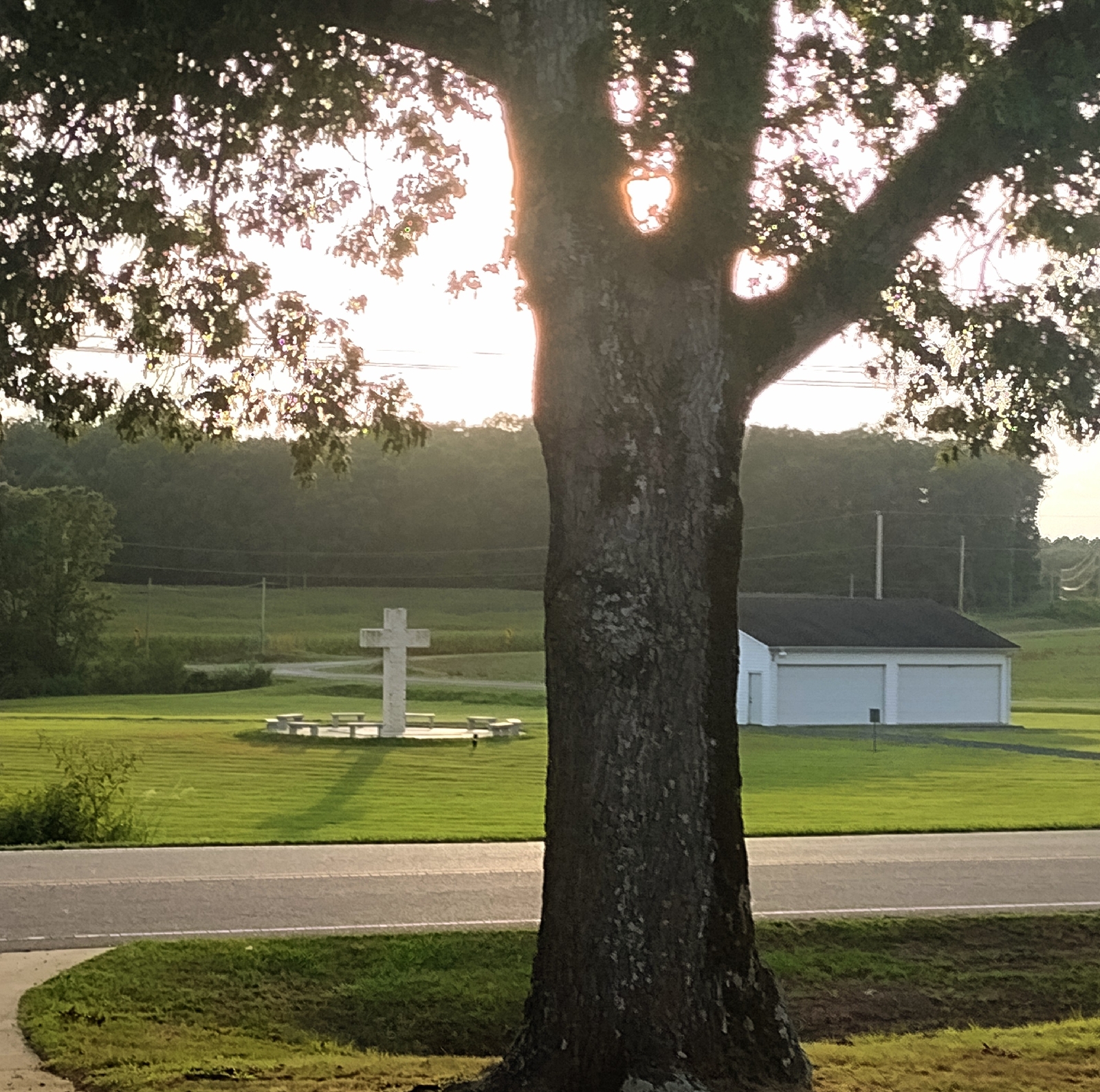
The cemetery has grown so much, that an extension has been arranged in a lovely setting across the street. To the left of the white cross surrounded by benches, out of range of this photo, is a group of graves adorned with flat markers, for easy mowing.
I found a Chandler grave and knew this must have been the Chandlers who attended Pilgrim Holiness/ Albemarle Wesleyan Church in the 1970's and donated an abandoned house on their property to the Church Youth Group. A member of the family donated a picture to his profile on Find-A-Grave, and although it is a younger version, it is most definately the Mr. Chandler that I remember.
My Uncle married into this same Chandler family, and they have a very interesting genetic heritage. One of them, when they still dwelt in Chandler's Grove near the Montgomery/ Davidson County border, before moving to Stanly County, had went west, to the mountains of North Carolina, and there found a bride with the surname Bell. This bride was from a group of dark, mountain people, a mix of indigenous and other. They returned to his home in time and this bride passed her olive-skinned genes down to this particular branch of Chandlers.
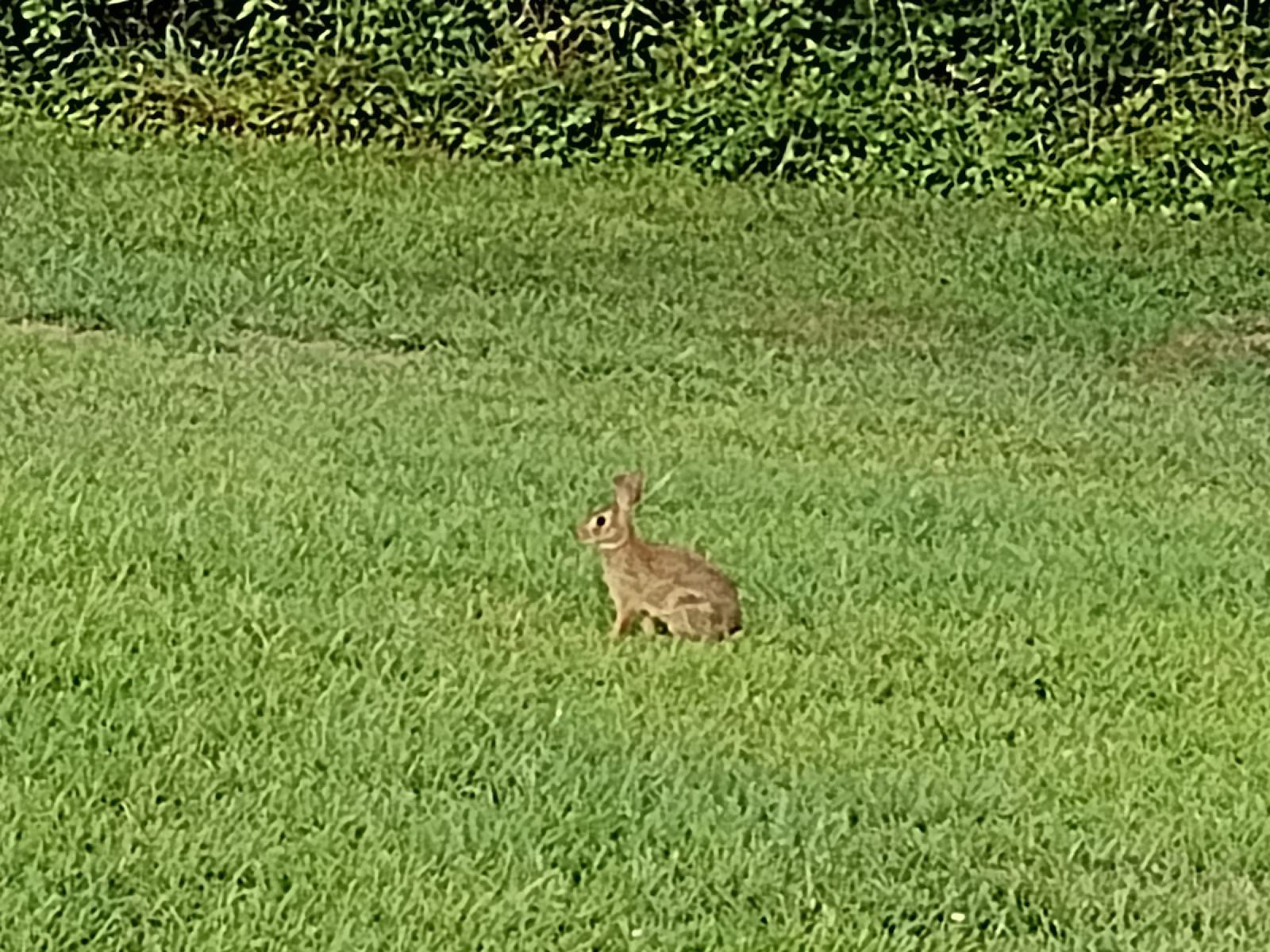
The cemetery is a place of peace and repose for other occasional visitors who also showed up during my visit.
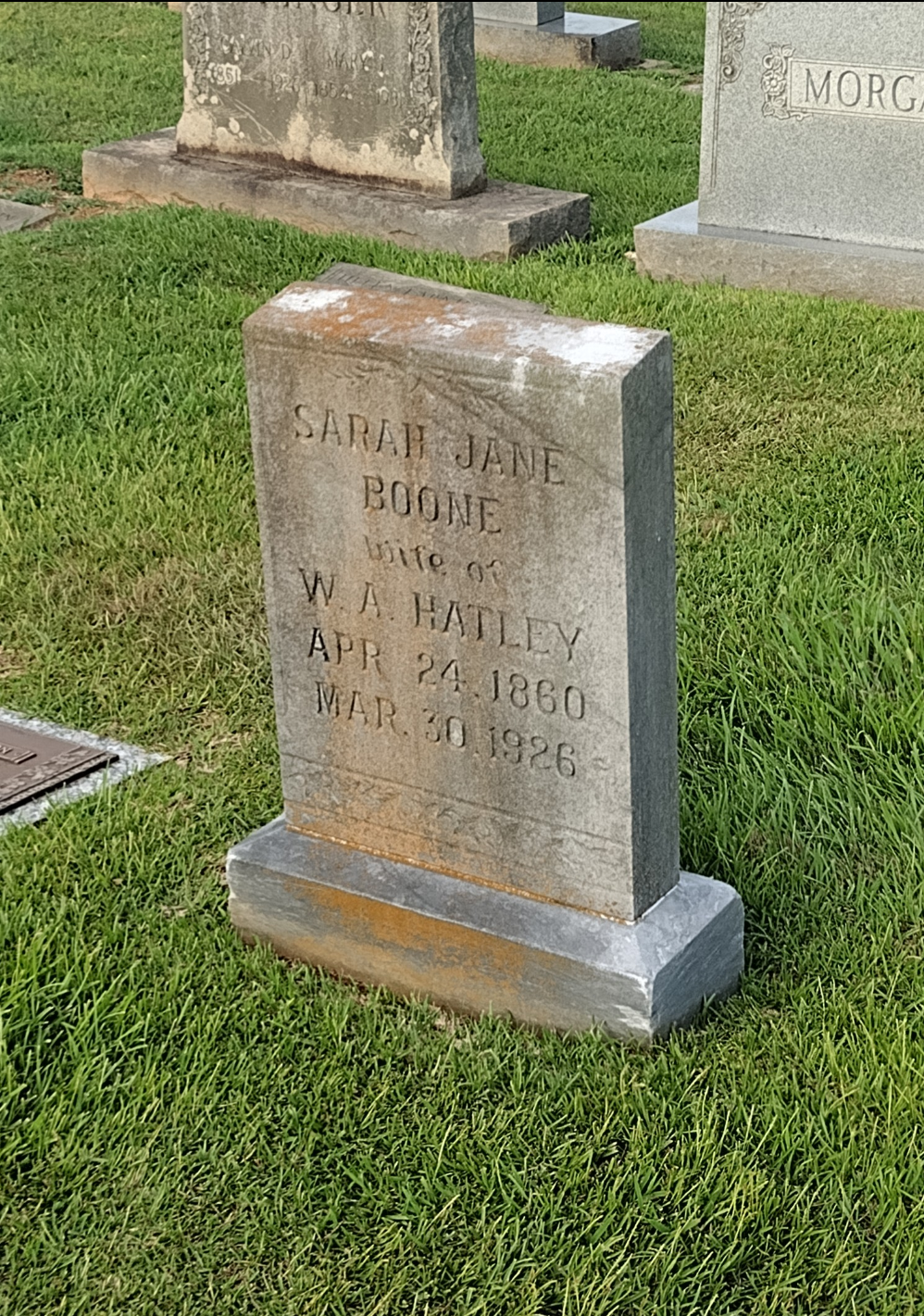
Sarah Jane Boone Whitley's stone caught my eye. She was the wife of W. A. Hatley, and I don't have to guess to know who her parents had to be. An early member of the Boone family settled in early Stanly Count area around Big Lick. After his wife died, he married Martha Murray and moved to Allegheny County northwest of Stanly in the Foothills of the Blue Ridge. On son remained in the Oakboro area. One of his sons married my Great Grandfather's oldest sister, Mollie. This must have been his aunt, as they were the only branch of that family to remain here.
No surname adorns this rugged looking monument, but the front is smooth and bears the name "Harris". This is the stone for Daniel Jefferson Harris and wife, Julia Hatley Harris.
This serene resting place contains the remains of several individuals I've encountered in this arm of my research, and obviously their children or grandchildren. The names still ring of the same names seen in the ancient deeds of this area upon the inception of the County. Hinson, Brooks, Hatley, Ledbetter, Whitley, Barbee, Smith, Furr, and many others, worshipped and lived in this area.
The next stop was the crossing of the Rocky River itself. On the other side is Union County and the Union/Anson County line. The families who lived in this area near the river were very close to these other counties and several of them crossed over and settled there. As five of Hezekiah Whitley's are unaccounted for after they grew up, I would not want to think they all died young. Possibly Martha, but the other four, Mary, Adaline, Elizabeth and Sarah, were all of marriageable age when we see them no more. As close as they lived to these other counties, I wonder if the mystery of their fates can be found there, instead.
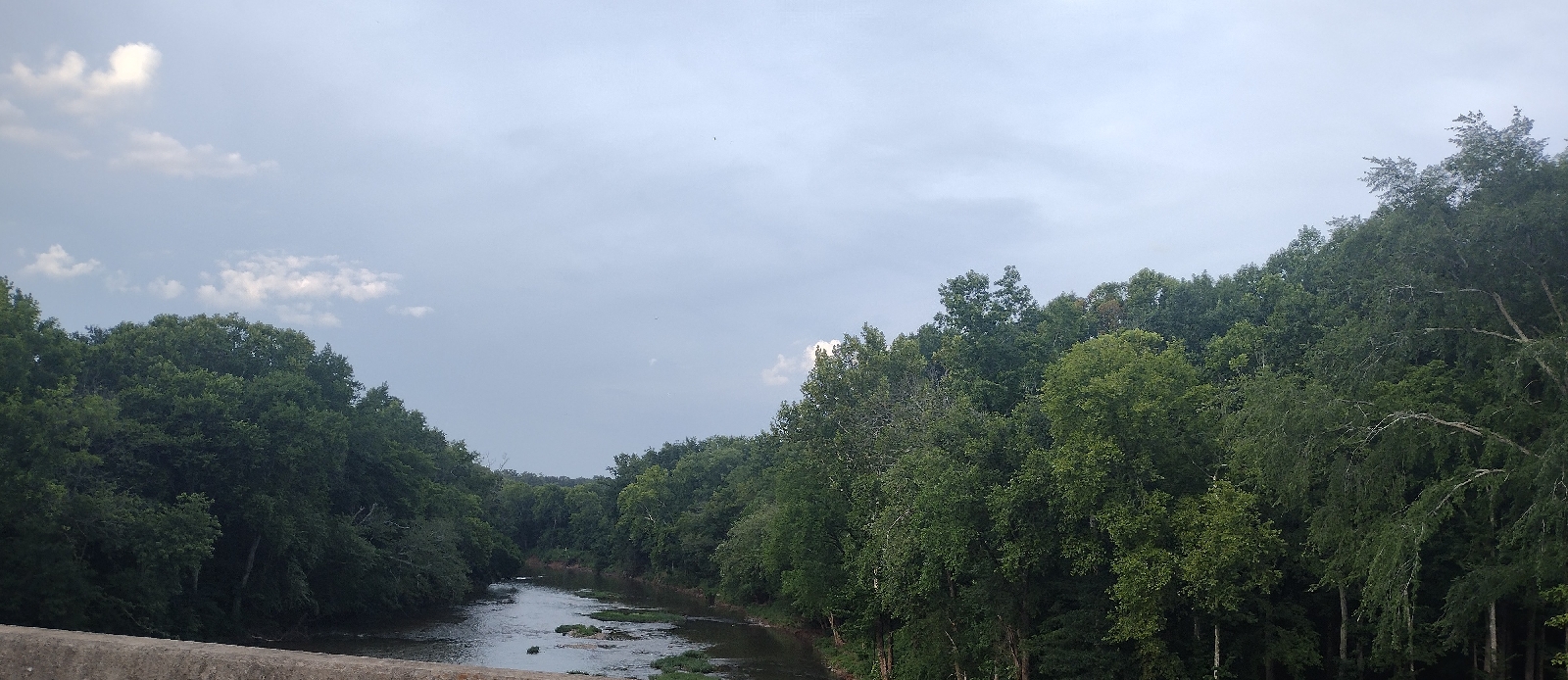
And, there, a brief glimpse of the Old Rocky itself, the slow, shallow stream that brought settlement to this part in the early years. Exodus Whitley was here at least by 1772, while it was still part of Anson and before the Revolution.
Right after crossing over, you find the sign and road of Pleasant Hill Baptist Church. One of the Whitley daughters is buried there. On paper, it looks to be a distance, but it's literally right across the river.
This concludes this arm of my adventures in Oakboro. Next will be the last of the trilogy, a look for the two Whitley cemeteries themselves.










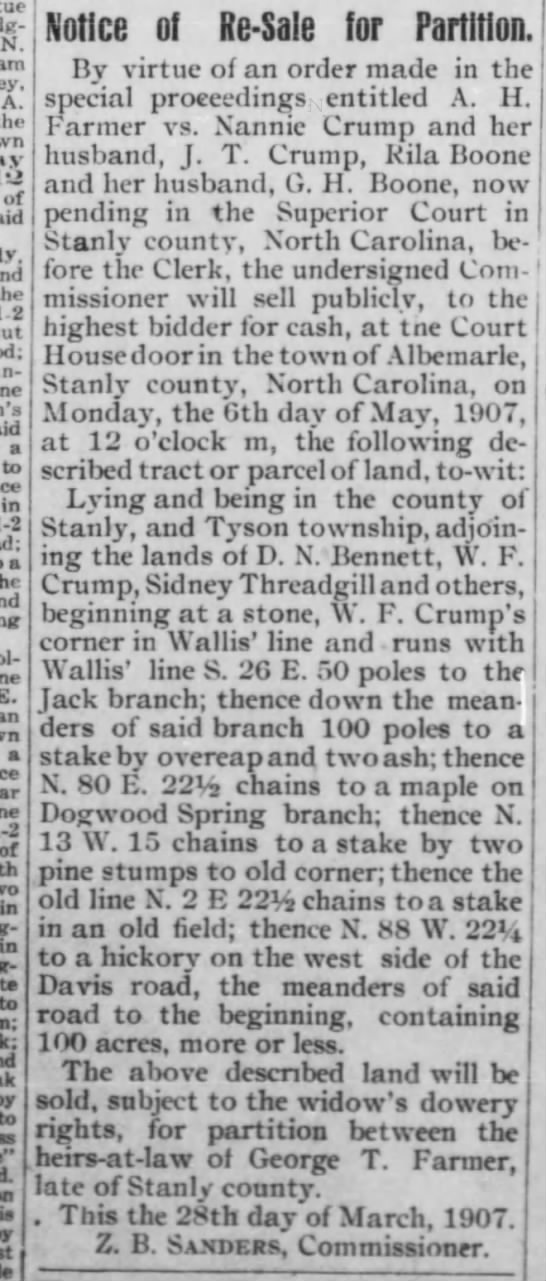
 Now, Rilla and G. H. Boone, that would be a typo of Lilla and George Henry Boone. A. H. Farmer, is of course, only son, Adam Huston Farmer.
 Edward Winfield Davis was born on December 3, 1811. He was the second sheriff of Stanly County, North Carolina, and a most eligible bachelor for most of his life.


