
Henry and Martha Palmer Davis

Some of my ancestors intrigue me more than others. Possibly because the more I find out about them, the more I wonder about the actions they took and why. Sometimes it's because they are such a mystery. Sometimes it's because I'm haunted by a mentally created image of them in my dreams or memories.
For instance, after discovering through Mtdna that my mother's mother's mother's line led back to Iceland, and that I am apparently descended from a woman named Anna Jonsdottir and that the Haplogroup to which I belong began in Finland 30, 000 years ago, I have envisioned a blonde, nordic woman looking off over the ice as my original "Mother".
Of course, Job Davis, the 4th Great Grandfather and brickwall ancestor for whom I named this blog, is one of those. As is his son, Henry. I am fascinated and bothered at the same time, by the evolution and contradictions of the character of the man that was Henry Davis.
 |
The North-CarolinianFayetteville, North Carolina 01 Feb 1840, Sat • Page 3 |
He was ordained as a Methodist Episcopal Minister and performed weddings.
 |
Carolina WatchmanSalisbury, North Carolina 17 Aug 1844, Sat • Page 3 |
I believe my fascination with Henry lies in his diversity of character.
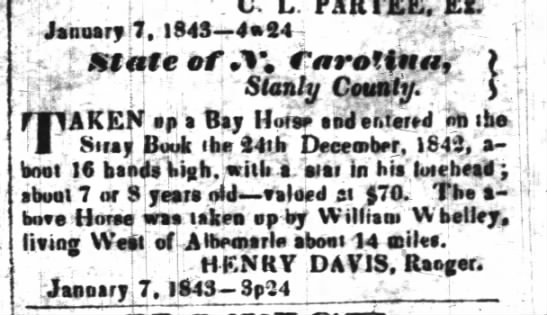 |
Carolina WatchmanSalisbury, North Carolina 21 Jan 1843, Sat • Page 3 |
He served as a Ranger.
 |
Carolina Watchman
Salisbury, North Carolina 20 Jul 1848, Thu • Page 3 |
He attained the military rank of Major and ran for a seat in the House of Commons in the State Legislature.
 |
Fayetteville Weekly ObserverFayetteville, North Carolina 29 Jan 1845, Wed • Page 4 |
Lawrenceville was the County Seat of Montgomery County, which before 1841 had included Stanly County, before Troy was established.
In a case called "Mason VS Hearne", Henry is mentioned as a Landlord.
December Term, 1852.
Where A took an absolute deed for a tract of land from B, and then executed an agreement in writing with C. reciting that "he had a deed for C's land," for which he had paid the purchase money, and therein bound himself to make C a deed on her paying back the said purchase money within two years; and it appearing thus, as well as from other facts, that A was to hold the land merely as a security for his debt: — Held, that C, upon her payment of the purchase money, was entitled in this Court to a reconveyance of the land from A, and to an account for the rents and profits — the time of payment not being of the essence of the contract.
CAUSE removed from the Court of Equity of STANLY, at Fall Term, 1852.
J. H. Bryan, for the plaintiff.
No counsel for the defendant in this Court.
The plaintiff by her bill, filed 11 February, 1851,
"No. Carolina, Stanly County, 13 Feb'y, 1843.
"Articles of agreement between myself and Martha Mason. I certify that I have a deed for her land to which I paid thirty dollars for the land, on which no lives, 50 acres, which I bind myself to make her a deed for the same, if the said Martha Mason pays me the thirty against 13 February, 1845.
"J. HEARNE."
Afterwards, from time to time, the plaintiff states that she did work and labor for the defendant to the value of $19.05, (an account whereof is exhibited), and having also taken up her note to Davis, she offered to pay the defendant the sum mentioned in the above agreement, and take a conveyance of the land — which he refused, saying "that it was too late." That she still remained (with her mother) in possession of the land, and the defendant brought ejectment against her and turned her out of possession; and further, that he had sued out a warrant against her for the rent of the premises, and recovered judgment thereon for $25 — on which judgment he entered a credit of about $17, for the said labor and services rendered by her; whereas she charges that she was not to pay rent, and that said credit should, according to their agreement, have been applied to the payment for the land. The plaintiff then states, that she afterwards, to-wit, in September, 1850, made a formal tender in gold coin to the defendant, of the balance due him under their said agreement, according to the above showing; and that he positively refused to accept the same and execute a deed to her. The prayer is that he be decreed to execute a conveyance and for an account.
The defendant, in his answer, admits that "he purchased the land of Davis" — having before refused to become the plaintiff's surety for the purchase money; and he admits the agreement with her, above set out; but he avers, that she failed to pay the $30 therein mentioned within two years; and (90) that remaining in possession, she agreed, soon after her father's death, to pay him for the rent of the premises $5 per annum. That after her default, he did bring ejectment against her and evicted her; and also that he sued out a warrant and obtained judgment against her for $25, on account of said, rent, and credited the same, as charged in the bill, for her work and services rendered — which he insists he had a right to do, under their said agreement.
As to the first alleged tender, he denies that the plaintiff ever offered to pay him, until after the expiration of the two years, the time mentioned in the above contract, and after ejectment brought against her; and he admits, that in September, 1850, he did refuse the tender as charged; and he insists on his right in equity, as well as at law, to hold the land.
Replication was taken to the answer, and the parties took testimony, principally as to the fact of plaintiff's agreement to pay rent, and as to the manner in which her payments to defendant were to be applied.
Mason v. Hearne, 45 N.C. 88, (N.C. 1852)
I previously posted of Henry's participation as a Trustee of the Methodist Episcopal Church, participating in founding churches in other counties, see my post, "The Moods and Mores of Henry Davis" in the below link.
The Moods and Mores of Henry Davis
In 1838, he was included in a list of petitioners to have what is now Stanly County divided from Montgomery County, due to the dangers in crossing the PeeDee River to get to the County Seat for Court, supplies, etc. As seen previously, his mail was delivered to Lawrenceville in 'East PeeDee' and from the Ledgers of the Daniel Freeman Store, which was located in Lawrenceville at that time, we see that he traded there.
1838 Petition of Inhabitants Seeking to Divide Montgomery County from angelfire.com/benjthomasfansnc
He was afterwards elected as a Justice of the Peace. The below excerpt is from:
On January 11, 1841, a new county was founded in North Carolina’s piedmont region – Stanly County. Created out of the western portion of Montgomery County, Stanly County’s eastern borders were determined by the Yadkin and Pee Dee Rivers. The names of Stanly County’s first Justices of the Peace remain prominent among Stanly County citizens today –William Swaringen, chairman, Edmund Lilly, Eldridge Parker, Henry Davis, Joshua Hearne, Jacob Austin, Richmond Snuggs, James Allen, John Stone, Francis Kron, John Miller, Daniel Palmer, Thomas Rowland, Mathias Moose, and John Furr. The county court elected D. Hearne, Clerk of Court; S.P. Morton, Register of Deeds; and Eben Hearne, High Sheriff. The Hearne family donated fifty-one acres of land to establish Albemarle, the new county seat. The County Commissioners accepted the deeded property, and a section of what had been the great Hearne Plantation became the heart of the new town.
As you can see, Henry Davis was a man of many contradictions, as by the end of his life, he had fallen so deeply into alchoholism and derelictism, that his younger brothers had to have him declared incompetent so that they could overtake his affairs to ensure his wife and children were cared for.
There is a story recounted in the Palmer Family History, that includes his second wife, Martha Palmer Davis, that tells of Henry getting beligerant at a wedding and a fight ensuing, which caused much grief and trouble. His character has passed through history as that of a volatile and strong-willed, yet highly intelligent and benevolent man.
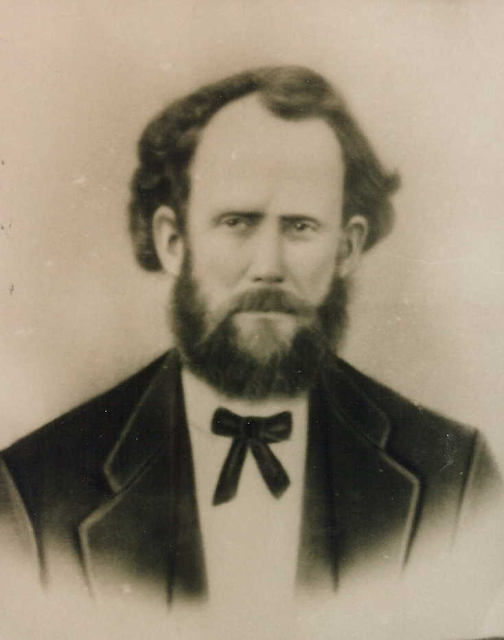
I have copies of 3 of the children of Henry Davis. Now that I have a copy of his own portrait, I can compare, how close of a resemblance they bear to their father.
Henry was married first to Sarah L. Kendall, born 1811 in Anson County, NC, just across the Rocky River from the Davis's. She was the daughter of Reuben and Sarah Smith Kendall. She gave Henry two sons. Benjamin Franklin Davis was born in 1829, when she was 18 and two years later, she gave birth to John Edward Davis, in 1831. She passed away shortly after the birth of John Edward, at age 20.
Reuben Kendall made provisions for his two grandsons in his will, so Frank and John inherited land in Anson County, in lieu of their mother, from Reuben Kendall. John is first seen in the 1850 census, working for his grandfather Kendall as an Overseer. He then married Emmeline Katherine Staton, daughter of esteemed Baptist minister, Uriah Staton of the northern Anson County area. John later established himself in the Burnsville area and became a minister (and farmer) himself, although I did find he owned land in the Cedar Hill area as well.
 |
| John Edward Davis |
John Edward Davis holds a strong resemblance, in my opinion, to his father. They both share a high foreehead, the low brows and low, prominent cheekbones. John Edward, however, had dark, probably brown eyes, while Henry had light, probably blue or light green eyes.
John and Emmaline had 7 children:
1853: William Postelle Davis
1856 Uriah Alexander Davis
1858 Ada Missoura Davis Marsh
1864 Joanna Davis Kiker
1866 Harriett Francis Davis Parker Beachum
1876 Sallie Elizabeth Davis Austin
1877 John Edmund Davis
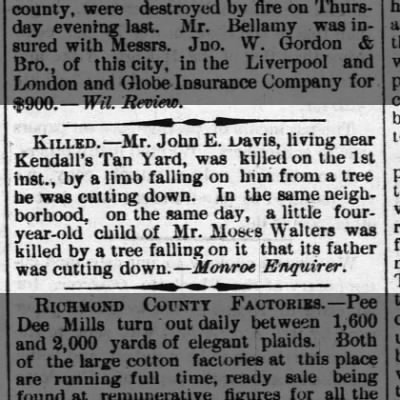
Rev. John E. Davis served in the Civil War and was the Excecutor of his father's estate. He died at age 46, accidentally, after being injured by a tree limb in 1878. His wife, Emeline lived until 1929.
After the death of Sarah Kendall Davis, Henry married Martha Palmer, the daughter of James and Martha Atkins Palmer from the central Stanly County area, just north of Albemarle and near the Kendall Valley area. James and Martha Palmer had 7 daughters and only one son. I'm sure James was happy in the beginning to have Martha Jr. marry well. She took over the raising of his two young sons, although it is apparent Reuben Kendall was very involved in his grandsons lives. Martha Jr. favored her mother a great deal and I can see the influence of the Palmer genes strongly in their offspring.
 |
| Martha Palmer Davis |
Henry and Martha would have 9 children:
1837 Sarah "Sallie" Davis - married Woodson D. A. Crump of Anson County.
1838 Nancy Baldwin Davis - married John Wall of Anson County and migrated to Carroll County, Mississippi.
1840 Henry Hampton Davis - married widow, Ann Eliza Allen High, settled in Burnsville, Anson County, NC.
1842 Mary "Mollie" Davis - there are some reports she married a Smith. I've not determined her fate.
1844 Martha J. "Mattie" Davis - married Joseph Alexander Ingram, migrated to Rusk County, Texas.
1846 Horton Hampton Davis - married Francis Julina Aldridge, remained on the Davis property in Stanly.
1848 Job Davis II - migrated to Carroll County, Mississppi with sister Nancy, died in Garza, Texas.
1850 Laura Davis - never married, died in 1911 in Albemarle, NC
1852 Margaret Victoria Davis -married William D. Crump,stepson of sister Sallie. Lived in Tyson, Stanly Co.
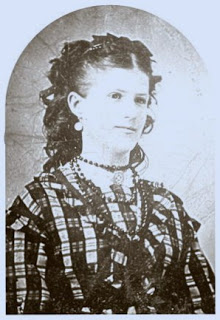 |
| Nancy Baldwin Davis Wall |
Nancy was the second daughter of Henry Davis and Martha Palmer Davis. At the age of 18, she became at least the third wife of James Wall, Jr. 38, son of James Wall Sr., and Nancy Long Wall. He already had a large family of children, and after marrying Nancy, he packed everyone up and migrated to Bright Corner, Carroll County, Mississippi. There's a story in the Palmer chronicles that tells of Nancy's weeping and complaining and being very unhappy about moving away, that I can't recall the exact words of at the moment. Nancy gave James at least 5 and possibly 7 more children before passing away at age 42 of Lung Disease in 1880.
| Surname: | Nancy B. Wall |
|---|---|
| Year: | 1880 |
| County: | Carroll CO. |
| State: | MS |
| Age: | 42 |
| Gender: | F (Female) |
| Month of Death: | Apr |
| State of Birth: | NC |
| ID#: | 198_357185 |
| Occupation: | HOUSEWIFE |
| Cause of Death: | LUNG DIS |
James Wall, albeit 20 years her elder, outlived her another 22 years, passing away in 1902. He had taken another wife with Anson County roots, Sarah Streeter, but there were no children born to that marriage. Nancy's known children were: Cornelia, John Davis, William Long, Benjamin Wiley and Hettie Harris Wall.
 |
| James Wall Jr. (photos of James and Nancy Davis Wall were copied from the book, "The Walls of Walltown", written and compiled by Ann Wall Thomas, 1928, by someone before being transferred to me. |
Horton Hampton Davis (1846- 1902) was my direct ancestor and 2nd Great Grandfather. He was the 6th child of Henry and Martha and Henry's 4th son. His older brother, Henry Hampton Davis, was born in 1840, married a widow, Anne Eliza Allen High, and lived in Burnsville. As both their intials were "H. H. Davis", they were often confused. As "Hawk" or "Haut", my ancestor, was often called, lived in Stanly County as an adult and Henry Hampton lived in Anson, generally, if you see H. H. in Stanly, it was Hawk and if you see H. H. in Anson, it was Hamp.
Hawk Davis was a late bloomer, much like his Uncle, Edward Winfield Davis, who he was like a son to. In fact, when E. W. died, Hawk was made guardian of his minor children, until his widow, Rebecca, remarried. Likewise, when Henry died, Hawk, who was still a minor, came under the guardianship of his Uncle Ned.
Hawk married Francis Julina Aldridge, whose family had been a neighbor of his before her father passed away during the Civil War. He was 10 years her senior. Julina had a number of children before their marriage in 1891, when he was 42 and she was 32. Her older two children, Mollie and Jesse Fillmore Aldridge, occasionally went by the name Davis, but mostly Aldridge. Mollie's tombstone has her name as "Mollie Davis Boone".
In the Permanent Voter Registration books of the Turn-of- the- Century Jim Crow era, Fillmore named his father as Ephraim Whitley, son of Benjamin Lindsey Whitley, to whom Julina was bound as a child.
All of Julina's other children all went by the name Davis. All of the children who lived were: 1877 Mollie, 1879 Jesse Filmore Aldridge, 1881 George W. "Gus" Davis, (Gus is listed as a Davis in documents, but his actual father is unknown. He was not H. H. Davis' biological son. 1887 Titus Henry, the first biological Davis, 1888 Rebecca Jane ( Aunt Becky lived to be almost 100. I remember her well. She passed away in 1987), 1891 William Hampton (my line), 1892 Martha Priscilla "Mattie", 1893 Carrie J. Davis, 1895 Thomas Parrish, 1897 Ritchie Clark, 1898 Cora Victoria Davis.

I've included the portrait of Henry again, in order to compare the resemblance between father and son. John certainly favored him more, and having seen a portrait of James Palmer and wife, I can certainly see a great deal of Palmer in Hawk. Hawk does still have those low-slung cheekbones and Henry's equaline nose. The hat may make a difference.
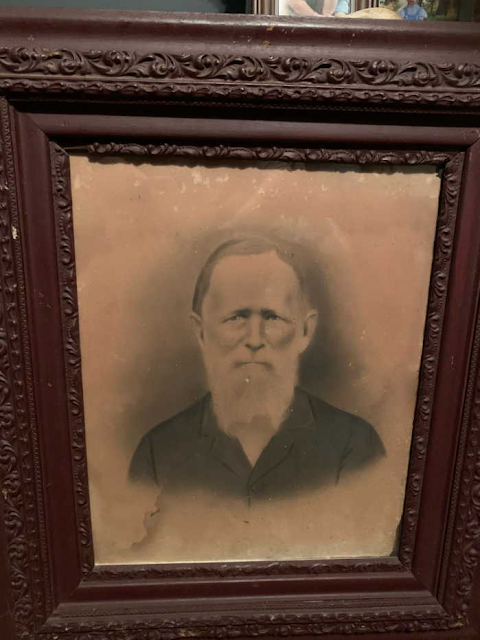 |
| Henry Davis |
Below is a portrait of Job Davis II, Henry's youngest son who accompanied the Walls to Mississippi. He has no descendants that I know of. I think he bears a striking resemblance to H.H., yet favors Henry more than Hawk does. Such is the way with siblings.


