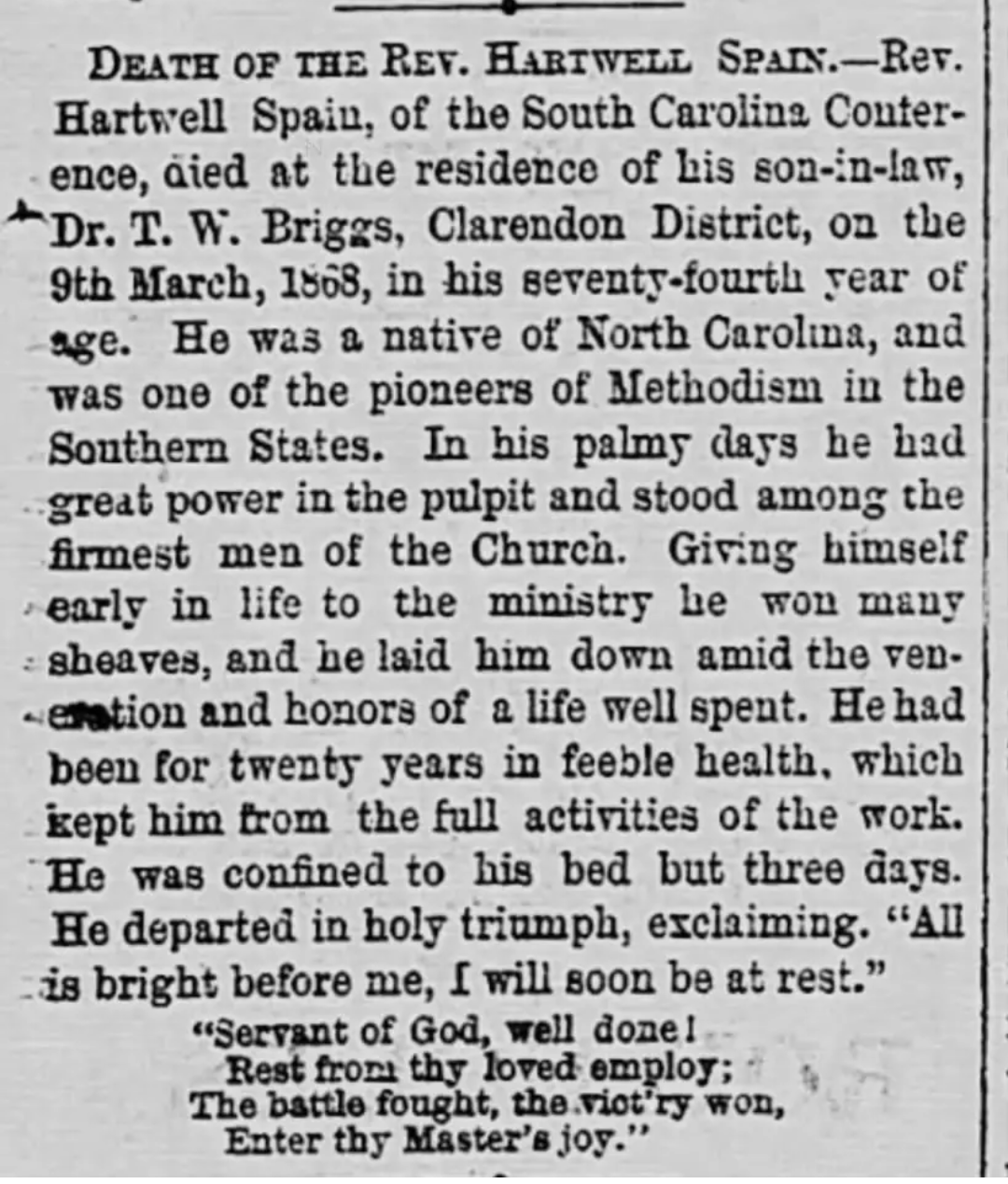
In the 18th and 19th centuries, parents didn't always name their children after ancestors and relatives. I've noticed that often they were named for Presidents, like George Washington and Thomas Jefferson, or other historical figures like Benjamin Franklin or Francis Marion. Religious leaders like Martin Luther, Francis Asberry, and Hartwell Soain also garnered their fair share of namesakes.
Charleston, South Carolina · Monday, March 16, 1868
Charles Robbins of Anson and Montgomery County, North Carolina named his firstborn son Green Deberry Robbins. He's not the first Green Deberry I've encountered. In fact, he's the fourth Green Deberry in my family tree. Two of them were Green Deberry Whitley's, but there were actually four of them, and probably more, as descendants of these were on the move and migrated away.
The oldest that I know of was Green Deberry Whitley (1815-1881), son of George and Rebecca Cagle Whitley. He's buried at the old Whitley Cemetery in Red Cross.
Green Deberry Whitley Jr. (1862-1950), was the son of Green Deberry Whitley and Caroline Smith Huneycutt Whitley.
Green Deberry Whitley (1850- 1933) was the son of Benjamin Lindsey Whitley and Mary Eudy Whitley
Green Deberry Whitley (1836-1863) was the son of Needham Whitley and Mary Rebecca Cagle Whitley
All of those were related, of course, and were from Stanly County, NC.
I also have a Green Deberry Ausin (1835 -1933) in my tree. He was from Union County, NC, but of course, Union was part of Anson at one time and borders Stanly.
I discovered a Green Deberry Stegall (1860-1936) out of Union County, who is pictured above.
There was also Green Deberry Castles (or Cassells) (1832-1907), in Webster County, Mississippi, son of William Castles and Rachel Burleson Castles, and with names like Castles and Burleson, I knew his roots had to lead back to the Montgomery/Stanly/Anson/ Union County area, and certainly enough, they did. The Castle family were neighbors of the Robbins after they had moved from Anson to the part of Montgomery that had became Stanly.
But Green Deberry Robbins was not named for any of those. In fact, born around 1800-1801, he was older than all of them. They were not named after him, either. He was probably still in his teens when his family left for Tennesee, and had not accomplished anything yet, for anyone to be named for him and had not yet had children.
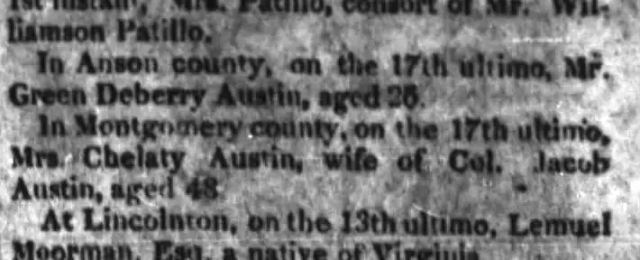
Raleigh, North Carolina · Thursday, October 09, 1828
Then I found this clipping. A Green Deberry Austin older than the other Green Deberry Austin.
The above paper gives a little more information. Green Deberry Austin was the son of Jacob Austin, and died of Thyphoid Fevver, along with his mother, Chelaty, a nickname for Charlotte Palmer Austin. This Green Deberry was a contemporary of Green Deberrty Robbins, but still not older.
Colonel Jacob Bryant Austin was born around 1782 in Anson County and was the son of Regulator Bryant Ausitn and wife Temperance Parmelia Osborne Austin. Bryant Austin, born in Virginia, was in the Battle of Alamance, and part of a group that sent numerous petition to Govenor Tryon, protesting the high taxes and unsued suffering caused by the high taxes and fees being charged by the British. He is also my daughter's sixth Great Grandfather. Col. Jacob Austin was her fifth.
Col. Jacob Austin shared by Karen Austin Blum
There are other scattered Green Deberry's throughout the west and south, and everywhere that people from here migrated to, but without fail, they all seem to lead back to the area of Stanly, Montgomery, Anson, and Union Counties, with a center around the Rocky River. These families only go so far back in this area. In the early and middle 1700's, this was a wilderness. They seem to have been in North Carolina Counties east of here before that, Wake, Edgecomb, Johnston, Franklin, Bertie and in Virginia before that, eventually, the trail leads back across the ocean to Europe, primarily the British Isles.
The question remains, Who was the first Green Deberry? There were certainly enough of them in my family tree. There were both Greens and Deberry's in this area at a very early date, I'm a descendant of a Sarah Green who married Mark Morgan. Did all of these men have a common ancestor at some point named Green Deberry, who had a mother or grandmother whose maiden name was Green? I can't find any Green Deberry on record as having made any waves in history, so he wasn't a politician, a scholar, or a religious leader. The name seems to center around the Whitley or Austin families. Is that where it originated? Did Green Deberry live in early Wake or Butte Counties of North Carolina? Did he dwell in Southside Virginia or in Pennsylvania before he, or children of his, came down the Great Wagon Road? Or did he predate their arrival to America?
Why did Charles Robbins name his oldest son Green Deberry?
Why did George Whitley I name his son Green Deberry?
Why did Col. Jacob Austin name his son Green Deberry?
WHO WAS GREEN DEBERRY?
If anyone comes acress a Green Deberry ??? older than Green Deberry Robbins, born 1800 in Montgomery County, North Carolina, please message me and let me know. He might be my ancestor.
At different times in our countries history the expansion of pioneer families into the wilderness came at a trickle. At other times it seems as if they turned the water on high. In the area of the Southern Piedmont of North Carolina, the Revolutionary War had brought many new arrivals from Virginia, Pennsylvania, Maryland and other states north of us. Then the War of 1812, the Indian Wars, and the distribution of other land bounties to the south and west caused an outpouring of families out of North Carolina into Tennesee, Alabama, Georgia, even Illinois and Indiana, and later Arkansas , Mississippi and Texas.
I can not yet determine where the small branch of the Robbins family who arrived in Anson and Montgomery Counties of North Carolina were before they arrived here in the early days of our settlement in the 18th century, but when they left, they seemed to have left altogether, for Tennesee. After several decades, I believe one came back. My DNA is telling me this.
As I dig deeper and deeper into the family trees and the constant moving and resettling of the Robbins family, DNA is steadily leaving a trail of bread crumbs, letting me know I am on the right path. Every few days, sometimes every day, that I search for records on ancestry.com, I will come across a bit of information contributed by a descendant, or someone attached to one of those descendants, who knows more about their particular branch of the Robbins family tree than I do. Alot of times, when I click on the link to check out the information, the individual is no relation. That doesn't surprise me as not everyone on ancestry has taken a dna test, I would dare say most have not. Others have and may be a descendant, but at the distant generations, we might not share any dna, having retained different portions of dna from the same ancestors. Others may be researching and not be a descendant at all. Maybe they are a spouse of a descendant, or, they do like I do, and explore the people around the ancestor, to see if there is any familial connection, especially when the names keep popping up in records together. I've dredged up a lot of information I would have otherwise missed this way. However, I am meeting enough distant cousins that I know I am on the right road, and my dna serves like one of those painted arrows along a hiking path that points you in the right direction. At the risk of blowing up an old predetermined theory on the maiden name of Mrs. Sylvia Honeycutt of Red Cross, Stanly County, I am continuing to follow the path of the Robbins into Tennessee and areas beyond.
While aiming my magnifying glass in the direction of John Robbins, Sr and Jr., I just can't forget about Charles .
The above family tree for Charles Robbins is taken from someone else's Tree off of Ancestry.com. Now, personally, I believe they have hooked their horse to the wrong wagon, as the parents, who would have been John Robbins, Sr. and wife, don't geehaw. It appears to me that Sr. passed away before 1800, and was born more lilely in the 1730's, or 1740's, at the latest. But I could be wrong. I'm new to the Robbins nest, so this information could have come from very viable sources. What interested me the most, was they have an Isham Robbins as the youngest child, born in 1776, which seems viable, and died in 1843, when the Isham Robbins I am reseaching died. Edit: I now know that John Sr. did not die in North Carolina and did not die before 1800. I also know he had at least three sons: John Jr., William and Charles.
This is what I know about Charles.
From what I have been able to surmise, John Robbins,Sr. had three sons, John Jr., William and Charles. If there were others, they were not mentioned in the records of Anson or Montgomery, where he lived. William is not mentioned in the records of North Carolina. The William who does show up with John in the earliest records of Anson County is believed to be his father, William was an older man.
There were two John Robbins in the 1790 census of Anson County.
Name
John Robbins
Home in 1790 (City, County, State)
Anson, North Carolina
Free White Persons - Males - 16 and over
1 John Jr.
Free White Persons - Males - Under 16
1
Free White Persons - Females
3 Elizabeth, twho unknown
Number of Household Members
5
One shows one male over 16, one male under 16, and 3 females in the household. I believe this one to be the home of John Robbins, Jr. I know he was born in 1766. He may have had a son and two daughters by then.
Name
John Robins
Home in 1790 (City, County, State)
Montgomery, North Carolina
Free White Persons - Males - 16 and over
2 John Sr. and Charles
Free White Persons - Males - Under 16
1 William
Free White Persons - Females
5 Unknown
Number of Slaves
2
Number of Household Members
10
The other had two males over 16, one under 16, 5 females and 2 slaves. The two males over 16 could have been John Sr. and Charles. The younger male could have been William. , The names of any of the females are not known to me at this time, despite some being listed in the above tree. I have not been able to confirm those.
Charles Robbins
Montgomery
1797-07-10
1794
100
S. W. side of Peedee river
1036
Charles Robbins recieves his first land grant, in Montgomery County, North Carolina, in 1797. It was for 100 acres on Long Creek. It began at a pine on John Robbins corner and ran with John Robbins property line.
Charles Robbins shows up several times in the Montgomery County land records, as he was a young man at this time, he often served as a Chain Carrier for neighbors.
Grant 1070 Charles Robbins and Thomas Mainord (Maynerd), served as Chain carrier in the 100 acres grant of Hosea Rowland's property, granted by John Crump, and was located on both sides of Turkey Creek, beggining on Buzzard's Branch, in 1794.Grant 1070, Montgomery County, NC Land Warrants and Surveys (1778-1833).
His own grant is mentioned, but in this deed, he references, his father, who was John Robbins.
"Oct 20, 1794 by John Crump to Charles Robbins 100 acres taking in an improvement I had joining my father's line where he lives on waters of Long Creek.... 100 acres surveryed Jan. 1, 1795 by J. Atkins, on SW side of Pee Dee and on waters of Long Creek, border begins at a pine in John Robbins line. Hosea Rowland and Thomas Maynard chain carriers." Grant #1060 Montgomery County, NC Land Warrants and Surveys (1778-1833).
This proves that Charles was a son of John Robbins (Sr).
In 1796, in Warrant No. 2265, John Crump granted 150 acres to a Lewis Baird on the waters of Long Creek that was said to have joined the property of Charles Robbins. It began at a pine in Stokers line, joined Robins, Barnaba Dunn and John Atkins were chain carriers. Just before this Lewis Baird had been granted a 300 acre tract from Crump that was on the waters of Curl Tail Creek and included the Rocky Ford "of said creek". Grant 1509, Montgomery County, NC Land Warrants and Surveys (1778-1833).
The surname Baird came up while I was exploring who lived along a stream named Boston's Branch, where John Robbins Jr. had a grant, and Benjamin Baird and William Baird were among those names.
Sept 30, 1799, Hamblet Underwood recieved a 100 acre grant from John Neal on Bear Creek, that joined Whitmill Harringtons old line, Charles Robbins and Samson Gilbert were the chain carriers. Warrant #5106, Grant #1795, Montgomery County, NC Land Warrants and Surveys (1778-1833)
Lastly, on February 1, 1804, John Gilbert recieved a 50 grant on the North side of Bear Creek that joined his own property and that of Charles Robbins. Richard Wenleby and Needham Smith were chain carriers. Grant 2158, Montgomery County, NC Land Warrants and Surveys (1778-1833).
As I have noted before, there are multiple connections and associations between the Robbins and Gilberts. I believe it to be too much for a coincidence. The Gilberts deserve a closer look.
Name
Charles Robins
Home in 1800 (City, County, State)
Montgomery, North Carolina
Free White Persons - Males - 16 thru 25
1
Free White Persons - Females - 16 thru 25
1
Number of Household Members
2
Charles first shows up in a census in the 1800 census of Montgomery County. He's a young adult, just starting out on his own, and appears to have taken a wife. Both are between 16 and 25, one male and one female. Among the names listed nearest to him were Thomas Castles, Anton and Mary Rolands, Richard Green and Asa Smith. On the next page over, following Asa Smith, is Andrew Smith, Andrew Bankston, Richard Bankston, Daniel McLester and Jesse Mann. In the 1810 census, examing Phillip Smith, who was the last to recieve a grant on Bostons Branch, we see these same names, at least some of the same surnames. Castles, Smith, Bankston, Mann, Daniel McLester.
Name
John Robins
Home in 1800 (City, County, State)
Fayetteville, Anson, North Carolina
Free White Persons - Males - Under 10
1
Free White Persons - Males -10 thru 15
1
Free White Persons - Males - 26 thru 44
1
Free White Persons - Females - Under 10
1
Free White Persons - Females - 10 thru 15
2
Free White Persons - Females - 26 thru 44
1
Number of Household Members Under 16
5
Number of Household Members Over 25
2
Number of Household Members
7
There are no other Robbins in Montgomery County, and only one in Anson County, and that is John. This would be John Robbins, the younger. It appears that Charles maintained his father's lands that lie in Montgomery County, and bordered his, and that John Jr. had returned to Anson County and his father's property on Richardson's Creek. John, the older brother, is now over 26, as is his wife. He has three daughters and two sons, one between 10 and 15, and one younger than 10.
Among John's neighbors in Anson are Thomas's, Smiths, Culpeppers and Broadways. He is sandwiched between Benjamin Thomas and Richard Smith.
Neither John nor Charles Robbins is found in the 1810 census of North Carolina. I am exploring John, idependantly and more thoroughly, at the moment and he will be explored further in another post. Charles has followed the calling West, to Tennessee.
He is found in the 1811 Tax Record of Steward County, Tennessee. Charles Robbins appears to have been in good company. Alot of very familiar sounding, Anson and Montgomery County names, are in this list. Just in this little snippet is a Hardy Howell, a John Palmer, Stephen Howell, Caleb Aldridge and Clement Aldridge. Those last two I know, were my ancestors. Caleb Jr., son of Caleb Senior, stayed in Stanly County, NC. On the other side of the page are the names of John and Henry Arrington, Elijah Carter, Nathaniel Castles, James Whitley, James Harris, Thomas Almond...wait, am I sure this isn't a record for Stanly? Montgomery County, NC? Check again, yes, it is Stewart County, Tennesee.
Name
Charles Robbins
Home in 1820 (City, County, State)
Wayne, Tennessee
Enumeration Date
August 7, 1820
Free White Persons - Males - Under 10
2
Free White Persons - Males - 10 thru 15
2
Free White Persons - Males - 16 thru 25
1
Free White Persons - Males - 45 and over
1
Free White Persons - Females - Under 10
1
Free White Persons - Females - 26 thru 44
1
Number of Persons - Engaged in Agriculture
4
Free White Persons - Under 16
5
Free White Persons - Over 25
2
Total Free White Persons
8
Total All Persons - White, Slaves, Colored, Other
8
In 1820, Charles and his family are enumerated in Wayne County, Tennesee. This time he is among neighbors from various parts of the country. Not a familiar name on the page, save Charles. Sometimes the different location reflected an actual physical move, in other cases, it simply invovled divisions. Counties were being carved off larger county blocks in Tennessee faster than Dollar Generals popping up.
By now, Charles is about 45, and his wife, under 44. They appear to have had 5 sons, one over 16, two between 10 and 16 and two under ten. There's only one little girl in the home, under 10.
In 1820, Charles has a land entry of 134 3/4 acres on Bear Creek in Wayne County, Tennesee, R 10, Section 2, Civil District No 2. Wayne County Deed Abstracts.
Also, in 1820, Charles entered No 1368 for 73 acres on Bear Creek, R 10, section 2, Civil District No 7, Wayne County Deed Abstacts PP 259.
In 1825, Charles applied for a Grant in Wayne County.
Charles Robbins supposedly died in Henry County, Tennesee. I disagree. I believe it's much more likely he died in Wayne County. There is a Charles Robbins in Henry County in 1830, but he's in his 30's and Charles was much older than that. I believe that's the Charles who was in Benton County, TN in 1840. He's another story, and I have since discovered, a nephew of Charles's.
Some family trees include the following statement concerning his death:
1830•Buried at Oakwood Cemetery, Milan, Gibson Co.,Tennessee. Plot 487, USA
I can neither confirm not deny this.
Charles Robbins, born about 1770 in Anson County, NC, supposedly married a lady named Leticia or Letia, according to descendants of this couple.
Name
Charles Robbins
Home in 1820 (City, County, State)
Wayne, Tennessee
Enumeration Date
August 7, 1820
Free White Persons - Males - Under 10
2 Alexander, John
Free White Persons - Males - 10 thru 15
2 William R., Gilbert P.
Free White Persons - Males - 16 thru 25
1 Green D.
Free White Persons - Males - 45 and over
1 Charles
Free White Persons - Females - Under 10
1 Araminta
Free White Persons - Females - 26 thru 44
1 Leticia
Number of Persons - Engaged in Agriculture
4
Free White Persons - Under 16
5
Free White Persons - Over 25
2
Total Free White Persons
8
Total All Persons - White, Slaves, Colored, Other
8
There are 6 recorded children of Charles and Letitia, and one daughter unknown; Green Deberry Robbins, William R. Robbins, Gilbert Pete Robbins, Alexander Robbins, John Robbins and Araminta Margaret Robbins.
The sons of Charles Robbins, along with his brothers William and John Jr and some of the sons of John Jr, end up migrating to Tishomingo Mississippi, at it's very inception. They are mentioned in the early History of Tishomingo helping build roads and supporting bonds for a new county government. It is also very possible that Charles was with them and that's why they were there, and passed away soon after their migration to yet another state.
I have decided to explore each of the children of Charles Robbins a little more in depth, due to the interesting twists, turns and coincidences I have encountered. They desevere their own stories.
The mantra for real estate agents worldwide has implications in genealogy circles,too.
I recall when I was in the D.A.R., an individual attempting to prove her lineage using decendancy of land records and proof of bordering properties in a case of the lack of a Will, or estate records to prove the connection between generations. Simply put, would they accept the fact that these individuals of the same generation who owned adjoining properties and had the same Surname, qualify as proof that they had inherited it as heirs at law of the man of an older generation who lived there prior?
I don't know if her submitted application and the hard work she had done to provide proof, or whatever ragged shards of it remained, was accepted, but it was suffice for this descendant to know who 'her people' were.
In the case of Isham Robbins, who shows up suddenly in the first tax list of Stanly County, North Carolina, dated 1841, as owning 150 acres on Cucumber Creek, without even a trace of him before, I wondered if there could be a link in the descendacy of the land that would tie him to the Robbins family who had dwelled there decades earlier?
Isham Robbins isn't in the 1840 census of Montgomery County, North Carolina, the parent county of Stanly. Neither is his son, Solomon Franklin Robbins, despite being active in the earliest court records just a year or so later. There is no grant or deed showing how the land he was taxed for came into his hands. So my thoughts turn to the possibility of it having had been inherited, and as the Montgomery County Courthouse was known to have been the victim of arsonists several times over, any records could have, and probably had been, destroyed.
Isham Robbins estate was settled in 1843, a mere two years after he was taxed, by his widow, Frances Caroline Whitley Robbins and John Honeycutt, who was in the least, her neighbor. Two years after that, John Honeycutt was taxed for 300 acres on Stony Run Creek. Solomon Robbins also owned land on Stony Run Creek, but Fanny's property was said to be located on Bear Creek. Cucumber Creek, which still holds the same name all of these 180 years later, was located primarily in the same township, but in a different location than those two. Was the property inherited from Fanny's Whitley family, or could they have been inherited from the earlier Robbins?
I began searching old maps. The history room at our local museum has an excellent collection of maps. Among them were two, where a team of local historians, some years ago, had begun mapping early land grants and naming landmarks. I zeroed in on this location shown above. Little Bear Creek flows from north to south down the middle of the screen. To its east is Long Creek and southeast Little Creek. Midways near the middle of the map is Saint Martins Church. Saint Martin's Church is a Lutheran congregation that was established in the early 1820's, beginning with meetings held at the home of the Swiss Jacob Efird (Efrect or Eoforheard). Just to the left of where 'St. Martin' is labeled, you see "Exodus" for Exodus Whitley. Exodus Whitley also owned property across the Rocky River in Anson County on Richardson's Creek, which bordered that of old John Robbins. The Creek that rises north from his name is Big Bear Creek. West of the name of Exodus Whitley is Stony Run Creek. Traveling up Big Bear from Exodus Whitley's grant, crossing Hwy 24/27 is another stream, or two. The stream to the west of Big Bear shows George Whitley's grant and is called Whitley's Branch and the stream to the east of Bear is called Ramsey's Creek, or "Big Branch". Although my ancestor, Samuel Ramsey lived near, and is buried at, Saint Martin's, I believe that stream was probably named for William Ramsey, who lived early in this area.
I keep running into my Ramsey relatives while researching my Faulkner lines, and now, by digging into the Robbins. I've never attempted to find out anything about William Ramsey, early Stanly County settler, and kept my eyes on Anson, and a little bit into Richmond Counties. This is neglectful on my part, especially since Samuel Ramsey's father, Starkey Ramsey, is another one of my brickwalls, and really didn't live far south of the Rocky River. The only clue was on one of his land grants, his property bordered that of a John Ramsey. John Ramsey was older, and shows up in the 1790 census of Anson, when Stark doesn't show up until 1800. There were a few other Ramsey's that showed up in those early years, including a Samuel Ramsey, before his son, Samuel was born. Stark, and his children, were the only ones who remained in the area. The rest disappear, probably having migrated on, south or west, as was the trend in those days.
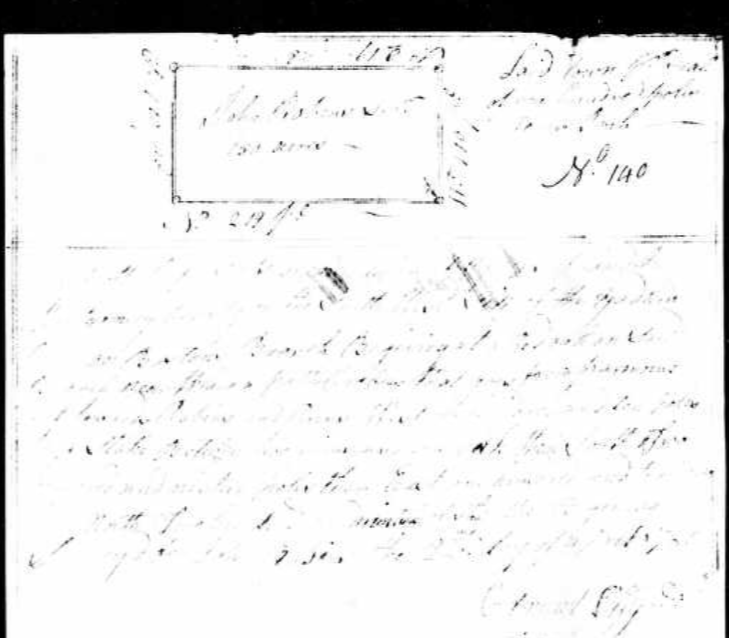
On March 2, 1780, John Robins recieved a 150 acre Grant, Warrant 140, issued by Benjamin Baird, on the SW side of the Yadkin River and on Boston's Branch. The border began at a Red Oak along the branch near where a path crosses "from Parmours towards Robins'. It was surveyed 5 years later, 1785, by Edmund Lilly. William Ramsey, whom I just mentioned, and John Robbins, Jr. were chain carriers. John Jr. would have been in his teens at this point. The grant, pictured below, is difficult to read, #342, issued August 9, 1786.
In all honesty, there were not that many grants given for Boston's Branch. It must have been a small stream. The other one dated 1780 was that of William Baird, for 200 acres, Warrant 292 issued on June 26, by BenjaminBaird to William Baird on Boston's Branch on the Waters of Long Creek and includes AndrewBankston's or John Kelly's improvement. It was surveyed in 1785 by Mark Allen, on the SW side of the Yadkin River between Deep Creek and Long Creek and began at a pine on Parmer's line. Zachariah Hogon and Mark Allen were chain carriers. Grant 422 issued Nov. 26, 1789
There's that name, 'Parmer" or 'Parmour' again, as well as Baird. Another intestesting thing is the part where it includes the improvements of Andrew Bankston or John Kelly. John Robbins Sr. must have gotten anscious after his young son, John Jr. was drafted into service during the Revolutionary War, and hired a substitute named William Bankston to take his place. My bets would be that William Bankston was related somehow to the above mentioned Andrew Bankston. This was a family that did not remain in the area. A quick search of just Land Grants shows grants being in 1779, the year Montgomery was cut from Anson, and the names of Jacob, Lawrence, Daniel and Andrew Bankston, with Andrew recieving a whopping 5 grants, all located in what would become Stanly County. Switch the search to Anson and I found 5 more for Andrew, beginning in 1775, all on the West Side of the Yadkin, the first on the east side of the Long Branch of theYadkin River, two on the Middle Fork of Mountain Creek and two on Deep Creek, which is in modern Anson.
Another interesting deed, not on Boston Branch, but included here because of the date, was a 150 acre grant received of Henry 'Munger' (Mounger) in 1782 on the Northeast side of Bear Creek, and includes a springhead at the head of Little Creek, beginning at a pine, whereinThomas Reynolds and John Robins were chain carriers. This must have been John Jr. as John Sr. was declared an invalid in the 1782 tax records.
Inspecting a terrain map, Little Creek seems to be born off the runoff from a ridge to the east of Tyson Road and begins near Western Road, fed by hills along the side of it. Henry Mounger, like Benjamin Baird, was an early land prospector. He was continually cutting grants from his larger tracts.
Next up, on Christmas Eve, 1785 was Hezekiah Dollarhide,shown above,recieving a 100 acre grant from John Crump on Boston's Branch of Long Creek and included 'young John Robbins improvement'. Grant 403 was issued on August 7, 1787 and John Pamer and Edmund Lilly, Jr. were chain carriers. It appears John Jr. was clearing and cultivating this land before Hezekiah Dollarhide recieved the grant.
Two years later, in 1787, Hezekiah Dollarhide recieved a second grant, to property on Little River in Randolph County, NC, as an assignee of John Knight. There were two Hezekiah Dollarhides, one born in 1745 and the other in 1783. This would have had to be Hezekiah Sr. The family left Randolph County before 1820 and settled in Wayne County, Indiana. He died there after 1830.
Hezekiah Dollarhide
Home in 1820 (City, County, State)
Wayne, Indiana
Enumeration Date
August 7, 1820
Free White Persons - Males - 45 and over
1
Free White Persons - Females - 16 thru 25
1
Free White Persons - Females - 45 and over
1
Number of Persons - Engaged in Agriculture
1
Free White Persons - Over 25
2
Total Free White Persons
3
Total All Persons - White, Slaves, Colored, Other
3
When John Robbins Jr. stated in his pension application that he had lived in Indiana for awhile after his service, I wondered if that had had anything to do with Hezekiah Dollarhide, or if he had travelled with him.
Then came the Smiths. On October 3, 1800, warrant 5391 was issued by John Neal to "Sherrid" Smith for 150 acres that began at Sherrod Smiths (also seen as Sherwood) own corner tree on Boston's Branch of Long Creek, surveyed on May 4, 1801 by Thomas Cotton. It was on the southwest side of the Yadkin River, on Bostons' Branch of Long Creek, and joined the property of Asa Smith, 'near' Castle. Sherrod and Asa Smith were the chain carriers. It then stated that on November 24, 1801 Sherrod Smith paid purchase money for 150 acres in entry #5391, signed by the comptroller, grant 1785.
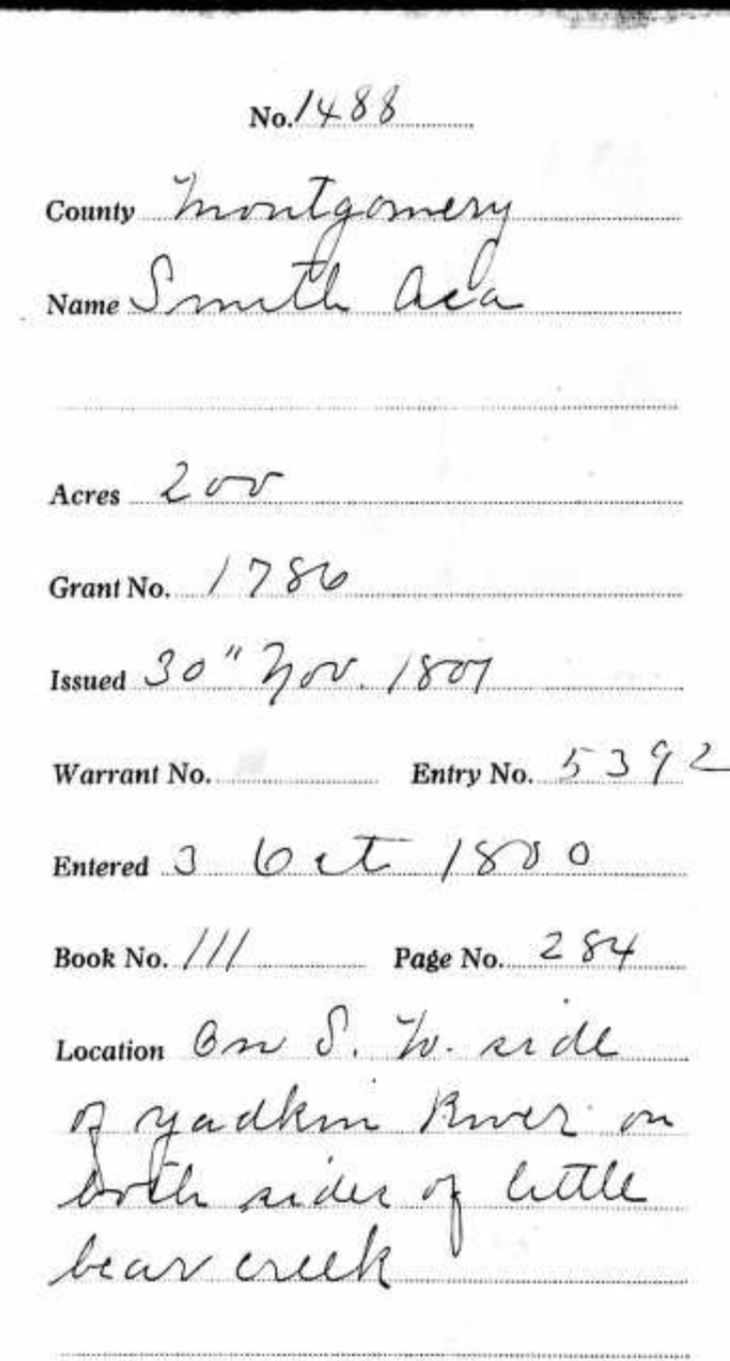
The very next grant, No 5392, was to the aforementioned Asa Smith. While his property was not on Boston Branch, I've included it because he had property that bordered that of Sherrod Smith that was on Boston's Branch.
Asa Smith recieved a grant for 200 acres on each side of "Bear" Creek, that was SW of the Yadkin River and on both sides of Little Bear Creek bordering a post oak in his own 100 acre tract. Richard Green and Sherrod Smith were chain carriers.
I kept looking for a spot where a branch off off Long Creek might lend itself to allowing joinng properties close enough to touch a 150 acres property that straddled Little Bear Creek.
Asa Smith owned several properties. The below deed has an interesting northern border that looks very difficult to plat. This was the one that straddled Little Bear Creek.
But we're not done with the Smiths, oh no!
In 1814, Phillip Smith received a warrant of 100 acres, issued on June 8 by Will Stone, on the waters of Long Creek, on Boston's Branch, joining the lands of Sherrod Smith and Andrew Bankston, Surveyed in 1814 by David Cochran on the waters of Long Creek, the border beginning at a pine in 'Sharwood' Smith's line, joined Phillips own line and that of Lloyd Rowland. Sherwood and Phillip Smith were chain carriers.
Boston's branch was becoming a regular little Smithville.
And above is Phillip Smiths plat of land, a simple rectangle with an anchor. I am not able to tell which side of it was on Boston's Branch, and where it met the property of Sherwood Smith or Andrew Bankston. My best guess would be that 'toe' was sticking in the creek.
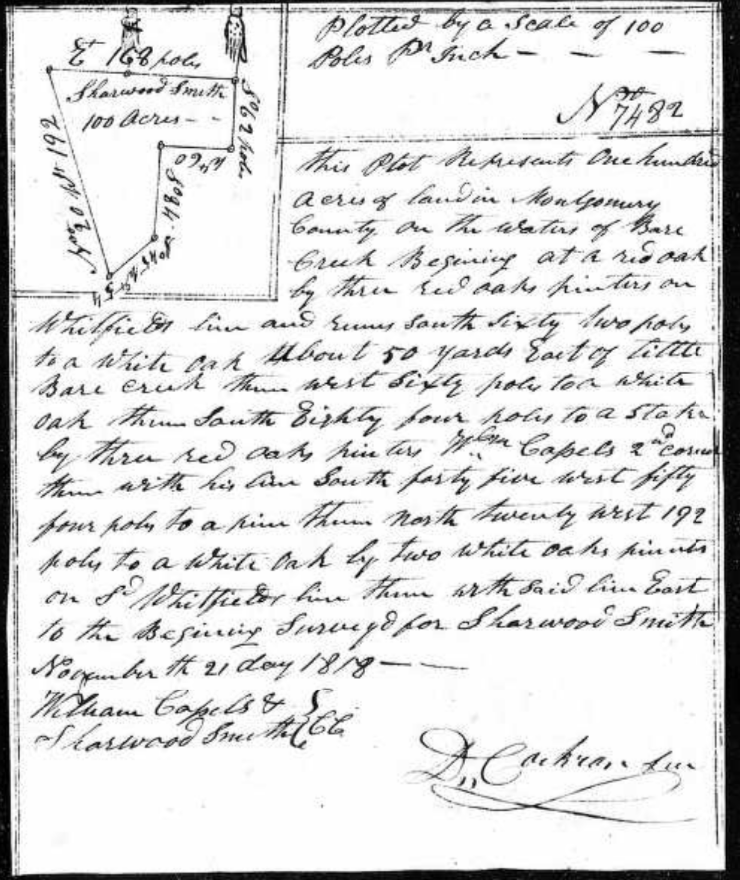
Then below, we have Sherwood Smith's land on Bear Creek, meeting Whitfields line and was 50 yards east of Little Bear Creek It also met the property of William Capel and William Capel and 'Sherwood' Smith were the chain carriers
I keep coming back to this area of the county, and these creeks and roads, flipping them one way or another, and looking at the current county GIS maps to see if any shapes look familiar. As of yet, this puzzle remains scattered on the table in so many pieces.
Asa Smith owned another tract which bordered the property of Brittain Chappel. I begin to notice that some of these mulitiple tracts to the same individuals were not that close together. This wasn't a small farmer adding to his already owned property widen his purvey, this seemed more like an investor, grabbing up property, perhaps as people moved on, and maybe capitalizing by renting it out, but they certainily were not driving that oxteam up a dirt road for 10 miles every day to plow their second field.
Asa Smiths grant that neighbored Brittain Chappel named Elijah and David Smith as chain carriers. This was certainly a family venture.
The Smiths seemed to have a bit of an enclave on, or near, Bostons Branch, so it is time to take a close look at who they were.
Asa Smith was counted in the 1790, 1800 and 1810 census records of Montgomery County, North Carolina.
He recieved several land grants in Montgomery County. The first, Grant Number 1786, in 1801, was located on the Southwest side of the Yadkin River, on both sides of Little Bear Creek. This grant of 200 acres included Sherrod Smith and Richard Green as chain carriers.
His second grant, shown above. 7629, dated 1817, joined the property of Brittain Chappel, joined his own property on Long Creek.
His third grant, Number 2529, Dated December 5, 1818, was on the waters of Long Creek. Elijah and David Smith were chain carriers.
Asa may have removed to Tennesee. I can not be certain. I am also not certain of his relationship with Sherrod, or Sherwood Smith, but the chances are pretty good that they were related in some way, the most likely being brothers, as they were not parent/child. This is just a possibility.
Sherwood or Sherrod Smith, is a little better known. He was born in Viriginia and was also in Montgomery County, North Carolina by the 1790 census, but did not stay here. He married his wife, Faith "Faithy" Holmes in Mecklenburg County, Virginia on December 21, 1786. By 1830, he was in Carroll County, Tennesee and he is in Willamson County, Tennesee in 1840 and 1850. He was also on the 1816 petition concerning the county courthouse location, along with his sons, Phillip and Sherwood Jr.
Will of Sherwood Smith
Sherwood Smith died in Williamson County, Tennessee in 1851 and left a will., menitioning two of his sons living in Illinois. One of them was Phillip.
Name
Philip Smith
Gender
Male
Birth Date
1780
Birth Place
Montgomery County, North Carolina, United States of Jo
Death Date
14 Sep 1860
Death Place
Blueville, Christian County, Illinois, United States of America
Cemetery
Taylor Cemetery
Burial or Cremation Place
Riverton, Sangamon County, Illinois, United States of America
Phillip Smith was the oldest son of Sherrod Smith. He was born in Montgomery County, North Carolina in 1780 and married Nancy Cooper, daughter of John and Elizabeth Carter Cooper. He first shows up in the 1810 census of Montgomery County, on the West Side of the Pee Dee River and recieves his grant on Boston's Branch of Long Creek in 1814. By 1820, he was in Sangamo, Madison County, Illinois, where he chose to raise his family. He died there in 1860.
In 1810, however, the Smiths were in Montgomery County, North Carolina. The above list is the census page that Sherwood, Asa and Phillip Smith all appear on. The complete list is a little difficult to read in spots and since I am familiar with most of these names, I will retype it here:
James Casles (Cassels/ Castles)
Sherwood Smith (also seen as Sherrod)
David Rowland
Asa Smith
Richard Greene (Chain Carrier mentioned in Asa's grant)
Daniel McLester
Andrew Bankston (also mentioned in several of the above deeds. Land bordered Smith land on Boston's branch)
John Palmer (see * note below. Very important)
Robert Stokes
Ambrose Stokes
Allen Stokes
James Coleman
Phillip Smith (son of Sherwood, on Bostons' Branch)
Henry Carter
Samuel Mann
Henry Mann
Solomon Holt
Malachi Mann
Richard Stokes, or Stoker
I thought WOW!, I know these people! No, I don't literally know them. I'm not that old. I am familiar with these names having came across them in prior research adventures. How's that?
*Note: Now I know who "John Parmer" or "Parmour" was, the dude with the path. Palmer, not Parmer. Not only do I know him, somewhere in my dna are pieces that John Palmer shared. He's my 5th Great Grandfather. John Palmer (1746- 1817) was born in Maryland and the son of Thomas Palmer and Susanna Hunt. The Palmers were a very, very old New England family. He married Janice Tamer and settled along the upper part of Long Creek in what is now Stanly County, and was then, Montgomery. Henry Davis, son of Job Davis, whom this blog is named for, married Martha Palmer, a granddaughter of John Palmer, as his second wife, and became my third Great Grandparents. This was at the inception of the new county of Stanly and Henry had moved from the Rocky River and purchased land on Cloverfork Creek, to be closer to his business in helping found the infant town of Albemarle.
James and Martha Atkins Palmer
I don't know exactly where John Palmer lived, but I do know exactly where his son James Palmer and wife, Patsy Atkins Palmer lived, and where Martha Palmer Davis had grown up. I also know the general location of where the Holts and Manns, listed at the bottom of the page, lived.
Now, census takers used a methodology of taking count that I am not familiar with, but I do know they didn't count one family, and then ride 15 miles in another direction to count the next. The people listed were centrically located near enough to each other. Given, the population was sparse and neighbors could be far more than " hollering distance" away. Still, the neighborhood is suggesting a location more along the northern part of Long Creek, an entirely different location than I was looking at.
Could Boston Branch have been, literally, in my own backyard?
Plats assembled by George Thomas
I have a distant cousin on the Burris side who has an inate talent for assembling these little snippets of plats, and had already some of the Smiths. Now we have a visual of where Phillip Smith's little point of land belonged.
Now I have new names to cut out and stare at like so many pieces of a jigsaw, and try to place them on a map.
And we are back to John Robbins barely visible grant on Boston's Branch. While in Anson County, I can find mention of properties adjoining that of John Robbins into the 1830's, long after I expect John Robbins Sr. was deceased, the latest mention of John Robbins, which I expect was John the Younger, in Montgomery County, was in 1814.
I will attempt to track his course from Montgomery County, North Carolina into Tennesee and Indiana and finally, to Spadra, Johnson County, Arkansas.
Which Branch was Boston's Branch and where did it go? Did it dry up and just disappear from record, or did it just gain a new name? Why was it called "Boston" in the first place? Did one of the early settlers upon it come from Boston? I keep looking at Gilberts Creek, shown on the left side of the map. In other deeds and records, the Robbins were very involved with a family of Gilberts, both in Montgomery County and in Anson. John Gilbert, Jesse Gilbert, Samson Gilbert, for the most part. I've found in other families that I've delved into that when two families seem particularly intwined and involved in one anothers business, that they are in fact, one family, intermarried and connected, usually, generationally, sometimes in several ways.
William Ramsey is another man I want to look into. Maybe, just maybe, there was a connection to Stark or to John Ramsey the elder, (as Starkey had a son named John). Another little tidbit, is that signature of John the Younger, (and of even a younger John Robbins who appears to be John III) as Jno (squiggly) Robbins Jr. The squiggly is not a J, as it looks nothing like a J. I believe it might be an I.
The location of Boston' branch has not been acertained. I'm tossing this missive into the metasphere to see if anyone out there has any more information about it. Was it renamed, or did it dry up due to changes in the environment? Was it on the northern end or southern end of Long Creek? Only just a handfull of men had grants located on it, so it must have been a small, short branch. The only thing I am sure of, Boston Branch was nowhere near Cucumber Creek.
When the jigsaw is assembled, I will be back. I will be looking at those men in the 1810 census located nearest to the known occupants along Boston Branch. Until then, I'm going to Clarksville.