
 |
| American Battlefield Trust |
There existed, in the (fuzzy) years of the late 18th and early 19th centuries, a man named Needham Lambert. The name Needham, in itself, was not a cognomen of fate in Johnston County, North Carolina. While very prominent within the families of the Bryants and Whitleys, reading early records from Franklin, Johnston and Butte, one can easily witness a variety of men with the given name of Needham and a range of surnames.
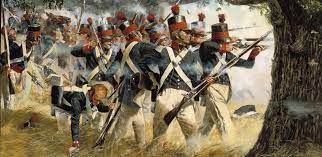
Needham Lambert didn't leave a wealth of information about himself, but he served in the War of 1812.
| Name | Needham Lambert |
|---|---|
| State | North Carolina |
| County | Johnston County Regiment |
| Township | Eighth Company |
| Year | 1812 |
Now, while the troops in the War of 1812 ranged in age from 15 to 70, most of the men were indeed young men in their early 20's. There's no record of what year Needham was born . He never appeared in a census record, there's no real gage to even narrow that number down with. However, it seems he died a young man, due to a number of other factors.

Needham Lambert served as Pvt in the War of 1812. James Lewis listed his taxes for 1 poll. Above, he is number 17, next to Jacob Avera. He seems to have had a close relationship with the Avera, or Avery family, and also with members of the Sanders family, but the relationship I am most interested in is that with John Lambert, also a resident of Johnston County, NC, and my 5th Great Grandfather.
John appears in the 1800 and 1810 census as a young man with a growing family in Johnston County, North Carolina.. In 1800, the two names prior to his are Ethelred and Edwin Smith. The three names after his are John Jones and Matthew Jones and Matthew Jones, Sr. He is also listed near Drury Honeycutt. A Drury Honeycutt would migrate to Stanly County and live in the area where the Lambert family would take root. Same one? I'm not certain, but it's possible.
In 1810, he's sandwiched in between Willis Hayes, William Carrell and Needham Bryan. Also nearby are William and Brittain Honeycutt. John will end up with a grandson named Needham Bryant Lambert, via his son, William. That is one reason why the name Needham Lambert is so interesting, although the Bryant family, and Needham Bryant in particular, were prestigious in the early days of Johnston County.
Only John Lambert appeared in the 1800 and 1810 census of Johnston County, North Carolina. Needham did not. In court records, John was frequently shown as an insolvent, meaning he was unable to pay his debts. As a minister of the Gospel, he relied on the Lord to provide and lived frugally and sparingly.
In the Tax records for Johnston County, John shows up with 1 poll, himself, and in Etherled Smith's district, in 1802 - 1808. He's next to William Honeycutt in 1802 and Dr. William Jones in 1805. I mention this because in 1809, John Lambert suddenly shows up with 110 acres of land. This was new. He was at this time in William Jones's District, near William and Brittain Honeycutt and John and Asa Austin. Two years later, the property of John Lambert has been reduced to half.
Needham Lambert, on the other hand, first shows up in 1806, also in Ethelred Smith's District, with 110 acres and no poll. In 1812, he is listed as just 1 poll, but the unusual note is that it records "James Lewis for Needham Lambert".
Needham Lambert doesn't show up in the Tax Listings after 1812, and neither does John Lambert. The next Lambert to grace the Tax records of Johnston County is William in 1820, as 1 poll. William was the oldest known son of John Lambert, and stayed behind when the rest of the family loaded up to relocated to settle in the Mission area of what is now Stanly County near its border with Cabarrus County, NC
William was born about 1797. He shows in the taxables first in 1820, at the age of 23. He shows up in his first census in 1830, at age 33, when the rest of his family has migrated westward to the Piedmont and he has assumed the small farm in Johnston County.
Needham, year of birth unknown, shows up first in the 1806 List of Taxables, Aaron Smith's District. It actually appears as:
"Thomas Page 300 acres 1 poll same for John Page 400 acres No poll
Henry Chapman 0 acres 1 poll
Needham Lambert 110 acres No poll."
I'm not certain of what significance this is, especially the "Same for", as neither John Page, Henry Chapman or Needham Lambert were in the exact same position as Thomas Page. Page is another family name that the Lamberts intermarried with after their arrival to the Stanly/Cabarrus area, so this is something to look into. Also, the fact that Needham has no poll in 1806 leads me to believe he is less than age 21 that years, despite being a land owner.
Both of the next two tax listings for Needham, 1811 and 1812, in Captain H. Bryan's District are reported as
"James Lewis for Needham Lambert" and Needham is taxed at one poll, meaning he is now over 21. No land is noted and he doesnt' appear to be present. Who is James Lewis and why is he reporting for Needham? I might have an answer for the latter part of that query. The War of 1812, which Needham served in. He was off to War. Did he even return?
North Carolina - The War of 1812
Detached from the Johnston Regiment of NC Militia
Lambert, Needham
Avera, Jacob
Bridges, Braswell
| Farmer, Kedar |
The next time the name of Needham Lambert appears in the records of Johnston County, NC, involve his estate records. Needham was now deceased. There seemed to be quite the disagreement over whom would be responisible for the settlement of his estate.
In a book title. "ABSTRACTS OF JOHNSTON COUNTY RECORD OF ESTATES, RECORD OF ESTATES VOL. VII NC ARCHIVES 17.56.501.7 we first find "Inv. of Est. of Needham Lambert, December 17 1812. Will Sasser Admr. "
1812 was the last year Needham Lambert was taxed (as reported by James Lewis), and recall, he was also a soldier in the War of 1812.
"State of North Carolina
Johnston County
At a County Court of Pleas and Quarter Sessions begun and held for the County afore said, at the Court House in Smithfield, on the Twenty third day of November, being the fourth Monday in the Month, in Thirty Seventh Year of American Independence, And in the Year of our Lord One Thousand Eight Hundred and Twelve....Administration on the Estate of Needham Lambert Decd. is granted to William Sasser who came into court and entered into bond in the Sum of Two hundred pounds with Samuel G. Smith and John Sanders Jr. his Securities and Qualified agreeably to Law. Ordered that letters issue, and that said Admr. have Leave to sell agreeably to Loaw, the perishable Estate of the Deced.
"Returned by William Sasser Administrator of the Estate of Needham Lambert Decd. an Inventory of the Estate of said Decd. which was ordered to be recorded.
Returned by William Sasser """"""" Needham Lambert Decd. and account of sales of the Estate of said deceased amounting to the Sum of ~L 84.19 &1/2. which was ordered to be recorded. "
22 May, 1815 "Ordered that John Sanders Jr. Ellick Sanders and Thomas Rice be appointed a Committee to settle and adjust the accounts of the Estate of Needham Lambert, decd. with the Admr. thereof and Report to Court next. "
There was no real reason to believe there may have been any relationship between any of these men and Needham Lambert, as if one was to continue reading through this session of court of beyond, their names popped up quite frequently, as in being appointed to other committees, and in the same paragraph, "Ellick Sanders to Robert H. Helme, which was duly proven by the Oath of William Sasser." It appears they were among the prominent citizens of the area. In 1810, when John Lambert is listed in Alfred Whitley's list of insolvents, meaning he could not keep up with his debts, including perhaps, his poll tax, he is listed with one poll. The very next sentence is one where the afore mentioned Ellick Sanders and William Sasser were appointed on another Committee to settle and adjust the accounts of one. Phereby Davis. It just appears to be something they did on a regular basis.
 |
| Old Smithfield Courthouse, Johnston County, NC |
'Administration Pendentilite is granted to James Durham on the Estate of Needham Lambert, decd. who came into Court and entered into Bond in the Sum of $100 with John Williams and Bryan Smith is Securities & Qfd.
Ordered that Robert H. Helms, John Farmer, and David Turner be appointed a comittee to settle and adjust the accounts of the Estate of Needham Lambert, decd. Between John Sanders adm. of the Estate of William Sasser decd. who was Admr. of said Lambert and James Durham present administrator and report to next Court.
Pendente lite, which I believe the above statement meant, was appointed in a Probate Court to manage an estate and probate a Will during the pendency of a dispute or until someone permanent could be appointed. It appears that William Sasser, the Administrator of Needham's estate, had himself passed away, so things were left in the air for awhile. A few years in actuality.
Wednesday morning, August 26, 1818, "Ordered that Robert H. Helme, David Turner and John Farmer be appointed a Committee to settle and adjust the accounts of the Estate of Needham Lambert, decd. Between John Sanders, Jr. Admr. of William Sasser, decd. who was admr. of said Lambert decd. and James Durham the present administrator and report to next court.
There were other statements within the Courts of 1812 to 1818, repeating the sames names, although perhaps in a different order, but repetitive and giving no additional information, so I will forego the redundancy of those.
One of the most telling and interesting reports within these Court records for me, was the Sales of the Estate of Needham Lambert, with William Sasser, Admr., dated December 17, 1812. There is no doubt that Needham Lambert passed away in 1812.
Buyers in other Estate Sales I've read or been privy to, wherein I was much more familiar with the names and how they related to the deceased, were shown to be primarily family members, friends and neighbors, people who were actually connected to the deceased in some way, who had known them. Below is the list of Buyers from the Estate of Needham Lambert.
James Lewis Thomas Jones Daniel Dees Kedar Farmer 'Nicy' Lambert John 'Sambert'
John Avera Jacob Avera David Avera Jonathan Britt Reddin Britt Hardy Bryan
Braswell Bridgers John Farmer William Rivers John Allen William Sasser Henry Barnes
Green Parker Samuel Wilder Samuel Frost.
Some of the names, like Farmer and William Sasser, are those included in the Estate Settlement itself as bondsmen or Administrators. The Avera or Avery family, is mentioned in beaucoups of records, and were also among the neighbors of my Lambert family in the census records. or taxed in the same District as either John or Needham Lambert. James Lewis listed a poll tax 'for Needham Lambert' in 1812. I wondered about the relationship between James Lewis and Needham. Time for a closer look.
Wondering about the transcription of the records in the book, I ordered the actual documents from the State Archives, and waited.
I have received the first of 4 documents, (if they are to be found) that I am waiting on from the NC Archives. The only thing new that I discovered from them was that "Sambert" was indeed incorrectly transcribed, and should have been "Lambert".

| Name | Nancy Lambert |
|---|---|
| Enumeration Date | 7 Aug 1820 |
| Home in 1820 (City, County, State) | Johnston, North Carolina, USA |
| Free White Persons - Females - Under 10 | 1 |
| Free White Persons - Females - 26 thru 44 | 1 |
| Free White Persons - Females - 45 and over | 1 |
| Free White Persons - Under 16 | 1 |
| Free White Persons - Over 25 | 2 |
| Total Free White Persons | 3 |
| Total All Persons - White, Slaves, Colored, Other | 3 |
Needham was married to a lady named Nicey or Nancy. I believe, after recieving his estate papers from NC Archives, that her name was Nancy and Nicey was a transcription error found in a book of records for Johnston County. A Nancy Lambert appears in the 1820 census for Johnston County. Nancy heads a household of 3 females. There is one lady over 45, another between 26 and 44 and a little girl under 10. Was this Needham Lambert's widow, her mother, and possibly a daughter? There's no way to know at this point.
I found no more of Needham, Nancy (or Nicey) Lambert. They lived and breathed, that I know. They lived and breathed at the same time and the same place, bearing the same surname as my ancestor, Rev. John Lambert. That is why I am curious as to who they were. Was there a connection?
By 1830, John Lambert Jr. and Frederick "Fred" Lambert, were settled and enumerated in the Western part of Montgomery County, the part which would in a little over a decade be renamed "Stanly". Older brother, William, who had remained back east, had married his first wife, Louisa Young, in Wake County in 1819, was living near his in-laws. Rebecca, the oldest daughter, was married to Pleasant Almond and living next door to her brother, John Jr. Rev. John, the itenerant minister, was not enumerated until he was an septugenarian in 1850, yet the ancient records of Baptist Churches like Meadow Creek and Bear Creek inform us that he was there in the early years of the 1820's and acting as an 'Elder', or minister, and attending Primitive Baptist Conferences.
My next step, while waiting on more records, is to look into the persons named in the scant records of Needham's existence. A few of those who made purchases of his estate served with him in the militia, Kedar Farmer, Braswell Bridges, Jacob Avera. James Lewis, who reported his taxes for him in his absence, is shown in the 1810 census and also served in the War of 1812, according to a pension requested by his wife, Sarah.
| Name | James Lewis |
|---|---|
| Residence Date | 6 Aug 1810 |
| Residence Place | Johnston, North Carolina, USA |
| Free White Persons - Males - Under 10 | 1 |
| Free White Persons - Males - 16 thru 25 | 1 |
| Free White Persons - Males - 45 and over | 1 |
| Free White Persons - Females - Under 10 | 1 |
| Free White Persons - Females - 26 thru 44 | 1 |
| Number of Household Members Under 16 | 2 |
| Number of Household Members Over 25 | 2 |
| Number of Household Members | 5 |
| Name | James Lewis |
|---|---|
| Gender | Male |
| Spouse | Sarah Crawford |
| Spouse Gender | Female |
| Bond date | 15 Dec 1804 |
| Bond # | 000068792 |
| Level Info | North Carolina Marriage Bonds, 1741-1868 |
| ImageNum | 001842 |
| County | Johnston |
| Record # | 01 134 |
| Bondsman | William Giles |
| Witness | R Sanders |
| Soldier | James Lewis |
|---|---|
| Widow | Sarah Lewis |
| Military Service Location | North Carolina |
| Pension Number - #1 | Wid Orig 10335 |
| Roll number | 57 |
| Archive Publication Number | M313 |
I find no more on James. He must have died before 1820. Were they friends, neighbors, brother-in-laws?
More research into these associates, not the prominent men who served in the same capacity to settle the many estates of the young men who seem to perish around the same time as Needham Lambert, perhaps from the service in the militia during the War years, but those like James Lewis, who seem to have known him well.
I leave with these ideas concerning Needham Lambert;
I believe he died a young man, less than 21 in 1806, but 21 by 1811. I believe he may have died in the War of 1812. I know he died in 1812. He was married to a girl named Nicey or Nancy. He may or may not have had a daughter. He never appeared in a census, and should have been in one in 1810, at least, in Johnston County, so he was living in someone else's household. He was somehow, in some way, connected to my ancestor, Rev. John Lambert and lived in the same county during the same period.
Rest in Peace Needham Lambert. Thank you for your service and sacrifice.


