Showing posts with label Wingfield. Show all posts

Sunday, July 19, 2026

30 Fathers in 30 Days: Jarvis Wingfield

When Peter Winfield of Mecklenburg County, Virginia, arrived to the Rocky River area of Anson County in 1782, along with a caravan of friends and relatives, he brought with him the genetics of his grandfather, Jarvis Wingfield. In the same manner, Jarvis Wingfield carried the genes of his maternal grandfather, Jarvis Dix, whom he was named after. Peter was my fifth Great Grandfather, his father, Edward, my sixth, making Jarvis Wingfield my seventh Great Grandfather, and his Grandfather, Jarvis Dix, my 9th. The first name of Jarvis's mother was unknown, we only know her as the daughter of Jarvis Hix, who married William Wingfield. 

The Wingfield/Winkfield/Winfield family is one of my most researched families, as I found them absolutely fascinating. There was also material to research, so I didn't become frustrated beating my head against a brick wall, thanks to the Wingfield Society, a group formed to preserve and search for all things Wingfield. I've even attended one yearly meeting, when it was held within a reasonable driving distance. I therefore have folders upon folders, and notebooks, filled with Wingfield/Winfield information. I have two fat folders on Jarvis alone. I promise to keep this brief, or as brief as I can make it. God be with my children after I die who have to sort through this stuff and don't let them toss it aside. I hope I have one who becomes interested in their genealogy when they get older. 

The first ancestor in this line to touch ground was William, but we must first travel back to Suffolk, England.

The Wingfield Family stems from a Saxon family that are found in Suffolk, England, prior to the Norman Conquest of 1066. They were from the start an Upper Middle Class family. Several were knights and there were two known to be Knights of the Garter.


Wingfield Castle still stands in the Parrish of Wingfield in Sussex, England. It's story began in 1384 when a man named Michael de la Pole "obtained the Kings’s leave to crenelate his masum mannem Wyngefeld ” and enclose all the land belonging to the estate".


 Michael had fallen in love with a lady named Katherine de Wingfield, the daughter and heiress of Sir John de Wingfield, a favorite courtier of Edward of Woodstock, son of King Edward III, known through history as "The Black Prince". Contrary to modern film depiction, he was not black. His nickname derived from two factors, his fierceness and lack of mercy in battle during the Hundred Years War, and the darkness of his armor. Yet, the castle was founded on a love story. 

There is little known about William, himself, other than he was born about 1636-1640 in England, migrated to Virginia. He married the daughter of Jarvis Hix. Her given name is unknown. Some sites or researchers use the generic name of Mary. Given she lived in a time and place where 90 percent of all girls were named either Mary, Elizabeth, Ann, Jane or Sarah, there's a good chance she was a Mary. About a 50/50 chance. Those are pretty good odds. If you've ever read ships records, like I have, you'll notice that Mary was as common a given name in England as M******d is now. Forgive me a bit of cheekiness.


William died a young man, before November 6, 1667, in Charles City, Virginia. While the Wingfield family had a hand in the founding of  Jamestown, William Wingfield, the Patriarch of my branch, didn't arrive until settlement had safely and successfully been established as growth had spread up the James River. A map drawn by Augustine Herrman showed Charles City overtaking both sides of the river. At present, it's only an incorporated burg with a few hundred people and a deep well, and wealth, of history. Unfortunately for us, Charles City County, is a burned County. He had a Will, as it was mentioned in court records. Dr. John Coggan and John Howell ordered it to be proved on November 7th. That is how we know he died sometime shorty before that date. After William died, his young widow remarried to a man named William Dobson. Dobson, with the consent of his wife, gave guardianship of her two sons with William Wingfield, Robert and Jarvis, to her father, Jarvis Dix. "for as long as the law provides." This arrangement, which leads me to loose a little respect for Generic Mary, was registered in court in February, 1678. I realize things were very different back then. Women had few rights and fewer choices. Children who lost their fathers were considered orphans. Although, it was not the same thing as a woman 'ditching the kids for a dude', today, the fact that William Dobson did not want to take custody of the children, as happened with most stepfamilies, is telling and sad. Thank God for (their) Grandpa Jarvis.

Jarvis was the younger of the two boys, although he was his grandfather's namesake. Older brother Robert would later be associated with properties that had originally been the land of Jarvis Dix. The elder Jarvis had been born around 1616, and had arrived in the colony by about 1636.

Although the Will of William Winfield did not survive, the few recorded terms of Court did. Found in Alexandria, Virginia was the Charles City order book for 1676-1679, and found inside were a few valuable references. 

"Ordered that Dr. John Coggan and John Howell appear at next court to prove the Will of William Winkfield (another variation of the name), dec'd and that William Dobson be summoned to give security for the estate of the orphans" 7 November 1677. County of Charles City 1676-1679 page 229.

Dr. John Coggin was a large landowner in Charles City County and one of the only Physicians in Virginia during those early years. John Howell had first patented land in Henrico County and in 1637 he patented 212 acres on the south side of the Appomattox River in Bristol Parrish. His property adjoined that of Captain Epps, Cason, and Nathaniel Tatum. Jarvis Winfields land would also border Captain Francis Epps and Nathaniel Tatum. There were much intermarriage and other connections between the families. 

Then later, "William Dobson with consent of his wife, gives his two stepsons, Jarvis and Robert Winkfield to their grandfather, Jarvis Dix, for as long as the law provides and at the expiration of their time, to give them whatever the court considers convenient." November 16, 1677.

"The above deed was exhibited in court and registered Feb 4 1678, William Archer, clerk" Page 262.

These prove the parentage of Jarvis Wingfield and his brother Robert, and the timeline shows that they were born in Viginia Colony, in America. 
 
Javis's stepfather, William Dobson, had been imported by Captain James Sturdivant/Studivant. There would become a generations long connection between the Wingfield's and their associated branches, and the Sturdivant's. There were several marriages between the Wynne, Wingfield and Sturdivant families. 
Charles City is situated between the James and Chickahominy Rivers and was one of the shires established from the outgrowth of Jamestown in 1634. Jarvis Dix has obtained a land patent in Charles City County, along the James River around 1682, adjoining Williams and Barkers. Land grants show that the Sturdivant family lived in the part of Charles City that would become Prince George County about 1702, on Bull Hill Creek, (it began as City Creek). This is the same area that Jarvis Dix, Robert and Jarvis Wingfield, and the Wynne Family lived.

Jarvis Dix had married Mary Tatum, daughter of Nathaniel Tatum and his wife, Anne Godfrey Tatum, my 10th Great Grandparents. 


Unlike his son-in-law, records of the existence of Jarvis Dix exist on two continents. He was baptized in London in 1616,  as "Jarvise Dick" with his father being named as Robert Dicke (Dix) and his mother, Tabitha Pickman (Pittman). 


NameJervis Dick
Arrival Year1637
Arrival PlaceVirginia
Primary ImmigrantDick, Jervis
His name appears on a list of those being transported, found at the Virginia State Library, and reported in a book called Cavaliers and Pioneers: A Calendar of Virginia Land Grants, by Nell M. Nugent

He was summoned to court with Nataniel 'Tatem", which proved his status as son-in-law. Land he leased from Edward Hill Sr was sold to Col. John Gilliam, his neighbor.


In 1679, Jarvis Hix was freed from paying levies due to reaching the age of 63. Jarvis and his wife had at least two daughters, Jerusha and Miss Dix Wingfield Dobson. There are no sons noted, which may be why he took in his grandsons.

In the book, "Historical Southern Families IV", Chapter "Winfield-Pettypool" of Sussex, Virginia, that in Prince George County in 1702 and 1704, that Robert Wingfield was holding 107 acres and Jarvis 100 acres.

In 1695, Jarvis married Hannah Wynne, supposedly the daughter of Col. Thomas Wynne and Agnes Stith. There was another Hannah Wynne who married a Malone, and they were not the same person, therefore, they are easily confused. 

 Deed, 3 November 1701,Wingfield, Jarvis, For real property in that part of Charles City County, Virginia, which later became Prince George County, Virginia, from Thomas Busby  to Jarvis Wingfield. 
A second deed to Jarvis Wingfield from Thomas Busby was recorded the same day. By 1723, Jarvis and family had removed to Surry County, Virginia. Surry was founded in 1652 by the Virginia Company from a portion of James City County that lay south of the James River.

Surry County, Virginia
Deed Book 7, p. 490, 17 Dec 1723   “Jarvis Winfield and wife, Hannah Winfield, to Stephen Housman.100 acres on south side of Joseph's Swamp and bounded by John Doby Sr., Nathaniel Tatum Sr., and Thomas Busby. Wit: Robert Wynne, Richard Huson, Thomas Wynne. Rec. 18 Dec 1723.” Among the neighbors were Thomas Busby, Nathaniel Tatum and Thomas Wynne. This would have had to have been a younger Nathaniel Tatum, perhaps an Uncle or a Cousin.


In the Albemarle Parrish Register it was reported by William Winfield (his oldest son),In Sussex County, Virginia, that "Gervas Winfield aged 87, died March 24, 1756".  Sussex County had been carved from the southwestern half of  Surry County, two years earlier, in 1754,  the part south of the Blackwater River.


The most telling record we have of Jarvis Wingfield is his probate file.

In a Chancery Court Suit titled Wingfield Vs Wingfield dated 1757, the children of Jarvis Winfield battled it out for a fair division of property in Sussex County. The Lawsuit in its' entirety can be found at the link below.


From the lawsuit we get the following information on the heirs of Jarvis Wingfield and wife, Hannah. The younger Wingfield children were suing their oldest brother, William, and their mother, Hannah.
 
 “John Wingfield, John Barlow and Mary his wife, Thomas Dixon and Judith his wife, Richard Huson and Elizabeth his wife, Thomas Wynne and Martha his wife, Joel Wingfield, Joshua Wingfield, Martha Wingfield, and Peter Wingfield by Mary Wingfield their mother and protector, which said Joshua, Martha and Peter are infants under the age of twenty one years and children of Edward Wingfield deceased and which said Edward Wingfield was and the said John Wingfield, Mary Barlow, Judith Dixon, Elizabeth Huson and Martha Wynne are the children of Gervas Wingfield late of this county deceased. That the said Gervas Wingfield being in his life time and at the time of his decease possessed a considerable personal estate consisting of sundry valuable slaves and other things departed this life on or about the 24th day of March one thousand seven hundred and fifty six Intestate leaving Hannah Wingfield his widow and relict and William Wingfield his oldest son and heir at law."

In a later paragraph:

"In the year of our lord One thousand seven hundred & fifty six Administration of the estate of the said Jarvis Wingfield was committed to the said Wm. Wingfield who whereupon conceiving himself to have authority to do so, did of his own accord assign to the said Hannah Wingfield slaves as her third part-.that the said slaves are more than the said Hannah's full and equal third part of the slaves whereof the said Jervis died possessed, and that by the above recited Clause of the Act of Assembly the said William had no power to do so. "

There would be more suits to follow in 1757, in Dixon vs Wingfield, a disagreement over a slave was heard. Thomas Wynne and his wife, Martha Wingfield Wynne testified. It was a cousin marriage, not rare.

Family disputes over property, money and objects have divided families for generations. Hannah Wynne Wingfield would later even sue her grandson, Joshua Wingfield, son of Edward, for trespass. 

In this suit, we see that Edward Winfield had died young leaving minor children: Joel, Joshua, Martha, and Peter. Peter is my direct ancestor who would first settle in Mecklenburg County, Virginia, on Taylors Creek, and then later remove to North Carolina and settle along the Rocky River, primarily in Anson County, but as he lived on or near the River, there was property on both sides. Later records include another daughter for Edward, Hannah. It seems Edward predeceased the lawsuit by a brief period,  and Mary may have been expecting.

The children of Jarvis Wingfield and Hannah Wynne Wingfield were:

  • William Wingfield (1694-1770)  married Sarah Harris
  • Edward Wingfield (1695- 1755) married Mary Harris
  • Martha Wingfield (1696 - 1759) married Thomas Wynne
  • John Wingfield (1698-1771) married Anne Eustace Buckner
  • Mary Wingfield (1700-1756) married John Barlow
  • Elizabeth Wingfield (1700-1770) married Richard Huson
  • Judith Wingfield (1707-1772) married Thomas Dixon
 I was so chuffed to see that my 6th Great Grandmother, Mary Harris Wingfield, seems to have stuck up strongly for her children and kept guardianship of them, being called "their mother and protector".

Another fact that has always intrigued is the fact that it was recorded that Edward Wingfield had paid "667 pounds of tobacco for Elizabeth Davis". Who was she? His granddaughter, Sarah would marry into a Mecklenburg County, Virginia Davis family after moving to the Rocky River.


Children of Edward Wingfield and Mary Harris Wingfield were:

  • Joel Winfield (30 Dec 1731-1777)  Wife Unknown. At least two daughters, Martha and Mary.
  • Martha Winfield (1736) Married William Faison
  • Joshua Wingfield (1739-1818) Married 1st Jemima Freeman 2nd Rebecca Thrower Carloss.
  • Hannah 1744 - ? ) Married Matthew Godwin
  • Peter (1746-1802) Married Charlotte Freeman

And they removed to Anson County, North Carolina and settled along the Rocky River in the area that now covers


Wednesday, July 22, 2015

The Heirs of John W. Howell

John W. Howell was the youngest of the three sons of Richard Howell and Sarah Winfield Howell of the Rocky River area of the Anson/Stanly County border in North Carolina. He and his brother Jordan, after an obvious education, decided to relocate to the growing market town of Cross Creek, or Fayetteville, North Carolina in the southeastern part of the state, where they would become businessmen, in about the early 1820's.  In fact, they lived not far from a road that ran from Salisbury to Fayetteville, called the "Throughfare".

Image result for historic fayetteville nc
Historic Fayetteville

Both brothers married widows from up north, once they arrived in Cumberland County, the two widows may have even been related. Jordan married the mysterious Mrs. Hannah Handy, who had no obvious children, while John W. Howell married Clarissa W. Pearce, widow of merchant Nathan Pearce, who was the mother of 8 children and a very highly esteemed lady in her community.


Jordan and Hannah had three known children and perhaps another son. The known children were Jordan Lafayette Howell, Clarissa Howell who married Jeremiah Broadway of Anson County and Charlotte Howell who married Allen Newsome of Davidson County.

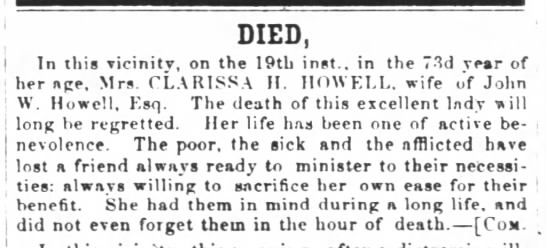
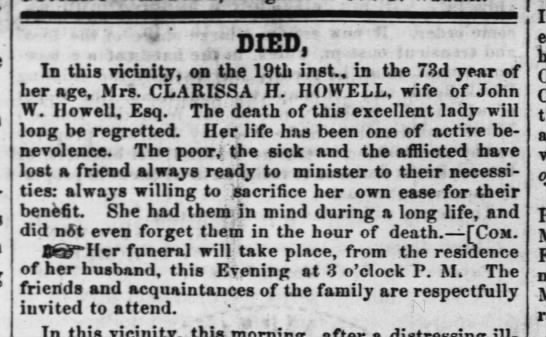
Clarissa Pearce Howell and John W. Howell passed away in the same year, perhaps from the same malady. Clarissa was first, in April.

Fayetteville Weekly Observer 
(Fayetteville, North Carolina)
25 Apr 1853, Mon • Page 1


And again;


Fayetteville Semi-Weekly Observer 
(Fayetteville, North Carolina)
21 Apr 1853, Thu • Page 3

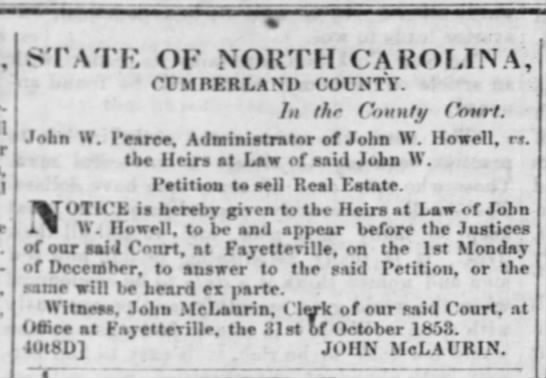
John W. Pearce, son of Clarissa and stepson of John W. Howell, was the minister of the estate of John W. The following ad ran for several months in the paper soliciting heirs of the estate. Who were they and where were they?


Fayetteville Semi-Weekly Observer 
(Fayetteville, North Carolina)
1 Dec 1853, Thu • Page 1

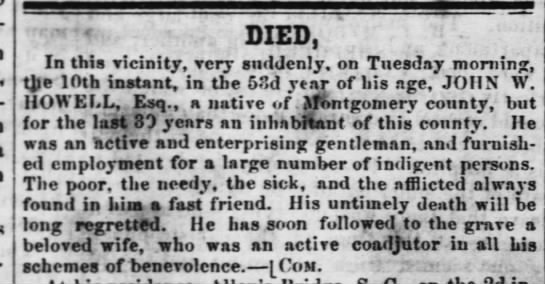
John's own obituary did not mention any heirs, only his benevolent wife.


Fayetteville Semi-Weekly Observer 
(Fayetteville, North Carolina)
12 May 1853, Thu • Page 3

After the passing of both John W. Howell and his wife, his stepsons call for heirs did produce heirs, but not children.

The heirs that came forward, via their lawyer, Warren Winslow was Levi Stancil, Charlotte Stancil and Peter Howell, brother-in-law, sister and brother of John W. Howell. As John W. Howell's wife, Clarrissa Winslow Pearce Howell's maiden name was Winslow, the attorney Warren, was very likely related to her somehow.

Image result for old document scroll"This indenture made the 29th of June, 1857, between Levi Stancill and Charlotte, his wife and Peter Howell of the first part, acting through their attorney, Warren Winslow and John W. Pearce of the second part,.....being the lawful successors or heirs of John W. Pearce, deceased. "

This one document was 9 pages long and involved personal property and nearly 30 tracts of land. I want to inspect the land records more in depth later. Three of them involve Peter. His little brother made him a wealthier man than he already was.

The point is that at the time of his death, John W Howell had no children as heirs.


Image result for historic florida
Early Florida manse


The persons whom John and Jordan did business with were impressive, with far reaching influence. These were not isolated country bumpkins running a store or business. Fayetteville was a busy and international center of trade.

A deed dated December  1828 between Richard S. Hackley and Jordan and John Howell states that for $1500, in hand, Richard S. Hackley "of New York", sells to them a tract of land in Florida, above the "Big Swamp" and bordering a tract with a black house belonging to the "Deerfield family of Indians", and also bordering the land of "Indian Tom". The deed was witnessed by Dillon Jordon, Jr., John A. Strode and John Black.

In fact, the brothers did quite a bit of business with Richard S. Hackley.

The next deed following this one was actually dated earlier, in November of 1827, between Jordan Howell and Hamilton Donaldson for a tract on Hay Street in Fayetteville joining John Jarrett or Jarrott.  This shows the relationship between the Howells and the Jarretts as one of neighbors.

The deed registered immediately preceding that one was another between Richard S. Hackley and Jordan Howell, alone this time, on March 15 1826, Mr. Hackley being "of the city of New York and the state of New York", lot 5 in the City of Fayetteville. Apparently Mr. Hackley had owned this town lot for some time. But who was he?

For one, he was one of the first investors in Florida and founder of the city of Tampa.


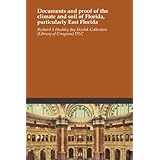
He was also the author of this book, published in 1835:

Documents and proof of the climate and soil of Florida, particularly East Florida

Dec 31, 1835
by Richard S Hackley Jay I. Kislak Collection (Library of Congress) DLC
And a very important businessman in the early decades of the 19th Century.

Product Details


He was a friend of James Madison. The following link is from Founders Online:

Founders Online: To James Madison from Richard S. Hackley

Richard S. Hackley, who died in 1843, married Harriett Randolph. Her brother, Thomas Mann Randolph, Jr., had married the daughter of Thomas Jefferson. Richard S. Hackley, among his other appointments and services, served as a U. S. consulate to Spain in 1806-1816.

The descendants of Jordan Howell's (brother of my GGGGreat Grandmother's first husband Richard) son, Jordan Lafayette Howell, claim kinship to Varina Howell Davis, last wife of Jefferson Davis, and therefore to Richard Howell of New Jersey, who served as Governor of that state. With the impressive business and associate connections of the Howell brothers in Fayetteville, I can no longer doubt creedence to that claim. Now to only find the lineage connections. This might even verify the old family rumor of kinship to Jefferson Davis himself, by Job Davis, Sarah Winfield Howells second husband.

It has been well-documented that her family tree leads to the Wingfields who co-owned the Jamestown Company, a trading firm that basically founded Jamestown, Virginia.


Edward Maria Wingfield.


There are  no tellings where this familial trail may lead.


Baltimore Maryland Journal


Sunday, July 29, 2012

Neddy

Edward Winfield Davis was born in Stanly County, North Carolina on December 3, 1811 and died on October 30, 1882. The Davis Plantation was located on the Rocky River, which forms the border with Anson County and during the time Uncle Neddy, as I will refer to him, was born, it was still considered Montgomery County. It did not become Stanly until 1841 and Neddy was one of the men to sign the petition to make "West PeeDee" its own county, due to the danger of crossing the Yadkin/PeeDee River, which forms the Eastern boundary of Stanly County and now separates it from Montgomery.

Neddy was the third son of Job Davis and seventh child of Sarah Winfield Howell Davis. The Davis family were Virginians, of Welsh decent and Methodist extraction. He had 3 older half-brothers, Peter Howell, John W. Howell, and Jordan Howell and one half-sister Charlotte Howell, children of his mother's first husband Richard Howell, and 3 full brothers Henry Davis (1806), James M. Davis (1808) and his only younter brother Marriott Freeman Davis (1815). Sarah had had a heavy hand in the naming of her children. She was the daughter of Peter and Charlotte Freeman Winfield. Neddy was the name sake of her paternal grandfather, Edward Wingfield. The Winfields dropped the 'g' after migrating to North Carolina.

E. W. Davis was the second sheriff of Stanly County. I remember somewhere having seen a portrait of him many years ago. I have yet to rediscover this portrait. I remember him being quite handsome and distinguished, tall and straight. His hair appearing brunette, but not dark in color. Being a black and white photo, I am judging it to be a sandy light brown. He wore a nearly handlebar moustache, but no other facial hair. He married late in life to Mary Rebecca Hathcock and fathered 5 children, one daughter Sarah Hortense Davis, his firstborn, and 4 sons, Thomas Ashe Davis, John Teeter Davis, Edward T Davis and Jaspar. Jaspar only lived one year and E. T. Davis died at age 15. Hortense, T. A. and Jay were the 3 children who outlived their father. Hortense died a young woman, but did marry and have one daughter Ouissa Stewart Hill. I have discovered that Ouissa is the lady in the article below identified as Mrs. Fred Hill.


In Job Davis's will, he refers to his son as Neddy, so this must be the name his family called him. As he was my great, great, great Uncle, I will always think of him as Uncle Neddy.


Mrs. Joe Holt is Carrie Davis Holt and Mrs Ed Thompson is Becky Davis Thompson, sisters of my Great-Grandfather, Will Davis.
E.W. Davis and Rebecca Hathcock marriage license. In 1868, Neddy was 57. Rebecca was only 18, having been born in 1850.

The following is an article published in the Stanly News and Press and in the Albemarle Bicentenial Book circa 1950.

SCGS  JOURNAL,  1,2  - 2 ­
EDWARD  JINFIELD  DAVIS,  SECOND  SHERIFF  OF  STANLY  COUNTY
-Mrs.  G.B.D.  Reynolds
The  second  sheriff  of  Stanly  County,  Edward  Winfield Davis,  entered  upon  his
duties  of  High  Sheriff  of  the  county  in  1842,  as  proven  by  the  tax  receipts  in
posession  of  the  Stanly  County  Historical  Society.
The  exact procedure of  the  election by  the  court,  composed  of  the  magistrates
of  the  county  and  recorded  in  the  court  minutes,  has  not  as  yet  come  to  light.
Edward  Winfield  Davis  was  thirty-one  years  of  age  when  assuming  the  duties
as  sheriff  - a  most  eligible  bachelor,  as  ages  ran  for  bachelorhood  back  for  a
hundred  years  or  more  - and  a  colonel  in  the  county  Militia.  It is  easy  to
imagine  the  attention  he  attracted,  both  at the  local muster  grounds  and  at  the
general  county  musters.  The  new  sheriff  had  already  lived  through  the  most
important  period  of  the  new  nation~  the  second  war  with England,  as  a  very  young
lad.  It is  safe  to  say  that  he  was  impressed  by  the  real  soldier  levies  from  the
western  part of  the  state,  marching  to  the  camp  near Wadesboro,  as  reserves  for
defense  of Wilmington  or  Charleston  against  the  British.
He  had  heard  the  right  of  the  local  families  to  take  their slaves  with  them
when  moving  to  western  territory  discussed  in  bitter terms.  He  was  aware  that  two
political parties  were  in  the  making  for  the  new  county,  and  might  have  been  a
factor  in  the  division  of  Stanly  from  Montgomery.
Edward  Winfield  Davis  was  born  December  3,  1811,  son  of Job  and  Sarah  Davis,
who  came  from  Mecklenburg  County,  Virginia,  and  settled in the  part  of Montgomery
county  along  the  Rocky  River  which  later became  Stanly.  i  It is  easy  to  surmise
that  his  mother  was  Sarah Winfield  before  marriage,  and  belonged  to  that  prominent
early  family  of settlers who  came  from  the  same  section  and  became  their  close
neighbors,  hence  she  named  her  eldest  child  for  her  own  family.  Counting  a  man's
wealth,  according  to  that  time,  in  acres  of  land,  sons, and.  slaves,  the  Job  Davis
family  was  one  of  the  new  county's  rich  farmers  with  hundreds  of  acres  of  fine
land  on  Rocky  River,  a  well  established mill  near  the  river  ford  at  the  crossing
of  the  old Winfield  road.  The  sons  numbered  four  at manhood,  with  slaves  not
divided  at..  their  mother's  death  in  1856,  numbering  63,  named  and  ranged  in valuation
from  $300  to  $900  each.'
The  inventory  of  the  personal  property  included  seven beds,  bedsteads,  and
furnishings,  walnut  bureaus,  cupboards,  walnut  desk,  paipted  chests,  one  large  and
two  small  looking-glasses,  clock,  folding  table,  tea pots,  sugar  bowls,  pink­
flowered  bowls,  coffee  canisters,  and  many  other  items  of  interest.
The  following· books  were  listed - one  large  family BIBLE, . two  volumes  WESLEY'S
NOTES,  one  volume  JUSTICE,  one  volume  LIFE  OF  GARRISON,  one  volume  WATSON  by  Wesley,
one  volume  FAMILY  ADVISOR,  one  volume  LIFE  OF  BENJAMIN ABBOT,  one  volume  EXPERIENCE
OF  METHODIST  PREACHERS,  one . volume  METHODIST  DISCIPLINE,  two  voLumes  ~'ffiSLEY' S
SERIvIONS,  one  WALKENE  DICTIONARY,  one  hymn  book,  one  testament.  Judging.from  the
above  library,  the  Davis  family  was  of  the  pioneer  Methodist faith  and  there  is
little surprise  that  four  acres  of  land  at  the  old  meeting  house  and  graveyard  near
his  home  should  be  excepted  forever.  .
Today  the  old  graveyard,  like many  others,  is  neglected  and crowded to  one
side  of  the  excepted  four  acres  with  a  huddle  of substantial  marble  tombstones,  to
tell the  casual  visitor  a  few  facts  of  those  who  played  a  partin making  local - 3 - SCGS  JOURNAL,  1,2
history.  Sleeping  near  in  the  same  graveyard  to  the  old Marster  and  Mistress  are
long  rows  of  their  faithful  slaves,  with  graves  marked  by  native  rocks.
The  Arbor  for  the  religious  services  is  remembered  by  few  of  the  older  people.
The  small  meeting  house,  with  a  chimney  and  fireplace,  became  a School  house  and  is
easily  located  by  former  students  by  the  old-chimney  foundation.  The  necessary
spring  at  the  foot  of  the  steep  hill sends  a  stream  of  pure  water  into  Rocky  River.
The  mill  and  the  old paternal  home  Tdhich  continued  as  the  home  of Edward  Winfield
Davis  aftef  his  marriage,  late  in  life,  to  Rebecca  Hathcock,  have  all  disappeared.
His  inscription  on  the  tombstone  says,  "Col.  E.W.  Davis,  Born  December  11,1811,
Died  October  30,  1882.  As  a  citizen  he  was  faithful  and  just.  As  a  husband  and
father  he  was  kind  and  affectionate."
from  STANLY  NEWS  AND  PRESS,  April  15,  1950

There were a number of mistakes in this article, one being that E.W. Davis was the oldest son, when actually, he was the next to the youngest of 8 for Sarah and 4 for Job. There was only one daughter in the bunch, Charlotte, who would marry Rev. Levi Stancill and migrate to Newton County, Georgia.