I am fortunate. Although some ancestors of my two biological parents may have crossed paths at some point in their lives, there are no common ones among them. They were not related at all, as has been verified by Gedmatch. My four grandparents, two of whom had consanguinity among their own heritage, did not cross with each other. My maternal grandfather's family came primarily from Southside Viriginia, and Jamestown prior to that. My maternal grandmother's family has been the hardest to nail down but seem to have made a path from the easternmost counties of North Carolina, through either Wilmington and up through Fayetteville and the Cape Fear River, or from the Orange and Warren County way down through Moore and Chatham, through Montgomery into Stanly from the East. My paternal grandfather's family was among the bunch who settled in the western part of the county, some coming from Edgecombe, Franklin and Johnston Counties before landing around the Stanly/Cabarrus border. But my paternal grandmother's ancestry was of a different sort, Scotch-Irish, some German, who settled in Mecklenburg County. A rebellious group of Patriots, most who had come down from Pennsylvania and settled around the Mint Hill area, and some into Cabarrus.

Mecklenburg County, North Carolina has the exultant and profound possession of an event that I have a strong family connection to, and they have patriotic attachment to, the Mecklenburg Declaration of Independence. This extraordinary, but debatable, document declared the citizens of Mecklenburg County free of British Rule and predated the official document signed in Philadelphia by over a year.
A group of Carolina dignitaries and citizens had gotten word of the goings on in Lexington and Concord. Disquieted and disconcerted by the events, they gathered at the Courthouse, and forged a list of resolutions that included the dissolution of loyalty to the crown, the establishment of a local government and the sovereignty of such, a cancelation of anyone who cooperated with the Tories, and the establishment of a militia to enforce their plans and independence.
Many locals considered the event and document with levity, but the hearts of the men who penned it were steadfast, and my grandmother, thus myself, is descended from five of them. One of those men was John Query.
John Query was my 7th Great Grandfather. From he, and his wife, Elizabeth, came a daughter Mary Elizabeth, who married John Lemmond (Lemmon, Lemmons), who, in conjunction with his father, surgeon William Marr Lemmonds, was also a Revolutionary War patriot, and also lived in the Clear Creek Community. William Lemmonds had also been a constable, like John Query. Through the Lemmonds a genetic trail was created that traveled down to my paternal grandmother, born a Lemmons, and then to me. As I am now a grandmother, John Query is the 9th Great Grandfather of my grandchildren, as are a collection of these old patriots.


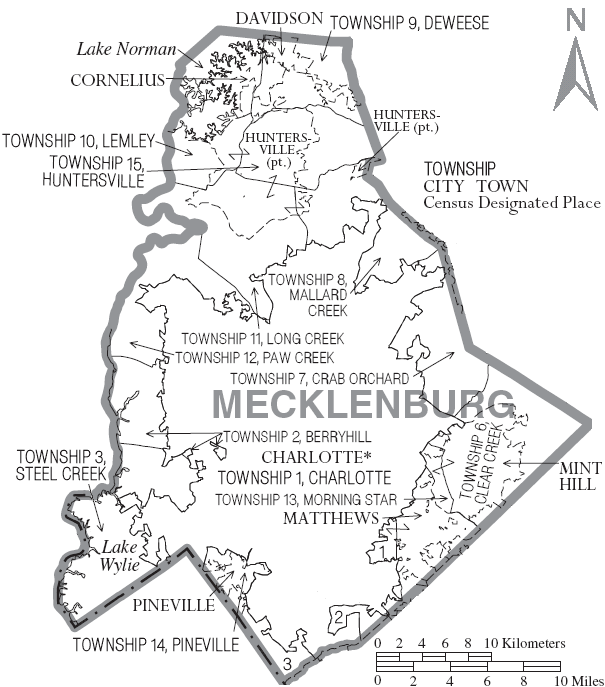
When one thinks of Mecklenburg County, this day and time, one thinks of the City of Charlotte, which is threatening to swallow it, and surrounding counties, whole. But Charlotte was not the first town in Mecklenburg County. Why, it wasn't more than a village until well into the 1800's. There was a time Cottonville, in Stanly County, was a larger community than Charlotte. Instead, Mint Hill was the first town in what is now Mecklenburg, settled in 1750 by Scotch-Irish pioneers, most who had traveled from Pennsylvania and Maryland. This group, not the only Scottish blood swirling in mine, comprises of about 20 to 25 percent of my DNA. In 1768, Charlottetown, a name that would be shortened later, received a charter to become the county seat, but citizens of the eastern part of it were not accepting of that, or happy about it. The Rocky River Community that consisted of mostly the Scotch-Irish and a German group that had settled on Buffalo Creek, tolerated this decision for about three decades, but by the 1790's, they were pushing for a new county, that became Cabarrus.
Three men are usually noted as the founders of the town of Mint Hill; John Ford, a judge for the Salisbury District, Adam Alexander, a magistrate, and John Query, a constable and tax collector. The last two are ancestors of mine.

There is a lot of misinformation concerning John Query, as there is with many individuals who lived here prior to the Revolution. The general consensus of the best sources is that he was of Scottish decent. Several online have him coming from Belfast, Ireland, however. Where that came from, I don't know. He was granted or purchased 100 acres in Cumberland County, Pennsylvania in 1755, so this was the era he settled there.

What is proved by records, is that he arrived in New York, New York, in 1739, as his name is found in "A List of the Persons Brought from Scotland by Captain Lauchlin Campbell".

The name is of Scottish Gaelic origin but has since spread to different regions where variations developed. Its roots are from the Isle of Ulva and the Hebrides, and derives from the Gaelic name Guaire, which means noble or proud, and traces back to the Siol Alpin, descendants of Kenneth Mac Alpine, the first king of Scotland from the 9th Century A.D.
Another issue of debate was the name of his wife. There is a very old D. A. R. record of a Miss Mary Stewart who tied her membership to the organization from her decent from John Query. In it, she claimed his wife was named Ellen Davis before marriage. The record is from the 1920's and I am not certain what the organization, founded in 1890, required as proof at that time. There did exist a prominent Davis family, of no connection to my mother's Davis family, who lived in Virginia still at this time, in Olde Mecklenburg, but no record of a marriage. Some online family trees link a marriage record of a John Query and an Ellen Davis from 1884 to their trees, without noticing two blatant facts that discredit it. One, the year is nearly a century after the death of John Query the Patriot, and two, the two individuals who married in 1884 were African American, not Scottish.
Miss Stewart also has the year of his death as 1805 which is in clear conflict with the probate of his estate, which took place in 1797.


'Elizabeth Query widow and relict of John Queiry Deceased to William Query for her right of Dower to her husband's lands bearing date the 23rd Day of May 1799 by William Wilson Esqr. '
In 1799, John's wife is clearly named as Elizabeth, not Ellen, in the court records of her Petition of Dower. Whether or not she was a first wife, or a second wife, I have no knowledge, but she was his widow.

The above page is an excerpt from the estate file of John Query naming the heirs of John Query bound to the county of Mecklenburg during the settlement of the estate and the name were Elizabeth Query, Jonathan Query, James Orr and John Stewart. I believe this to be the daughter, Elizabeth and not the widow, Elizabeth.

The 1790 census, the first one of the new nation, was the only one that John Query appeared in. He was interestingly sandwiched between William Query, Sr. and William Query, Jr. Coincidentally, they lived near two James Orrs, Whistling James Orr and one other. 'Whistling' James Orr married Margaret Jane Lemmonds and Sarah McConnell. The other may have been his son, as he had one named James, as did Nathan Orr. Records referred to different James Orrs as 'Jockey' James Orr and 'Heretic' James Orr to differentiate between them. It would be interesting to discover how their names had come about.

The fourth Query in Mecklenburg County was Alexander, found way out in left field near John Reed, of Gold Mine fame, who lived in what is now Cabarrus County. Sure to form, Alexander is the only Query in Cabarrus County in the 1800 census. Alexander was known to have arrived with John Query from Philadelphia around 1750- 1755. They are believed to have been brothers, along with William Sr., seen above.
According to a biography of Alexander Query, the brothers were sons of Rev. Thomas Query and wife, Eleanor. This may be where the "Ellen" came from. I can neither authenticate, nor disprove this theory.
Alexander Query lived until 1805. He had married Margaret "Peggy" McCord and was the father of Robert W. Query, Elenor Ellen Query Alexandeer, Agnes Nancy Query Alexander, Margaret, John and James.
 |
| 1800 Census of Mecklenburg |
The 1800 census of Mecklenburg County, NC shows a Robert, William and Jonathan Query together in a row. These are thought to be sons of John Query. Alexander, the only living Query of the first-generation lived in Cabarrus and his son Robert had not yet started his own household.


In John Query's 1797 estate sale, some 13 years later, the buyers list is led by William Query, then John Lemmons, his known son-in-law, and then Benjamin Lowery. This would have been Ben Jr. to whom he had been Guardian of.
 |
| Revolutionary War Voucher for John Quer |
Despite having been born abroad, John Query was without doubt an American Patriot. He was not a hot-headed adventure thirsty youth when war broke out. He was a well-grounded public servant of his middle years, in his forties. He participated in the campaign against Tories at Raft Swamp. He also served as a juror, tax collector and census taker, and served in the Clear Creek Militia. There he was promoted to Colonel.
It is said he lived in the section of Mecklenburg that would become Union in 1842.
He is noted as one of the founders of Mint Hill, and one of the three founding members of the Clear Creek Meeting house, that would become known as Philadelphia Presbyterian, where many generations of my family are buried.

There are multiple land records tied to John Query, but I'm only featuring a few that I find historically important. The one above shows that John Query obtained his first tract of land in North Carolina from Arthur Dobbs, and not Selwyn who owned most of Mecklenburg County at the time. To transcribe the above excerpt, " This Indenture made the twenty fifth Day of June in the year of Our Lord one thousand seven hundred and fifty- four Between his Excellency Arthur Dobbs Esquire Captain General Governor and Commander in Chief for and over the Province of North Carolina and Justine his wife of the one part and John Query of the County of Mecklenburg in the Province aforesaid of the other Part Witnesseth the said Arthur Dobbs and Justine his wife for and in consideration of the thirteen pounds proclamation money in his hand paid by the said John Query at or before the.....130 acres on Goose Creek.


The second one of importance was between John Query and Abner Nash. Abner Nash, an attorney by trade, was the second governor of North Carolina, and held the office between 1780 and 1781. He married Justine, the widow of the former Colonial Governor Arthur Dobbs, which is how he had came into the possession of this particular tract of land.
This Indenture made the Twenty first day of? in the year of our Lord one thousand seven hundred and seventy five between Abner Nash of the county of Halifax and Province of North Carolina of the one part and John Query of the County of Mecklenburg and Province aforesaid of the other part...sum of five pounds ten shillings Proclamation money to the said Abner Nash...55 acres beginning at his old corner at a blackjack on the waters of Goose Creek.
Another researcher has stated that the Query property was in or near the Fairview Community.

The third important deed dealt with the founding of the Presbyterian Church.
 |
 |
 |
| Fairview. Genealogies, History Records |
The above is concerning Mary Stewart, an early member of the Daughters of the American Revolution, who joined under the services of John Query.

An 1884 account of Mecklenburg Reminiscences describes John Query in the manner below:
' John Query, a native of Scotland, came to this country and settled on Clear Creek, in this county/ He was a man of good estate and true literary tastes.' Land records show he first settled on Goose Creek but frequented the Clear Creek community. Another book, 'Sketches of North Carolina' reported, "John Query one of the convention at Charlotte (referring to the Mecklenburg Resolves) belonged to the bounds of Rocky River (referring to the Church Congregation) ...He, Adam Alexander and Moses Shelby lived on the bounds of what is now Philadelphia called for a time, Clear Creek. These two were both elders of the Church.'

Above are the Mecklenburg Resolves as written.
Below is the list of signers.

 |
| Newspapers.com |
The above paragraph concerning John Query described him as a "home-and-farm' man which brings to mind an image of a simple, hard-working family man. He was known as an erudite and learned man, called a "scholar" and known for his exceptional mathematic skills. The paragraph was from 1784, when he was still alive, so I trust its accuracy more than reports from one hundred plus years later.
 |
The Charlotte ObserverCharlotte, North Carolina • Page 13 |
The above was in response to Mary Stewarts question below. I would like to know who now has in their Possession the old family records of the Query's in Pennsylvania that Lloyd M. Query referred to.


Mecklenburg Declaration of Independence
With the 250th Anniversary of the United States of America coming up, I am proud to feature one of my several Patriot ancestors.
The descendants of John Query, excluding my own line, I can't profess to have spent any due amount of time on, or can verify as truth. My own line of descent from daughter Elizabeth and her husband, John Lemmonds, is well documented with their five children:
1786- unknown Elizabeth Lemmond
1787 - 1858 John Query Lemmond
1791-1864 William Thomas Lemmond
1793-1849 Robert M Lemmond
1802-1825 Elenor Lemmond
The Lemmond name had multiple spellings and transformations, with a d, without a d, with an s, without an s, one m, two m's. Just as Query was also spelled Quary, Querie, Queiry. Spelling varied even within the same document in reference to the same person, so nothing to be concerned with in its variance.
Other speculative children of John Query and wife were:
A) Jonathan Query (circa 1759-1817) William Query and Robert Query were co-administrators of his estate. Deeds were bonded, or witnessed by John Query before his death. John Lemmonds is mentioned in his estate records. He is mentioned in John Query's estate records.
B) William C. Query (1761-1846) The sons of John and Elizabeth Query Lemmonds are mentioned in his estate records and two of them were administrators.
C) Robert Query (1763-1827) married Ellen Lemmond, a sister of my ancestor John Lemmond who had married his sister, Elizabeth. They were the parents of six children: Mary Ann QueryVan Pelt, Cyrus Query, Henderson Query, Newton Query, Martha Query Cochran and Robert Jr. In Mr. Wheelers early report and brief biographies of the Mecklenburg Signers, he had stated, "there was only one son, Cyrus Query, who died some years past" when referencing John Query the Signer. This was incorrect information, as Cyrus Query was a clearly documented grandson, having been born after the death of his grandfather, and son of Robert.
D) Jane Query (1765-1792) married Joseph Harris and moved to Greene County, Georgia. Four children: Jesse, Prissy, Mary and Joseph, Jr.
The above, including, Elizabeth Query Lemmonds, are pretty sound. The two oldest sons, Jonathan and Willam, died unmarried and childless.
Two other daughters, who are not so set in stone were Mary Query who married John Stewart and was the ancestor of Mary Stewart of the DAR and Margaret Query who married John Orr, Jr. They are buried at the Philadelphia Church Cemetery, so quite possible, but also possible to have been nieces instead.
A salute to all of our Patriot predecessors and Happy 250th birthday America!
 |
| Rocky Spring Meeting House Burying Ground |