Showing posts with label Ouissa Stewart Hill. Show all posts

Saturday, December 8, 2012

Dancing the Happy Dance


An accidental discovery this morning shows exactly why it is important to carefully examine the actual census document and not to read only the transcribers version of it. Old census records were rife with errors, but using dates, locations and knowing the family situation, you can recognize a family as your own. I went back to look at Ouissa Stewart Hill, the daughter of Sarah Hortence Davis Stewart, who was abandoned by her father and orphaned by her mother and ended up in the custody of her grandmother, and her stepgrandfather, when her grandmother, Rebecca Hathcock Davis Crump died.  I noticed that I did not have a location for Ouissa in the 1910 census. Her name had been mangled in the 1900 census as "Steward Wessie" as it had been written in in an improper order. 
So, I went to see if I had her step-grandfather in the 1910 census, which I did. By virtue of the legal papers where he applied several times to use her trust to purchase items for her, like a gold watch, or an organ, I knew that she should have been living with him at the time. I knew "Viney" was his daughter Lavinia. Under Viney was a niece "Steph Crump", a year younger than Viney, the age that Ouissa should have been.

Another pleasant discovery was that living next to JT Crump was the family of Ouissa's future husband, Fred Hill, with his grandfather Adam in the household, which helps me link him with the Hill family in a different part of my family tree. 
Ouissa was a handicapped child. A member of the Genealogy Society, who as a child, knew her as an old lady, said she had a deformed hand. It did not prevent her from marrying or becoming a mother and a farm wife, however, or apparently, being able to play an organ. 
But I decided to view the actual document and scan the neighbors. 
On viewing the actual document, I discovered that "Steph Crump" was not close to what it said at all. First, it clearley said "Ouissa" where surname should have been, her name just scribbled in, and the "Step", referring to the fact that she was his step-granddaughter, but then incorrectly notating her as a niece. But as he was her young aunt Lavinia's father, the family may have considered him an uncle. 
That is when I made an amazing discovery that made me do the Happy Dance. It is these little joys of discovery in genealogy that make it so fun. Right above the line in which lists the household of John T Crump, with his two teenaged relations, daughter Lavina and step-granddaughter Ouissa, is the family of a J. T. Crump b 1881, wife Nannie and son Dewey.  I had not only found Ouissa in 1910, I had found J. T. Davis in 1910. In 1904, he had married Nannie Farmer in Stanly County. John Teeter Davis was just a toddler when his father died in October  of 1882 and his mother remarried John T. Crump in September of  1883. He was raised by John T. Crump. In the 1910 census, just above John T Crump is the family of a J. T. Crump, wife Nannie and son Dewey fitting the ages of John Teeter Davis, and wife Nannie Farmer Davis. He may have alternately gone by J. T. Crump. 

In the 1920 census, John T. Davis is shown with a 14 year old son whose name begins with a "D". The transcriber had called it 'Danl', but it did not look like Daniel upon close observation. As John T. Davis had married Jenny Lenora Hooks by then, I knew Nannie had to have died prior to the marriage, and by the age, son "D" had to have been Nannie's. Perhaps there was another infant born and Nannie died in chidbirth. As I could not find any information on Daniel Davis, correct age and affiliation, I though perhaps he had died as well. 
Finding this information has solved one mystery and started me on another search. The informant on the Death certificate of J. T. Davis was a Dewey Davis, who knew the names of John's parents correctly, but had Ned being born in Mecklenburg County, Virginia, which was incorrect, but the birthplace of Ned's parents. I knew this person probably had a familial connection, with this knowledge, but knew of no Dewey Davis in the family tree. 
Making this discovery settles the mystery of who Dewey Davis was, the oldest son of J. T. Davis. 

Now to find out more about Dewey. I'm also wondering what the "T" stood for in John T. Crump. Rebecca was considerably younger than her first husband E. W. Davis. Was she secretly in love with J. T. Crump? Did she name her youngest son after him? Could J. T. have actually been a Crump by blood? A secret liason between a young wife and her childhood friend? The Crump family and Hathcock families had both settled a little more down river toward Center and the Forks of the Rocky and Yadkin rivers.

The journey never ends. 


Wednesday, August 29, 2012

The Second Meeting of the Stanly County Genealogical Society

I realize it is a bit odd to post notes on my second meeting before my first, but I haven't gotten one of those little red circles we wore around in a button in high school called a "Round Tuit". I want this blog to not only reflect the research I've done already, but to also reflect research I am currently working on, as well as chronicle historical places I am visiting and the things I am learning as I go along. I try to alternate between the two.

This week, so far, and yesterday in particular has been jampacked with discoveries and information. Sunday, we visited a historic street in Salisbury, NC that was magical and only 30 minutes away. Yesterday in the mail, I recieved two important documents of high importance in my research and last night, I attended my second meeting of the Stanly County Genealogical Society. Again, I was among the youngest there. There may have been one younger, although I am a grandmother. However, the combined knowledge in that room, and the wealth of imformation, was astounding. The combined years of research between all those researchers make me feel like a first grader having just finished my first Dick and Jane reader.

The presentation on "The Great Wagon Road" was fascinating. But it was things I learned afterwards, about my family, that I did not know, that was the real treasure, and from a distant member in it. If we all would just listen to our elders, what treasure we would own.

The presenter was a descendant of Martin Pfifer, one of the earliest settlers in the Cabarrus County area, named Bill Hallman.

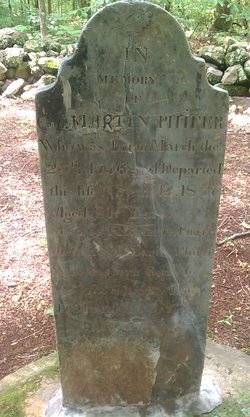
The following is the tombstone of  Martin Pfifer, Jr. He was the youngest of the three sons of Martin, Sr and his wife Margaret Blackwelder.
Capt Martin Phifer, Jr
The Cross Creek to Salisbury Road intersected with the Great Philadelphia Wagon Road at Martin Pfiefer, Sr.'s Inn. Cross Creek was modern day Fayetteville, North Carolina and the Great Wagon Road led many a settler from the Northern States of Pennsylvania, Maryland and Massachusetts down into Virginia and the Carolinas.

Martin Pfiffer was Swiss and from a wealthy mining family. He was born about 1720 and arrived in Philadelphia about 1737 in his latter teens. By the 1740's, he had made his way into Virginia and in 1744 he married a girl named Margaret Blackwelder. The Blackwelders were a German family, the name originally being Schwarzwalder, or "People of the Black Forest", meaning they originated in the Black Forest area of Germany.

Martin and Margaret's two oldest sons, John and Caleb were born in Virginia. At this time Martin owned 755 acres and an Ordinary. On record in Virginia are the permits for him to build the Ordinary and also, a sizable road to his Ordinary. On February 4, 1755, Martin Pfiffer sells his property in Virginia and later this year he is first found in Anson County, which encompassed most of this part of the Piedmont in that year.
He came down the Trading Path to Salem, the Moravian settlement which is now part of present day Winston-Salem in Forsyth County. His first deed has him listed as an Innkeeper and a Planter. He purchased 455 acres.

Arthur Dobbs, who was an Irish member of Parliment who became a land proprietor in North Carolina and was later appointed Colonial Governor of North Carolina. Along with Colonel John Selwyn, Dobbs bought a land grant of about 400,000 acres in what is now Cabbarus and Mecklenburg Counties. They advertised in foreign countries for settlement in this area, and also many families from Virginia and the North would relocate to what they believed to be safer grounds due to the French and Indian War.

In July of 1755, Govenor Dobbs would visit his lands in North Carolina. In his travel journals he writes that he meets a Swiss miner who had just came to the area. It is believed that the Swiss miner was Martin Pfiffer.

In March of 1756, Martin Pfiffer writes to England, to the Governors of Rowan and Anson for permission to build a road 'convenient to provence', through Cold Water, the area of Cabarrus County where his Inn was located, to the Granville line from Salisbury. The public road was laid out from Salisbury to Cold Water.

It was also stated that Martin Pfiffer was who sold High Shoals to John Fulenwider, who built the High Shoals Iron Works, in Gaston County, North Carolina, one of the first producers of pig iron by the charcoal process.

Traces of the The Great Wagon Road near the location of the old Pfiffer Inn can be seen in spots and on GIS images. One such trace can be located near the intersection of Winecoff Road and Hwy 73, from the street, it looks like an old driveway heading back into the woods. Another trace can be seen near the Intersection of Lucky Drive and  Eva Drive. Follow Eva drive down and you can see the road pick back up crossing Poplar Tent near Rock Hill Church Drive. At Old Stagecoach Road, you can see the trace going down through the woods, and Old Stagecoach Road, was indeed the Old Stagecoach Road. At the old Moss-Morris house near Weddington School Road, near the AME Zion Church on Coddle Creek, the road passes.

Near the present day Speedway on Morehead road, there are two abandoned houses. Near there is a large outcropping. This outcropping  was the line marker between Mecklenburg and Cabarrus Counties. The Wagon road ran between the rock and current Hwy 29 and on to Charlottesburg, present day Charlotte, North Carolina. Into Charlotte, the path of the old road becomes Tryon Street, named for later Governor Tryon. The Fayetteville road that intersected with the Wagon road at Pfiffers Inn ran east through present day Kannapolis.

Mr. Hallman stated dated during these early days of Cabarrus County, that there was a bridge across Dutch Buffalo Creek. He believes near that bridge was a Fort. On July 18, 1756, Martin Pfiffer was reimbursed for a road. Dobbs had asked for this road in March and for a Fort to be built for the Catawbas to trade with the immigrants. In 1767, 12 years later, Willilam Tryon, then Govenor, during a tour, noted that he 'saw the remains' of the Fort built by the inhabitants of Buffalo Creek.

Martin Pfiffer had 3 sons. The oldest, John, was a signer of the Mecklenburg Declaration of Indepence and died of the elements on a trip to visit his brother. Caleb was a Revolutionary War Colonel. Martin Jr, was a courier during the war. Most of the descendants of the Pfiffer family today are descended from Martin Jr, who was the most prolific.

The presentation was most informative and interesting. We could have gone on and on, but the time in our meeting room was limited.

Afterwards, a distant relative and I had a conversation about our family. His deceased aunt, Maudie Scarborough, had known my great-great grandparents, Hawk and Julina Davis. Julina had numerous children before her marriage to Hawk in 1891. He said that Hawk had once told Maudie that he knew half of those children (of Julina's) were not his, but he loved them just the same. We know that Mollie Aldrige/Davis Boone was the daughter of Ephraim Whitley as his name is on her marriage license. Jesse Filmore Aldridge listed Benjamin Whitley as his ancestor on the Permanent Voters list of Stanly County. Benjamin Whitley was the father of Ephraim Whitley, but Filmore was rumoured to be the son of Filmore Whitley, who was a cousin of Ephraim,not a brother. One of Ephraims younger brothers, George Whitley, did later marry Rosetta Elizabeth Aldridge, Julina's one year older sister. Hearing that these were words that came from my Great-great grandfather, who died 50 years before my birth, really touched my heart and gave me an insight into his personality.

I also learned from Mr. Aldridge, my distant relative, that Oussia Stewart Hill, who I have been researching, had a deformed hand, with little stubs for fingers. He also said there was something in her background that the old folks would not talk about. It may have been the fact that her parents were divorced, and that her father had abandoned them and ran off with her mother's teenaged cousin. Or there could have been another reason for the abandonment, or another scandal in Ouisa's past. I'd love to know...and maybe one day I will.

Friday, August 10, 2012

Putting Hortense to Rest

Sometimes old Newspapers can be our best allies in the search for information on our families. It takes patience and knowledge and a great deal of searching and reading to find the gemstone in the quarry.

I went back to Wadesboro today and then on to Rockingham in Richmond County in search of a number of things. I thought looking through the 1896 editons of the Anson Record, I found this gem in the April 4th Edition.

"Miss Hortense Davis, daughter of Mrs. J. T. Crump, of Cottonville, Stanly County, died last Monday, of pneumonia, aged about 25 years. Miss Davis was married to Mr. Will Stewart, of Monroe, several years ago, but obtained a divorce from him, after which she resumed her maiden name. "

Hortenses tombstone retains her married name. Possibly because of her surviving daughter, Ouissa.

So Hortense did not drown when she threw herself in the river. She caught pneumonia and died.

I still wonder at all of the circumstances that led to her death and to her cousin's insanity. Kitty Davis had returned to Anson County just a few weeks before Hortense had died and married an E. W. Cox from Marlboro County, South Carolina. In Hortenses divorce papers, she claims her husband William R Stewart ran off with her 15 year old second cousin Wincy Catherine "Kitty" Davis. They were found in Chester, Chester County, South Carolina.

Another item I was looking for in Anson or in Richmond Counties, was the marriage license of Edward Cox and Josephine Quick. According to the 1900 census and Edwards death certificate, they had gotten married in 1897, but it does not say where. There was no license in either Anson or Richmond counties. I have also not yet located a divorce decree or annulment of his marriage to Kitty on March 3, 1896. From what I have seen in early divorce proceedings that I have came across, one year is far too quick. Of course, there may have been a terrible discovery about Kitty that caused an annulment. I still need to go a peruse the court proceedings of Anson on microfilm in order to see if anythere there helps solve this mystery.

I recieved the forms to send in for Kitty's paperwork from Broughton State Mental Hospital. I found an "Inquistion of Lunacy" papers in Stanly County for James Clark Thompson, a great-grandfather of my Daddy's, but Anson County had no such item on microfilm and Kitty was not listed in Stanly.


On its side
I apparently turned the Richmond County Courthouse on its side and shook it. What did not come out was the marriage of Kitty's husband to his second wife. I wonder if he married her at all. I found land records of his forefathers and hers, but no marriage records between old E. W. Cox and Miss Josephine Quick.

The quest for the mystery of Kitty Davis's tragic life continues. But I find her innocent of killing her cousin. Directly anyways.