Showing posts with label Nash. Show all posts

Friday, March 22, 2024

The Widows of Wharf


Phillip Lynch appears only in one United States census, the very first, 1790, but he appears in that one twice, in Montgomery and in Anson. 


That must have been the year he crossed the river, that muddy, stone-filled, trifling- more-than- a- creek, steam known as 'The Rocky River', that forms a border between Stanly and Anson Counties. As seen in my previous post, Phillip is found first in Montgomery County, in the part that would become Stanly, and later in Anson, in the area that would become known as Wharf, for a time.

He bought land that bordered Green Roper, my Winfield relatives, Griffin Nash, and a Joshua Davis who had married Hannah Hogan, daughter of William Hogan. Then as soon as Joshua Davis dropped from sight, my ancestor, Job Davis appears. That's a fact that has piqued my interest in Phillip Lynch. 

NamePhillip Lynch
Home in 1790 (City, County, State)Montgomery, North Carolina
Free White Persons - Males - 16 and over1
Free White Persons - Females2
Number of Household Members3

In his Anson and in his Montgomery appearance, he appears as head of a family of three, himself, a male over 16, and two females. One would be his wife, Elizabeth, and the other, unknown, but possibly a firstborn daughter, as we can't be quite sure when some of his daughters were born.


In the 1800 census, no Lynch or Linch is to be found, but Phillip and his family should have been living in the following neighborhood.

There's William Marshall, James Marshall and Isaac Ambercrombe, who were all living near him in deeds. On up the page is my ancestor, Peter Winfield, before he passed away in 1802, and his estate divided between his heirs, who were Phillips neighbors. Next to Peter is Richard Howell, his son-in-law, whose household would have included my 4th Great Grandmother, Sarah Winfield Howell Davis. Richard would also die not long after this census, but after Peter, and before Phillip Lynch. I can't help but wonder if the Phillip Smith, just before Abercrombie, was actually Phillip Lynch. 

The family structure fits, two sons, one daughter missing, but not all of his daughters were born before 1800. The oldest female besides his wife, Elizabeth, may not have been a daughter at all, which is what I am thinking. I can't find this Phillip Smith in the next census, or in any deeds in this area.


The above map is the section that would fit like a puzzle piece to the section in the above map that says "Wharf". It would sit north of the previous map, between Davis Ford and Crump Ford. This one is from the early 20th century and called "The Furr Map".

We really can't know when Philip Lynch was born, nor from whence he came. If someone knows, I'd like that information. So I can't say if he was an older father with a younger wife, or a young father who became sick. I would guess the former, because Elizabeth "Betsy" Lynch would outluve him by over four decades, and Philip had accumulated lots of property and possessions, too much for most younger men. 


He wrote his Will on November 15, 1807, and passed away, not long after. My translation is below, leaving out most of the "legalese" and metanoia. 

I Phillip Lynch being weak of body do make this my last Will and Testament....

Item: I lend into my wife Betsy.... 100 acres of land including where my dwelling house stands......I also lend her one.. woman Hannah and her increase...one bed and furniture...
Item:... daughter Sally Lynch.. woman...Eady and her increase... also one Sorrell mare...100 acres called the Sanders place...plus 18 acres adjoining the same.
Item: ...son Green Lynch..the upper part of my plantation.. adjoining the part I lent my wife and William Marshall.. also 40 acres purchased of Green Roper... also a Gray mare.. and a man.. Daniel....
I give to my daughter Nancy Lynch 250 acres on Jacobs Creek in Montgomery County.... woman... named Easter.. furniture... one Mare now in the possession of A. Abercrombie.
I give to my son John Lynch one tract called Hyde's Folly..100 acres adjoining Job Davis.. one boy... Elisha...colt folded (foaled) last spring... bed and furniture...
I give to my daughter Catey Lynch..200 acres on the waters of Mountain Creek...girl...Lucy... also $100...bed and furniture..
I give to my daughter Betsy Lynch...100 acres in Montgomery County on Long Creek.. 50 barrels of corn...girl Jude... one Gray horse, one Sorrell, 100 acres in Montgomery County called Bryan's old field.

Also wish..Bob and Doll (people) sold my sheep is for the use of... wife...one cow one calf... rest of Cattle, sows and pigs (sic) ...sold.. and at the death of my wife I will Hannah and her children be equally divided between all my children ... cotton... tobacco...

Wife executrix...
Witnesses: Griffin Nash, Solomon Cahoon, Amon Yarborough.
Dated 15th day of November 1807
Signed Phillip Lynch

So, we know Phillip had a wife, Betsy, short for Elizabeth, two sons, Green and John, and four daughters, Sally (Sarah), Catey (Catherine), Nancy and Betsy II, (Elizabeth). Most, if not all, of the children were minors at this time. The three whose years of birth I am aware of at this juncture, were John W. Lynch, 1799, Betsy, 1804, and Nancy, about 1807, so these three of the six, at least, were very young when his Will was written. 

Elizabeth appears as a widow in 1810. She's between 26 and 44. Only five of her children are still at home, meaning one daughter has married, and I believe that one to be Sarah, which we'll see why later. Her oldest son was between 16 and 25, which would have to be Green, or in full, Edmond Green Lynch. The younger son between 10 and 15, John W. Lynch would have been 11. One daughter would have been between 10 and 15, Catey, and two under 10, Betsy and Nancy.


Just for a quick reference, there is a deed recorded in Anson County, supposedly from Montgomery County, NC, dated August 21, 1810 "Jane Norwood to Phillip Lynches Heirs", in Book O, Page 375.


This brief document referred to an older deed dated April 12, 1800, where Thomas Norwood of Montgomery County sold to Phillip Lynch of Anson County, for 100 pounds, a tract of land on Indian Camp Branch bordering John Gibson. Witnesses were Whitmell Ryle and Hugh Ross, Hugh Ross, a large land trader himself, shown as a neighbor of Phillip Lynch. A decade later, Jane Norwood is renounciing her right of dower to the heirs of Philllip Lynch. I don't know where Indian Camp Branch is, I'd like to know. It has a very interesting name.


In July of 1815, the actual division of the property of Phillip Lynch began, although it was clear he had passed away beofre 1810. The delay may have had something to do with the age of most of the children. By 1815, most of them had reached a solid age. John W Lynch, for example, was 16, his brother Green would have been twenty or more. Isaac Abercrombie, Edward Winfield, C. Coppedge, John Grady and Josiah Allen were appointed as Commissioners to divide the estate of Phillip Lynch. It didn't seem to go as his Will had required, most likely due to debts of the family. 

Lot 1 went to Nancy Lynch, consisting of 50 acres valued at  $129,  adjoining Job Davis (my 4th Great Grandfather) and Thomas Avett, (his brother-in-law, they married sisters). Phillip Lynch had left Nancy 250 acres on Jacobs Creek in his will.

Lot 2 went to Sally "Cawton", 50 acres valued at 139, adjoining the properties of Griffin Nash and Thomas Avett, again, sons-in-law of Peter Winfield and brothers-in-law of Job Davis. This property was up against the old Winfield property that had been divided out to the four children of Peter Winfield.

Lot 3 went to Green Lynch, 250 acres valued at $180 that bordered the lands of Griffin Nash and "Varhine", referring to Everett Verhine, whose name comes up in other documents.

Lot 4 went to Catey Lynch, 100 acres vales at $260, bordered Isaac Abercrombe and was called 'Sanders Old field".  Phillip had willed Sanders Old Field to his daughter Sally, and Catey was to get 250 acres on Mountain Creek that belonged to her father. The Will was not being followed at all. 

Lot 5 went to John Lynch, only 36 acres, but valued at $190 and bordered William Marshall and the Rocky River. The value of the property may have been because it was riverfront property. John had been willed a tract of land called 'Hyde's Folly', that bordered the property of Job Davis. 

Lot 6 went to daughter, Betsy Lynch, a 48 acres tract valued at $194 and bordered the properties of her mother, Elizabeth and brother, John. This land was in Anson County and Betsy had been deeded 100 acres on Long Creek in Montgomery (Stanly) County. I wondered what had become of Phillips properties in Montgomery County?

The document was signed by the Commissioners, men who were neighbors and members of the "Wharf" area community; Isaac Abercrombie, Edward Winfield, the only son of Peter Winfield, whos property Phillip Lynch bordered; C. Coppedge, John Grady and Josiah Allen. 


One noticable thing was that one daughter, Sally, was no longer a Lynch. Other deeds would make it clear that Sally, or Sarah, had married a man named William Cawthon, Cathon, Cawthorn or Cawthorne. William was the only member of his family in Anson County, so he wasn't a local. I wonder if he came just to marry Sally. The Cawthons and the Lynches seem to have came from Granville County, and Mecklenburg County, Virginia prior to that.

NameWilliam Cawthon
Enumeration Date7 Aug 1820
Home in 1820 (City, County, State)Coppedge, Anson, North Carolina, USA
Free White Persons - Males - Under 103
Free White Persons - Males - 10 thru 151
Free White Persons - Males - 26 thru 441
Free White Persons - Females - Under 102
Free White Persons - Females - 26 thru 441
Slaves - Males - Under 141
Slaves - Males - 14 thru 251
Slaves - Females - Under 142
Slaves - Females - 26 thru 441
Number of Persons - Engaged in Agriculture3
Free White Persons - Under 166
Free White Persons - Over 252
Total Free White Persons8
Total Slaves5
Total All Persons - White, Slaves, Colored, Other13


Above is William and Sally and family in 1820 Anson County. It shows both parents being between 26 and 44. If Sally was 26, she would have been born in 1794. They have a boy between 10 and 15 in the home and three under 10, and well as 2 girls under 10. That's 6 children by 1820, and they also had 5 slaves in the household. 
1820 was the census where the citizens were listed in alphabetical order, by district, or township. The Cawthons lived in 'Coppedge".

NameEdmond G Lynch
Enumeration Date7 Aug 1820
Home in 1820 (City, County, State)Coppedge, Anson, North Carolina, USA
Free White Persons - Males - 16 thru 251 Edmond Gree Lynch
Free White Persons - Females - 10 thru 151 Unmarried daughter
Free White Persons - Females - 45 and over1 Elizabeth
Slaves - Males - Under 141
Slaves - Females - Under 141
Slaves - Females - 14 thru 251
Slaves - Females - 26 thru 441
Number of Persons - Engaged in Agriculture5
Free White Persons - Under 161
Free White Persons - Over 251
Total Free White Persons3
Total Slaves4
Total All Persons - White, Slaves, Colored, Other7

Elizabeth Lynch is not listed as a Head of Household in 1820, but son Edmund Green Lynch is, and it appears that Elizabeth is living with him. The younest daughter is now between 10 and 15, or a birth year of 1805-1810. John W. Lynch doesn't appear to be in the home. He may have been living with Tod Robinson, which will be seen later. 

Several interesting deeds give a little input into the missing children and the movement of the heirs of Phillip Lynch. 

April 3, 1821 Jordan Howell, John W Howell of Fayetteville NC and Levy Stancill & wife Charlotte,of Montgomery County, NC sold property to Peter Howell of Anson County, 140 acres for $300 beginning at a Mulberry onthe Riverbank (Rocky), beginning at Griffin Nash'es line and joins Lynch and Nashes corner. It was witnessed by Stephen Nash and Darling Allen. Book U Page 1.

This was an important document in my own family and in that of the Lynches. Jordan Howell, John W. Howell, Charlotte Howell Stancill and Peter Howell, were the four older children of my 4th Great Grandmother, Sarah Winfield Howell Davis. Their father, Richard Howell had passed away. Peter, the oldest, took over his father's plantation. Jordan and John W. Howell, the middle two children, became merchants and moved to the trading town of Fayetteville, where their stepfather, Job Davis, owned property on Haymount and a brick townhouse on Hay Street. They were members of Hay Street Methodist Episcopal Church. Charlotte, the youngest, married Methodist Minister Levi Stancill and they would move to Georgia. But what does this have to do with the Lynch family, besides being neighbors. Stephen Nash and Darling Allen ! Both married Lynch daughters. 

Stephen Nash was the son of Griffin Nash. He would marry Nancy Lynch. They would have one son, James W. Nash, whom Griffin would name in his will, as Stephen would die a young man. 

Darling Allen Jr. would marry Catherine "Catey" or Katie Lynch. The above would be Darling Jr. because his father, Darling Allen Sr., was deceased by this time. They would have a number of children, whom I haven't nailed down completely yet, but the oldest son was named Edmund. Darling would outlive Catey and remarry to Eliza Harrison, and have more children, so which child belongs to which mother is still elusive. 


Also in 1821, a deed found in Book T, Page 311 Anson County, Elizabeth Lynch sells to Oliver Coppedge, for $275, a little 10 year old girl named "Chain" , guaranteed to be sound. This wasn't a random exchange. Oliver H. Coppedge was also a son-in-law. Witness was C. Coppedge, probably Charles.


Conestoga Wagon 1883 by Newbald Hough Trotter.

The mid to late 1820's was a time of upheavel and movement in piedmont North Carolina. Partially because of land opening up for settlement, and also due to allotments from service in the War of 1812. It was rare for a person or family to leave alone. For support, and for safety, they usually traveled in groups. When you see a family who migrated in a particular spot and then notice people with familiar names around them, it could be that they had all traveled together.

In Anson County Deeds, Book V, page 386, we see that in October of 1826, John W. Lynch, a young man of about 27, of the town of Washington, Alabama, sells to Thomas Waddill of Anson County, for $325, 36 acres on the West Side of the Rocky River that joined the Coppedge lands, his brother-in-law, Oliver, and sister Betsy. The deed states "being land allotted to me from land of Phillip Lynch deceased & known on division plat as lot #5." Signed by John W. Lynch and witnessed by Clement Marshall. Other deeds show John W. Lynch involved with Toddy Robinson, Tod Robinson served as a clerk in Anson County for quite awhile, but had his own land dealings and family interactions. It was his family that John W. Lynch migrated to Alabama with. 

On this same page, similar interactions were taking place, same book, V, same page, 386, William and Nancy Smith are selling to Dolly Lanier land belonging to the estate of Darling Allen, deceased. Witnessed by R N. Allen and Edward Winfield. This was the father and siblings of Darling Allen , Jr. who married Catherine "Catey" Lynch. These were all the Viriginians who had migrated from Southside Virginia and had built plantations along the Rocky River. The Allens were Baptists and the Winfields were Methodist Episcopal.

Newpaper Clipping of the Murder of Darling Allen, Raleigh, NC Dec 21, 1802


Darling Allen Sr. had been murdered in 1802 by Moses Allen , a slave of Darling Allen, who was afraid of being sold. Moses was hanged. Darling was about 40 at this time and his children were young. Little Darling Jr. was only 6. This is probably why the land transactions took so long to take place. 

The next page, Book V, page 388 involves a transaction between John Thompson, Sr. of Montgomery County. and Thomas Tomlinson of the same and mentions land on the southwest side of the Rocky River, in Anson, granted by the "King" in 1763 to Walter Gibson sold by deed two years later, 1765, to Shadrack Hogan, in 1771 to James Hogan and in 1777 to James Roper & William Colson and willed by James Roper to William Roper, who sold it to John Thompson. The land was 'immediately below Roper's Ford,  and witnesses by Clement Marshall and Thomas Waddill. It was this connection between the Ropers and the Hogans, and to Joshua Davis that piqued my interest in Phillip Lynch, as he became a neighbor and had land adjoining these, and also my Davis-Winfield family.

“A Cotton Plantation on the Mississippi,” Currier & Ives, 1884.

Photo credit: Yale University Art Gallery


I wonder where Roper's Ford was? Was it one of the Ford's nearly a century later that would be called Carpenter's Ford, or Crumps Ford? I know from a very old map, predating 1800, that what would be known as Davis Ford, was originally known as Winfields Ford, before Peter Winfields property that lie on that part of the river would be transferred to his daughter Sarah, who took Job Davis as her second husband. 


In August of 1828, on the 12th, we find this very informative deed in Book X Page 41:

"Oliver Coppedge and wife Elizabeth of Henderson County, Tennesee to Thomas Waddill (same dude who bought the property of John W. Lynch)". They sold the 45 acres for $250 that Elizabeth Lynch Jr. was allotted in 1815 of her father, Phillip Lynch's property. It lie on the Rocky River, beginning at a hickory, just above a spring branch and joined the properties of William Marshall, her mother Elizabeth Lynch, a hill, the river, and the lower edge mouth of a gut. It "being part of the land in Anson County North Carolina left to Elizabeth Lynch, now Elizabeth Coppedge, by her father Phillip Lynch in his will.'

It was witnessed by John Waddill and Wyatt Temple and signed by Oliver and Elizabeth Coppedge. It was also signed by John A. Wilson, clerk, of Henderson County, Tennesee. In a Pleas and Quarters Session in Henderson County, John C. Walker, chairman, verfied Mr. Wilson's credentials. 

Samuel Temple and William Cawthorn, Esquires ordered to obtain dower renouncement from Elizabeth Coppedge, William Cawthorn/Cawthon being her brother-in-law, having married oldest daughter, Sarah "Sally"Lynch. The dower was renounced on August 13, 1828 at the home of Oliver Coppedge before Samuel Temple and William Cawthorn in Nashville, Tennesee. December 8th of that year, Govenor Sam Houston certified John A. Wilson was a clerk of Henderson County. Signed by Sam Houston and Daniel Graham, Secretery of State and filed in Anson County, NC in July of 1829.

Sam Houston, circa 1850, Wikipedia


This was indeed THE Sam Houston. He was the sixth Governor of Tennesee and the 7th Govenor of Texas.His signature alone, makes this a very important document.


1830 

Elizabeth Lynch, widow of Phillip, is now Head of House again. Her oldest son Edmund Green Lynch, is seen in other deeds as getting himself into a bit of debt. She is living still in Anson County.

NameElizabeth Lynch
Home in 1830 (City, County, State)Anson, North Carolina
Free White Persons - Males - 30 thru 392 Green & John ? or ?
Free White Persons - Females - 50 thru 591 Elizabeth 
Slaves - Males - 10 thru 231
Slaves - Females - Under 103
Slaves - Females - 24 thru 351
Slaves - Females - 36 thru 541
Free White Persons - 20 thru 492
Total Free White Persons3
Total Slaves6
Total - All Persons (Free White, Slaves, Free Colored)9

The 1830 census tells us that Elizabeth is between 50 and 59 years of age, giving her a year of birth of between 1771 and 1780. She has two males in their 30's living with her. One of them would be Green Lynch. John was supposedly in Alabama. Did he come back home for awhile? She was stilll a lady of substance and property. She had six slaves. Her neighbors were Joseph B. Ingram, Ann Allen, Wilson Burns, Elizabeth Billingsley and James Turner. 

John W. Lynch is not found in the 1830 census, so maybe he was in Anson at the time.

Sarah Lynch Cawthorn/ Cawthon was in Henderson County, Tennesee with her husband William.

NameWilliam Cawthon
Home in 1830 (City, County, State)Lexington, Henderson, Tennessee
Free White Persons - Males - Under 52
Free White Persons - Males - 5 thru 92
Free White Persons - Males - 15 thru 191
Free White Persons - Males - 20 thru 291
Free White Persons - Males - 50 thru 591
Free White Persons - Females - 10 thru 142
Free White Persons - Females - 40 thru 491
Slaves - Males - Under 102
Slaves - Males - 10 thru 231
Slaves - Males - 24 thru 351
Slaves - Females - Under 101
Slaves - Females - 10 thru 232
Slaves - Females - 24 thru 351
Free White Persons - Under 207
Free White Persons - 20 thru 492
Total Free White Persons10
Total Slaves8
Total - All Persons (Free White, Slaves, Free Colored)18

The had what appeared to be 8 children and 8 slaves. William was in his 50's and Sarah in her 40's, probably on the lower end, as her mother was in her 50's. Guessing Sarah 40 and Elizabeth 58 or 59? There were two daughters between 10 and 14.


Catherine "Catey" Lynch Allen, and her husband, Darling Allen, Jr. were still in Anson County in 1850.


NameDarlius Allen
Home in 1830 (City, County, State)Anson, North Carolina
Free White Persons - Males - 5 thru 92 Edmund & John Allen
Free White Persons - Males - 30 thru 391 Darling
Free White Persons - Females - 5 thru 91 Ann 
Free White Persons - Females - 20 thru 292 Catey
Slaves - Females - 10 thru 231
Free White Persons - Under 203
Free White Persons - 20 thru 493
Total Free White Persons6
Total Slaves1
Total - All Persons (Free White, Slaves, Free Colored)7

Catey was a younger child, still in her 20's. Her husband was in his 30's and they had one slave, a teenaged girl, likely , and three young children, a girl and two boys. There was a woman Catey's age living with her. I wonder if it was her sister, Nancy.


NameOliver Coppage
Home in 1830 (City, County, State)Henderson, Tennessee
Free White Persons - Males - Under 51
Free White Persons - Males - 30 thru 391
Free White Persons - Females - Under 51
Free White Persons - Females - 5 thru 91
Free White Persons - Females - 20 thru 291
Free White Persons - Under 203
Free White Persons - 20 thru 492
Total Free White Persons5
Total - All Persons (Free White, Slaves, Free Colored)5


Betsey and her husband, Oliver Coppedge were also living in Henderson County, Tennessee. Oliver was in his 30's and Betsy in her 20's. They had two daughters under 9 and one son under 5, from the appearance of the census.

John W. Lynch and Nancy Lynch Nash do not appear in the 1830 census. As mentioned, they may have been living with relatives, and not heads of household. The last time Stephen Nash appears in land records is 1825, while Nancy appears as late as 1842. She may be the Nancy found as late as 1860, but that is another post.


John W. Lynch

John was the first child of Phillip and Elizabeth Lynch to pass away.

NameJohn W. Lynch
Birth Date8 Feb 1799
Death Date28 Feb 1833
CemeteryDoster Family Cemetery
Burial or Cremation PlacePrattville, Autauga County, Alabama, United States of America


He was buried in the Doster Family Cemetery in Prattville, Autauga County, Alabama, 20 days before turning 34.
NameJohn W Lynch
Record TypeAdmin
Probate Date3 Oct 1833
Probate PlaceAutauga, Alabama, USA
Inferred Death Year1833
Inferred Death PlaceAlabama, USA
Item Number1
CommentsNon-Packet
Item DescriptionBonds, Vol 1, 1830-1842


His estate was settled in October of the same year.

Tod Robinson, as the administrator of John W. Lynch's estate is eye-catching. John W. Lynch witnessed several deeds for Tod "Toddy" Robinson in Anson County as he distributed properties before leaving. I wonder what their relationship was, as John Lynch never married, so not a son-in-law. Perhaps he was an employee. Tod was a wealthy man. 

May 6, 1834, back in Anson County, Thomas Waddell, Jr. of Montgomery County sold to Clement Marshall of Anson for $400, two tracts of land. The first was 36 acres on the west side of the Rocky River joining the Coppedge property and the Rocky River "being land sold by John W Lynch and Oliver Coppedge and wife Elizabeth to Thomas Waddill Jr. "
The second tract was the one that started at a hickory on that spring branch, joined a hillside & lower edge of the mouth of a gut, "being land left by Phillip Lynch to his daughter Elizabeth, now Elizabeth Coppedge, who sold with Oliver Coppedge, her husband to Thomas Waddill Jr.". 
It was witnessed by Edmond Green Lynch, who had stayed behind with his mother, and R. M. Lanier. Proved with oath in July, 1843 by Edmond G Lynch. Book 11, Page 162.


The next year, in the Christmas season,  December 23, 1835, Elizabeth Lynch of Anson County, in a bill of sale, deeded two children, Jane, aged 8 and Edward, aged 4, to her son, Edmund Green Lynch, for $600. I think of my own 8 year old granddaugther and 4 year old grandson, and I can't imagine such a horrific thing. Still, it is there, in Book 10, Page 112. I have tried to find what became of these children with no success.

The deed was witnesses by James W. Nash, Elizbeth's grandson. He would have been about 17. It was then proven by the oath of James W. Nash in July of 1840 and ordered to be registered by N. Boggan.


1840

Elizabeth Lynch is still living in Anson County, and by the names of her neighbors, it appears she was in an entirley different area than before. There were alot of female headed homesteads around her, Elizabeth Lloyd, Sarah  Smith, Charlotte Hair, Peggy Teal, Mary Lockhart, Mary Pilcher, Nancy Williams. Were these the widows of Wharf?


NameElizabeth Lynch
Home in 1840 (City, County, State)Anson, North Carolina
Free White Persons - Males - 20 thru 291 James W. Nash
Free White Persons - Males - 40 thru 491 Edmund Green Lynch
Free White Persons - Females - 70 thru 791 Elizabeth Lynch
Slaves - Males - Under 102 Edward & ?
Slaves - Females - Under 101 Jane
Slaves - Females - 10 thru 231
Slaves - Females - 55 thru 991 Hannah 
No. White Persons over 20 Who Cannot Read and Write1
Free White Persons - 20 thru 492
Total Free White Persons3
Total Slaves5
Total All Persons - Free White, Free Colored, Slaves8


She would have been the woman aged 70 to 79, giving her a date of birth between 1761 and 1770. In 1830, she had been given an age bracket of 50 to 59, or a date of birth between 1771 and 1780, So 1770 would be a good estimate of her general year of birth. In 1820, she had been "over 45", meaning born before 1785 and in 1810, between 26 and 44, or between 1766 and 1784, which both fit. 

The 40 year old man was probably son Edward Green Lynch, giving him a birthdate of between 1790 and 1800. In 1830, he was in his 30's, same decade, and in 1820, he was between 16 and 25, or 1795 to 1804, so that narrows his years of bitrht range to 1795 to 1800. He was just a few years older than John W. Lynch, born in 1799. The man in his 20's was probably James W. Nash, grandson, as he had witnessed the Christmas deed. 

All of the other children, and grandchildren, had already migrated away to Tennesee, Mississippi and Alabama. I will look at them separately. 


There were two more deeds pertinent to this story.  On October 4, 1842, Griffin Nash, husband of Jemima Winfield, father of Stephen Nash, father-in-law of Nancy Lynch Nash and Grandfather of James W. Nash, of Anson County, sold to John Spillman Kendall, the Whale of Wharf., for $105, 54 and a half acres of land beginning at Kendalls corner and joining Howell (this would have been Peter Howell, son of Griffin's sister-in-law, Sarah Winfield Howell Davis). The Lot "being laid off to Nancy Nash in division of the land of Phillip Lynch deceased".  It was witnessed by  Allen Carpenter and James T. Kendall and listed in Book 11 Page 84 of the Anson County deeds. 

James W. Nash of Madison County, Mississippi on May 23, 1842 to Griffin Nash of Anson County, NC, gave Power of Attorney to his grandfather to sell his property in Anson County, known as the land on which the late Stephen Nash, his father, lived on before he died. He gave Griffin permission to 'sell the land to anyone'. He sold it to J. S. Kendall. Book 11 Page 69.

Griffins other sons, Peter Winfield Nash and Wilson Griffin Nash were in Madison,Mississsippi. James would marry Mary Nash, daugther of Wilson in 1846. Also in 1846, Griffin Nash, a man of many years, would pass away.


Sometime during this time, Elizabeth Lynch would migrate to Henderson County, Tennesee, where some of her daughters had settled. It is unknown if Green went with her, but he probably did, I can't imagine a woman of her age traveling alone in those days. 


Elizabeth's estate would be settled in Henderson County, Tennesee in 1849, suggesting she died sometime in late 1848. She would have been about 78. There is no mention of Edmund Green Lynch. She appears to have outlived all of her children except one, but she had lots of grandchilren, and therein is another tale. 


Wednesday, June 10, 2020

The Story of Drusilla Beasley


 -


CLIPPED FROM
The North-Carolinian
Fayetteville, North Carolina
08 Apr 1848, Sat  •  Page 3


I made the acquaintance of Drusilla Beasley while researching the family of William and Susanna Gurley Seigler. Their family is piecemeal, several daughters just disappearing with no trace and possible grandchildren appearing out of nowhere. 

Drucilla, who, as a newlywed, lived right next door to Susanna Gurley Seigler in 1860, is seen in the census as "Nicey", which is also a nickname for Eunice. As the Seiglers had a daughter by that name who disappears between 1850 and 1860, I considered the possibility that Samuel and Nicey "Cook" were related to the Seiglers and that "Nicey" was Eunice. But, alas, it was another transcription error and Samuel Cook was actually Samuel Crook, a son of Victory Crook, a neighbor along Richardson Creek who had many transactions and contact with the Seiglers as far as thier farms connected, their land adjoined, the families intermingled, purchases at estate sales, witnessing of deeds and the like.


Name:Nicy Cook
Age:20
Birth Year:abt 1840
Gender:Female
Birth Place:North Carolina
Home in 1860:Union, North Carolina
Dwelling Number:790
Family Number:790
Occupation:Servant
Married Within Year:Yes
Household Members:
NameAge
Samuil Cook21
Nicy Cook20


Drucilla is a servant and her husband is a Day Laborer. As they live next to Susanna Seigler and she lives next to her brother, Daniel Gurley, I wondered if the young couple worked for them.


Name:Drucella Beasley
Gender:Female
Marriage Date:1 Mar 1859
Marriage Place:Union, North Carolina, USA
Spouse:Samuel Crook
Spouse Gender:Male
Event Type:Marriage


Samuel and Drucilla married the year before the 1860 census in Union County, North Carolina. The marriage was doomed due to one big unforeseen, tragic event called the Civil War. Sam, a young man just starting afoot in his adult life was sucked in as one of the disposable toy soldiers.


Name
Samuel Crook
Residence
Union County
Occupation
Laborer
Age at enlistment
19
Enlistment Date
19 Mar 1862
Rank at enlistment
Private
Enlistment Place
Union County
State Served
North Carolina
Service Record
Enlisted in Company C, North Carolina Co. B 10th Heavy Artillery Battery on 19 Mar 1862.
Birth Date
abt 1843
Sources


North Carolina Troops 1861-65, A Roster


Having enlisted in March of 1862, Samuel first mustered in Salisbury, NC. By early fall, he had made it to Wilmington and from there deserted. Remarks from his military records at Fold3.com for the September- October muster show that he deserted on October 9,1862 and was "now in Jail at Monroe, NC". It appears he was caught after having made it home. Samuel found war not to be to his liking.

He had taken sick, too. A muster from May 21, 1862 stated he was with Youngs Battalion and suffering from Acute Bronchitis.

In December of 1863, it was noted that he was "undergoing sentence of General Court Martial at Smith's Island for Absence without leave".

In March of 1864, "Absent, Was dropped from last roll for desertion, but returned to his (illegible).......undergoing his sentence at Bald Head".

In the May and June muster of 1864, "Undergoing sentence for Genl' Court Martial... Bald Head."


There was no record of an execution, however, we find in his estate papers, in his home county of Union that his widow, Drucilla declared that he had died in December of 1864. 

"The Petition of Drucilla Crook complaining.....showeth that Samuel Crook died sometime in December 1864....possessed of some personal property."

Image result for bald head island during the civil warDrucilla applied for her dower.


But before I go on to what happened to Drucilla Beasley Crook after the death of Samuel, I found a most riveting story concerning where she came from in the first place.


Image result for old ballader 19th century


Murder ballads were a traditional form ballad that told the story of a tragic death, written by local peoples that told a story and passed down in generations. They had originated in England and Lowland Scotland and came across the waves with the colonists and survived well into the 20th Century.

Looking into the origins of Drusilla Beasley, I came across the Ballad of Patsy Beasley.


Martha "Patsy" Beasley was the mother of Drusilla Beasley, and in the anuls of old Anson and Union Counties, poor Patsy had  acquired her own Murder Ballad.

The below information comes from the site, "Bluegrass Messengers", concerning "Hand-me-down Ballads" by a Mr. Helms in the 1970's.

http://www.bluegrassmessengers.com/hand-me-down-songs-union-co-nc--helms.aspx Patsy Beasley


This local murder ballad and the remnants of its history are a good example of the function of oral tradition music. It has preserved through rong the account of an actual murder which took place in 1844 in a portion of territory then included as Anson County, North Carolina. Some singers try to cover this fact by replacing the precise name with the general state.

The story according to residents today goes as follows:
Patsy Beasley had one small child, about a year and a half old, which she left at the house whiie she went down to the spring to do the family washing. Several days later her body was found brutally murdered. Some say her little child was crawling around her, while others believe the child was found asleep in its bed. The only logical suspect at that time was her former boyfriend. Since there were no fencing laws at that time, neighbors built a rail fence around her body to protect it from wild animals until the inquisition. Community feeling was so strong against the boyfriend that he had to be moved to another county for his trial. Three years passed before he was actually convicted and sentenced to hang. Motives for this murder were and still are very vague, with many people declaring to this day that he was innocent. After one unsuccessful attempt to hang him (the rope broke dropping him safely to the ground), officials proceeded to try again, despite the belief that the rope's breaking was an omen signifying his innocence. Several years later a prisoner in a local penitentiary was overheard to say that he was actually the one who had killed Patsy Beasley.

Patsy Beasley

1. Come young and old, Come great and small,
The invitation is to all.
A harmless one and there she lay,
Exposed by night and by day.

2 And Patsy Beasley was her name
In North Carolina she was slain.
Down by the brook her body lay,
The villain took her life away.

3 Her skull was crushed, her hair was torn,
Her arms were bruised to the bone,
A little child alone was left,
To live with others or starve to death.

4 The people asked, they wondered why,
How she was killed and how she died.
How sad it was, such an awful fate,
Get right with God, don't wait too late.

Hand-Me-Down Songs (Union Co., NC)- Helms; 1982


Name:Drucilla Beasley
Age:7
Birth Year:abt 1843
Birthplace:North Carolina
Home in 1850:Union, North Carolina, USA
Gender:Female
Family Number:942
Household Members:
NameAge
John Beasley71
Ala Beasley69
Repsa Beasley18
Drucilla Beasley7


So this was the sad beginnings of the life of Drucilla Beasley. She was born in 1843 to a single woman, Martha Beasley, better known as Patsy. Patsy was the daughter of John and Ala Snipes Beasley. These individuals all lived in the area of Richardsons Creek, with the other families there I have been researching. The above census is the 1850 one of Union County, showing Drucilla living with her grandparents and her young aunt.


Patsy had made the mistake of involving herself with one Thomas Madison Nash, born about 1819, son of Walker and Edna Nash. He had promised her marriage, but sadly, that never occured. 

In 1843, a daughter, Drucilla, was born to them, and in 1844, when Drusilla was barely a toddler, her 24 year old mother was found brutally murdered and her 25 year old father was the prime suspect. 

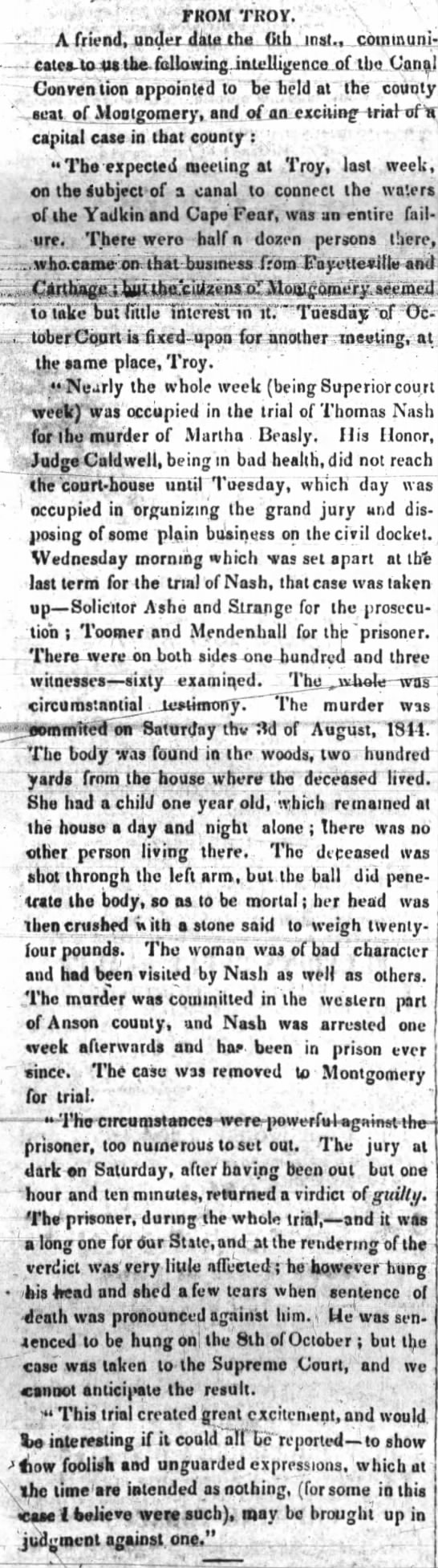
I followed the story through various accounts in the old newspapers of the day.

Patsy Beasly Murder, Thomas Nash -


CLIPPED FROM
The Greensboro Patriot
Greensboro, North Carolina
11 Sep 1847, Sat  •  Page 3
Image result for poor girl slain, 19th century
There were varying accounts of the exact circumstances of the death of Patsy Beasley, but a few facts stood out.She lived in a separate dwelling at the edge of her father's property, said to be near the store of one Jesse Parker. She left her one year old daughter, Drusilla, alone in the house, possibly napping, while she went down to a spring to the washing. There she encountered a terrible fate. She had been shot in the arm, and beaten nearly beyond recognition. A twenty-four pound stone had been used to crush her skull. She had been beaten with the butt of a gun and 'stomped" as well, it was reported. 
Image result for body by the creek, 19th century


Her body was not found for a day and a half, during which time the baby was alone and crawling around.Attempts were made, probably by family and friends on the side of Tom Nash, the accused, to sully her reputation even more than having an out-of-wedlock child would, by saying she was "visited" by other men than just he, a kinder, gentler way of calling her a prostitute. But there was immediate blame and instant knowledge of who the father of her child was among the community. Their thoughts went immediately to Tom Nash.


 -


CLIPPED FROM
The North-Carolinian
Fayetteville, North Carolina
18 Sep 1847, Sat  •  Page 3


The trial of Tom Nash bounced around like a ping pond ball for a bit, as his attorneys looked for a place to have a fair trial. So horrid, so brutal, so unimaginally violent was the murder of this young woman, that the community around was enraged. There was not soul in sight with compassion in their heart for Tom Nash. All were biased and eager for justice. But who was Tom Nash?


Thomas Madison Nash was born about 1819 in Anson County. He was the son of Walker Nash and his wife Edith (or Edna). The Walker Nashes had 3 known children, Thomas, a younger son named Abner, and daughter named Lovey who is named as a defense witness in the court papers.

I believe the Walker Nash family, and perhaps other Nashes in the area, are related to the Governor Abner Nash/ Thomas Walker Nash  family out of Prince Edward County, Virginia.

Walker Nash died while Tom Nash was in custody, about 1847.


Name:Eda Nash
Gender:Female
Age:50
Birth Year:abt 1800
Birthplace:North Carolina
Home in 1850:Union, North Carolina, USA
Real Estate:200
Cannot Read, Write:Y
Line Number:8
Dwelling Number:1234
Family Number:1234
Household Members:
NameAge
Eda Nash50
Abner Nash15
Mary Whitington14


Above is his mother in the 1850 census. I don't know who Mary Whitington was, but as I had a second great grandmother marry a Whittington, I need to look into it.


Name:Eady Nash
Age:71
Birth Year:abt 1789
Gender:Female
Birth Place:North Carolina
Home in 1860:Union, North Carolina
Post Office:Olive Branch
Dwelling Number:568
Family Number:554
Occupation:Knitter
Cannot Read, Write:Y
Household Members:
NameAge
Abner Nash25
Martha Nash25
Millard F Nash9/12
Eady Nash71
Sarah C Walter6


Youngest son, Abner, married Martha Hill, a GGGGreat Aunt of mine, daughter and they had two sons, Millard Filmore Nash and James Benton Nash. Abner Nash lost his life in the Civil War. All known Nash descendants of Walker and Edith are from these two sons of Abner. And from Drusilla, the baby whose mother their son Tom Nash so cruelly murdered. I don't know what happened to Lovey after the trial, whether she died or married after the trial, or just moved away. Poor Edie is working as a knitter at 71 and the family is living in Olive Branch in Union County. Olive Branch is near Anson and was part of Anson until 1842.


Name:Edney Nash
[Eda Nash] 
Age in 1870:90
Birth Year:abt 1780
Birthplace:North Carolina
Dwelling Number:355
Home in 1870:New Salem, Union, North Carolina
Race:White
Gender:Female
Post Office:Olive Branch
Occupation:No Occupation
Cannot Read:Y
Cannot Write:Y
Household Members:
NameAge
Isaiah Mcintire28
Martha Mcintire30
Sarah Mcintire16
Millard Mcintire12
James B Mcintire10
Stephen Mcintire3
Julius C Mcintire
Edney Nash90


In 1870, they aged Edith a bit, making her 90 and she is living with the McIntyres in New Salem, just 3 miles from Olive Branch. Martha McIntyre is her daughter-in-law, Martha Hill Nash, and Millard and James B are really Nashes and not McIntyres. 


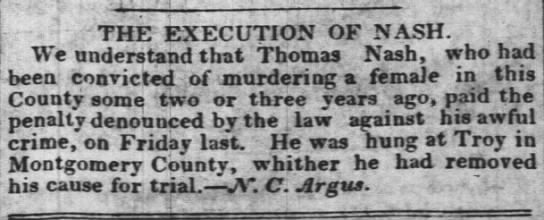
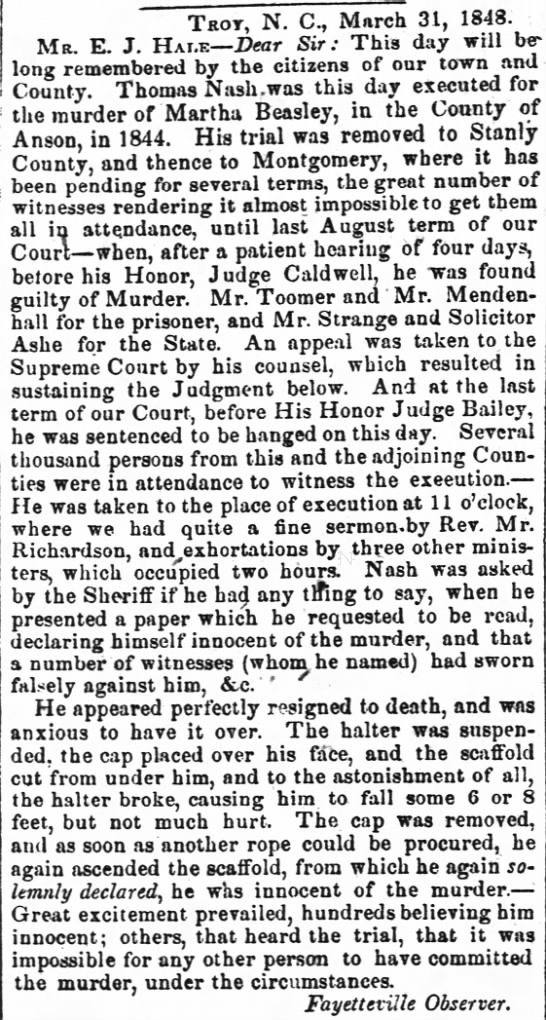
Thomas Nash execution date March 31, 1848 -


CLIPPED FROM
The Raleigh Register
Raleigh, North Carolina
22 Apr 1848, Sat  •  Page 2


Martha "Patsy" Beasley was murdered on August 5, 1844.

Almost immediately, the name of the most likely suspect came to mind to the people of Olive Branch. Tom Nash, who had "ruined" Patsy Beasley and was now wanting to marry Mary Whitley, but one person stood in the way, the woman whom he went to as he wanted, Patsy Beasley.


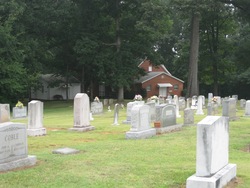
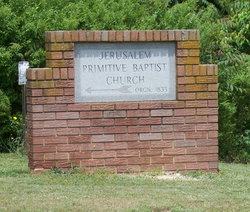
Jerusalem Primitive Baptist Church Cemetery
New Jerusalem Primitive Baptist Church Cemetery from Find-a-Grave


New Jerusalem Primitive  Baptist Church lies between the town of Burnsville, in Anson County and Olive Branch in Union County, two places that can hardly be referred to as 'towns' today. It sits within Anson, on the border of the two counties along Jerusalem Church Road that leads from Olive Branch to Burnsville. One can only assume that the location of Old Jerusalem Primitive Baptist Church was nearby the presently standing more modern building. The names etched on the tombstones in the old cemetery, that carries a mix of older and more modern stones, still reflect the names of families that have lived on this land since before 1844, and still do to this day. Helms, Edwards, Thomas, Baucom, but the name of Nash does not appear. Indeed, they must have been shamed out of the church.


Picture of
Jersalem was the church attended by the Nash family and perhaps also, the Beasley family. As accounted in a 1964 article in 'The Salisbury Post' out of Rowan County, NC by staff writer Heath Thomas, (I wonder if he was related to any of the Thomas family buried in the churchyard?), soon after the gruesome murder, the community gathered in church as always, and a heavy cloud of dismay may have covered the atmosphere in the small building. An unnamed Primitive Baptist Minister made a accusal and a proclaimation  that he had likely never made before, as in his congregation was one Thomas Nash, with his family, and the mindset in the community was in accordance on one idea, one suspicion, one allegation. The article recounts the event as follows:


 (The minister) "was preaching his Sunday sermon at Jerusalem Church and he laid a rather large flint rock on the pulpit. As he denounced the foul murder of Patsy Beasley, he suddenly seized the rock and said: "The man who killed Patsy Beasley is in this church house and I am going to smash his head with this rock." He picked up the stone and drew back his arm as if to hurl it."


This profession stunned and terrified one young man in the congregation. He acted on instinct and thus, gave away his guilt. It was a standard, hot muggy August Sunday in the South, more than a century before air conditioning. Ladies sat fanning themselves on the benches with their carefully folded paper fans. Gentlemen used the hats in their laps to fan away flies. The windows were open in hopes of a breeze to blow through and flys and bees took advantage of the open windows to explore. Tom Nash took advantage of the windows to escape. As the article described; "Young Tom Nash jumped through an open window and ran like a jackrabbit". 

The sherriff had his suspicions, but now he had an involuntary admission of guilt. Tom's rifle was found and the stock was found to be bloody. He now had the physical and circumstantial evidence to make an arrest, along with a motive.

Tom Nash was arraigned in Wadesboro in September of 1844. A Grand Jury, headed by George Dunlap read the minutes in Raleigh and Judge John L. Bailey ordered a continuance until March. The defence asked for the trial to be moved because of the prejudice against Thomas Nash in the area, but also not to move the trial to Richmond County because of the prejudice against him there. Perhaps the Beasley's had relatives there.

The trial was transferred to the September Term in Stanly County and again, the defense had appealed for the trial to be moved in order for Tom to get a fair hearing. The people of Stanly had said that hanging was to good for him, that he should be burned at the stake.

They also asked for the trial not to be held in Union County, where Patsy's family lived. The Nashes lived on the Anson County side and the Beasley's on the Union side of the Anson/Union line.

September 3, 1845, the judge ruled that the trial be moved to Montgomery County, NC at the request of John Beasley and Eben Gurley, witnesses for the prosecution.

Again, Tom asked for a continuance due to the fact that Edith Nash, his mother and Lovey Nash, his sister, material witnesses for the defense, were detained at home with a severe illness and that his father, Walker Nash had died "Monday a week ago", meaning February 17, 1845.  Elishateal Veal, a jailor in Anson County, was also a material witness.

He returned to Troy, Montgomery County, in March of 1846. In Montgomery, C. W. Wooley ordered him transferred back to Wadesboro to be held until August of 1846, until the last Monday in the month, for him to stand trial.


courthousehistory.com | a historical look at out nation's county ...
The historic Montgomery County Courthouse


 A Union County Ballad was written by Douglas and Karen Helms of Wingate University. 

The ballad was recorded by Henry Griffin of Marshville.


The Ballad of Patsy Beasley
Come old and young, come great and small,
The invitation is to all.
A harmless one, and there she lay,
Although exposed to night and day.
And Patsy Beasley was her name,
In Anson County she was slain.
Down by the spring her body lay.
The villian took her life away.
The people said, they wondered why?
How she was killed and how she died?
Her skull was crushed, her hair was torn.
Her arms were bruised all through the bone.
Her little child alone was left.
To live with others or starve to death.
How sad it was, this awful fate.
Get right with God, don't wait too late.


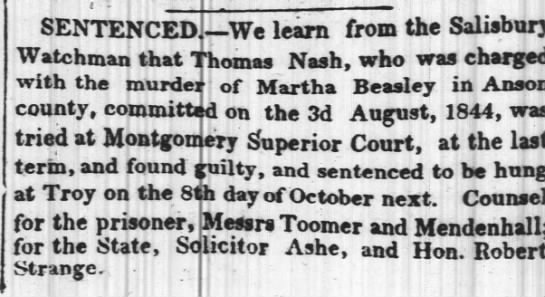
August Term of Court in the year 1846, the presiding judge was Judge Thomas Little. The prosecuting attorney was Robert Strange, who had been following him from county to county. This time the State asked for a continuance. John Beasley, Patsy's father, had stated that Mary Whitley was a very important material witness for the state, who he had expected to testify that Tom Nash had admitted that he was guilty of the murder. She had been the girl who had rebuked Tom because of his relationship with Patsy, that threw Tom into a murderous tailspin. He had killed Patsy so he could be with Mary and  now she was to testify against him. 

John Beasley stated that Mary had attended prior sessions, and could prove admissions of the defendant that he was guilty, but at the moment she was very pregnant, "so far advanced as to render it very unsafe for her to attend the present term of court". 

Finally, after a number of continuances, changes of venue and a delay of 3 years, Thomas Madison Nash had his day in court. It was a  hot, muggy day in August of 1847 in Troy, Montgomery County, North Carolina. about 32 miles from where the murder occured.

The judge was the Honorable David Franklin Caldwell, a resident of Rowan County, who was known statewide for his wisdom and fairness. A jury was called from all corners of Montgomery, from the Uwharries to the Sandhills; William Cagle, Kindred Shandley, William Hurley, Edmund Hearne, James Hall, Norman McCaskill, Burgys Goings, Boon McArthur, Norman Martin, John C Nichols, Valentine Moore, James W Hamilton.

It lasted 3 Days and Tom Nash was sentenced to hang on Friday, October 8, 1847 for the grievous murder of Patsy Beasley.

 -

CLIPPED FROM
The North-Carolinian
Fayetteville, North Carolina
06 May 1848, Sat  •  Page 2

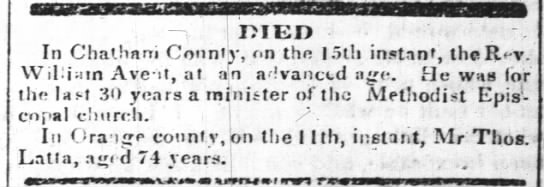
The 4 Ministers: It took my imagination to envision the Death Wagon, which had brought Tom Nash to his demise. A Four-Horse Wagon, wherein the Sheriff had placed Tom in the middle of the wagon, bound, with a rope around his neck. He must have been a sight, a good-looking young man, blonde, dressed all in white, 'including his hat. no doubt his dress was chosen to look innocent, and I dare say, angelic. He was surrounded by 4 ministers, 2 Baptist, 2 Methodist, also described as good-looking, chosen perhaps to make and impact. I want to know who they were and came to the following conclusions"Rev Richard Jacks, Jr. a nephew of Rev. Richard Jacks Sr., a Baptist minister who was a circuit rider who would settle in Ashe County later in life.Rev. Noah Richardson of Moore and Montgomery Counties, a Baptist who preached for 45 years and for 27 sucessive years, elected to preach on Sundays at the meeting of his Association. At his funeral, he was hailed by Rev. James McDaniel of Fayetteville, of being the best Preacher in North Carolina.Rev. William Carlisle of  Camden and Bennettsville, South Carolina, a young minister of Irish decenst known for his flashing good looks and fiery oratation. Rev. William Avant of Chatham County, North Carolina. -
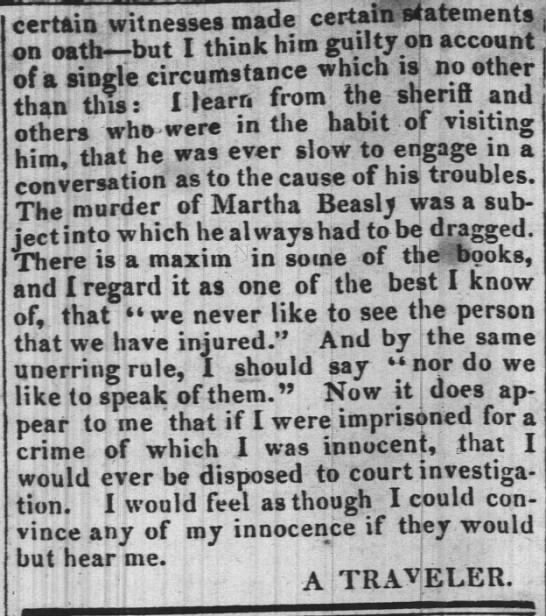
The article from The Carolinian continued in its description of the popular event and of the speech Tom Nash gave before his execution.

 -  -
CLIPPED FROM
The North-Carolinian
Fayetteville, North Carolina
06 May 1848, Sat  •  Page 2

And thus was the end of the life of Thomas Madison Nash. He was said to have been buried at home by his mother, and with help, I am sure, from his brother, if not others, on their property some distance from the Nash Family plot, as he was not wanted among his close relatives, no more than allowed in the church cemetery. A rosebush was planted to mark the site by his mother Edith, and was later proclaimed by a Miss Sandy Thomas who lived there decades later to be quiet beautiful. No one has ever reported seeing the ghost of Tom Nash, so it is expected he rests in peace.
But what about the orphaned child, Drucilla (Nash) Beasley?Her mother was murdered by her father when she was just over a year old. He seemed to have no concern of her, nor is recorded to have ever mentioned her in his testimony that I can find.She came into the care of her maternal grandparents, John and Ala "Aley" Snipes Beasley. At the early age of 16, she married a neighbor, Samuel Crook, son of Victory and Nancy Medlin Crook of Union County in 1859.The Civil War left her a widow at 21. In the very brief probate file of Samuel Crook, Drusilla Crook files for her one year's widow's allowance in the January Term of Court in Union County, North Carolina. Within Drusilla states he died in December of 1864.It was during this will that her beloved Grandfather, John Beasley also passed away. Drusilla's young life had been wrought with tragedy.John Beasley, in his will, ensured that his granddaugther, Drusilla, would be taken care of after the event of his death, despite her marriage.

In the name of God Amen. I John Beasley of the County of Union in the State of North Carolina; being of sound mind and knowledg knowing the uncertainty of Life do Therefour make publish ordain and declare this to Be my Last will and Testament that is to say after all my lawfull Debts shall have been paid and discharged I will and bequeath un to my [Beloved] wife all my tract of land where I now live on at this time Except the Portion that I have heretofore give off to Samuel Crook & wife Drusilla During her natural Life also all my house hold and Kitchen furniture consisting of Every thing in the houses of mine also my stock of Horses and Cattle and hogs & All of the produce of corn and wheat and meat on hand And all of the pottery on hand at my death Consisting of everythng on hand at my death to make use of at her Disposal. (2.) I give and bequeath unto my Grand daughter Druscilla Crook wife os Samuel Crook Five acres of land adjoining the Lands I heretofore have give them. (3.) I give & bequeath unto my Daughter Alla Pusser one fourth part of this tract of land where I know live on at the death of my wife & myself it being apart of the south & west ajoining the lands of Wm. H. Simpson And the Big Survey taken the place or improvements where Victor Crook lives Supoosed to be about twenty seven Acres and one fourth of an acre.
(4. I give and bequeath unto my three Daughters Lucindy Sikes and Mary Harrison and Annie Sharp the balance of my Tract of land to be equally devided between them the place where I Now live on at the Death of my wife or widow (5.) I give & bequeath unto my daughter Keziah Kelly all of the property I have heretofore have give her and know more Except the Tract of Land which she has onely a Lifetime Rite to of 88 acres ajoining the Lands of Thomas J. Griffin and Daniel Smith and others.
(6.) I Direct that the tract of Land above mentioned to be sold the tract ajoining the lands of Thomas J. Griffin and Daniel Smith & others and the proceeds arising from it to be applied to paying Debts and the balance if any to be devided between my four Daughters Lucindy Sikes & Mary Harrison And Annie Sharp & Alla Pusser March The 14th day 1861 In witness whereof I have hereunto subscribed my name and affixed my seal.

John (X)Beasly (seal)A. T. Secrest
G. W. Helms

Minuet Dockett
Page 328

So this is where I had left off with Drusilla, in the aftermath of the Civil War. It appears family had a hand in her future, even then, as an adult at 21. Following court records seem to suggest she had Aunts who were quite jealous of her. The estate records of John and Ala Beasley (who died 3 years after her husband), are quite lengthy.Drusilla was married off to her first cousin, Noah Sharpe, and sent away.
Cherokee County, Alabama, Map, 1911, Centre, Cedar Bluff, Gaylesville


Anna "Annie" Beasley, was the 4th daughter of John and Ala Snipes Beasley. In 1821, at the age of 13, Annie had married Emory M. Sharp in Anson County. They then settled in Jamestown, Cherokee County, Alabama along the Georgia border. Noah Eugene Sharp was the 7th of her 9 children. He was born in 1840 in Alabama.


Name:Naah Sharp
[Noah Sharp] 
Age:18
Birth Year:abt 1842
Gender:Male
Birth Place:Alabama
Home in 1860:District 3, Cherokee, Alabama
Post Office:David Crossroad
Dwelling Number:587
Family Number:587
Household Members:
NameAge
Emery M Sharp65
Anna Sharp53
Ellen B Sharp21
Naah Sharp18
Levi L Sharp17
Roena Thomas24
Geo W Thomas5
Marth C Thomas2
Crofford M Thomas1

In 1860, when Drusilla was living in Olive Branch, Union County, NC with her husband, Samuel Crook, Noah is living in David's Crossroads, Cherokee County, Alabama, with his parents, Emory and Annie Sharp, and his siblings, Ellen, Levi and Roena, a widow, and her 3 young children.
Lincoln County, Tennessee Genealogy Genealogy - FamilySearch WikiNoah also served in the Civil War, but unlike Samuel Crook, had made it out alive. Though I can find no marriage record for Noah and Drusilla, they appear to have married soon after the death of Samuel Crook, in 1865. Their first child, Hettie Ann, was born on February 9, 1866, in Elmont Springs, Giles County, Tennesee.

Name:Noah Sharp
Age in 1870:30
Birth Year:abt 1840
Birthplace:Alabama
Dwelling Number:188
Home in 1870:District 17, Lincoln, Tennessee
Race:White
Gender:Male
Post Office:Pleasant Plains
Occupation:Farmer
Male Citizen over 21:Y
Personal Estate Value:100
Inferred Spouse:Drucilla Sharp
Inferred Children:M D Sharp
S A Sharp
H S Sharp
Household Members:
NameAge
M D Sharp3
S A Sharp1/12
Noah Sharp30
Drucilla Sharp27
H S Sharp4

The 1870 census would find the young family in neighboring Lincoln County, Tennesse, both on the Tennesee/Alabama border. Noah was a 30 year old farmer with 3 children, Hettie, Amanda and Sidney Allen Sharp. Drusilla apparently did not have any children with Samuel Crook.


NameAge
Noah Sharp40
Drusella Sharp37
Hetty A. Sharp14
Amanda Sharp12
Sidney Sharp10
Henry S. Sharp8
Gynthia S. Sharp6
Laodicia Sharp4
Ten years later, Noah and Drucilla were still in Lincoln County, Tennesee, now ages 40 and 37, and the family had doubled in size from 3 to 6 children. Additions were Henry, Cynthia and Laodocia. Noah's father, Emory, died in 1867. His mother, Anna Beasley Sharp, remained in Cherokee County, Alabama until her death in 1889. 


Name:Annie Sharp
Age:80
Birth Date:Abt 1800
Birthplace:North Carolina
Home in 1880:Cherokee, Alabama, USA
Dwelling Number:58
Race:White
Gender:Female
Relation to Head of House:Mother
Marital status:Widowed
Father's Birthplace:North Carolina
Mother's Birthplace:North Carolina
Cannot Write:Yes
Neighbors:
Household Members:
NameAge
Levy W. Sharp33
Georgia Sharp29
Emry Sharp3
William M. Sharp2
Jeppa L. Sharp10/12
Annie Sharp80


It may have been through some reason of inheritance that Noah Sharp returned with his family to Alabama. Noah and Drusilla would have 3 more children after the 1880 census, for a total of 9.1877 - Delpha or Delphia Sharp1881- John Preston Riley Sharp1883- Joel Wilson Sharp
Drusilla was 40 upon the birth of her last child and died in Limestone County, Alabama sometime after his birth and before the 1900 census.
Noah Sharp outlived Drusilla for several years. He appeared in the 1900 cenus living in Limestone County, Alabama with  3 of his children and 4 of his grandchildren.

Name:Noah Sharp
Age in 1910:69
Birth Year:abt 1841
Birthplace:Alabama
Home in 1910:Civil District 1, Giles, Tennessee
Street:Elkmont Springs And Huntsville
Race:White
Gender:Male
Relation to Head of House:Head
Marital status:Widowed
Father's Birthplace:North Carolina
Mother's Birthplace:North Carolina
Native Tongue:English
Occupation:Farmer
Industry:General Farm
Employer, Employee or Other:Employer
Home Owned or Rented:Own
Home Free or Mortgaged:Free
Farm or House:Farm
Able to Read:Yes
Able to Write:Yes
Survivor of Union or Confederate Army or Navy:Yes
Neighbors:
Household Members:
NameAge
Noah Sharp69
Joe W Sharp26
Mary E Sharp23
Y* M Sharp0

In 1910, he's back in Giles County, Tennessee, living with his youngest son, Joel and his young family.  He would pass away 5 years later, on April 16, 1915 in Limestone County, Alabama again, at the age of 74. It is believed that both Noah and Drusilla were buried in the Old Sharp Family Cemetery near Elmont or Ardmore on the Tennesee/Alabama State Line. The cemetery has been destroyed and the graves plowed under according to what I've been told. Some tombstones were saved.Best Places to Live in Elkmont, Alabama

Noah and Drucilla's 9 children were:
A) Hetty Ann Sharp Culp  b 1866 Giles County, TN d 1958 Athens, Limestone County,       AL.B) Amanda D Sharp Holloway Esckstine b 1867 Giles County, TN d 1825 Ardmore, Limestone County, AL.C) Sidney Allen Sharp b 1870 Lincoln County, TN d 1935 Athens, Limestone County, ALD) Henry L Sharp b 1872 Madison County, AL d 1907 Rogersville, Limestone County, ALE) Cynthia S. Sharp b 1874 Alabama or Tennesee or North Carolina (NC on 1880 census) Death unknown.F) Ladocia Sharp b 1876 Tennesee or Alabama or North Carolina (Nc on 1880 census) Death unknown. Possibly married Burnett.G) Delphia Savannah Sharp Smith b 1877 Alabama d 1926 Holcomb, Dunklin County, MissouriH) John Preston Riley Sharp b 1881 Lincoln County, TN d 1856 St. Louis, MissouritI) Joel Wilson Sharp b 1883 Limestone County, AL d 1973 San Angelo, Tom Green County, TX


http://www.bluegrassmessengers.com/hand-me-down-songs-union-co-nc--helms.aspx