

Probably not, but I have. A pattern emerges - Ann, Mary, Jane, Ann, Mary, Jane, Sarah, Elizabeth, Ann, Mary, Jane, Catherine, Martha, Ann, Mary, Jane, Susan, Margaret, Ann, Mary, Joan, Sophia, Mary, Mary, Mary. Why couldn't you people be original????
I've often wanted to time travel to when my 9th Great Grandmother had given birth to my 8th Great Grandgrandmother and was contemplating her name. I'd shake her by the shoulders and scream, "Don't name her Mary!!!".
Every once in awhile, however, you are lucky enough to get a Vashti.

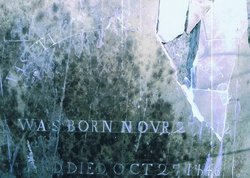 |
| Vashti's broken slate tombstone |
I don't have a great deal of information on Vashita "Vashti" Calloway Morton, but more on her than some other female ancestors.
Vashti, as she was called, was born on November 27, 1912 in what is now Stanly County, in the area that is now considered Palmerville, near Palmer Mountain along the Yadkin River. Badin Lake did not exist then and Badin Lake would become her scourge.
 |
| Ferry crossing the Yadkin at the Mouth of the Uwharrie. Stanly County Museum Photo Archives |
She was the daughter of Job Calloway and Susannah Martisha Randle Calloway. She was the granddaugther of Isaac Calloway and wife, Elizabeth Arnold Calloway and his first wife, Littie Elmore.
The Randles were Virginians. Colby was born in 1746 in Brunswick County, Virginia. He died about 1804 in Montgomery (Stanly) Couny, NC,, son of William Randle and Anne Marshall Randle, just one of my Marshall lines.
Her paternal grandfather, Isaac Calloway was born in Somerset, Maryland in about 1750. He died about 1801 somewhere along the Pee Dee River and supposedly is buried at the old Palmerville Church. His wife, Elizabeth Arnolds family, Peter Arnold and Elizabeth Greene, came from Onslow County, and hailed from Warwick, Kent, Rhode Island before that.
| A Bird's Eye View of Palmer Mountain, the Clover-shaped area in the middle of the frame |
Oddly, the surname Calloway is said to be of Norman-French origin. Below from Wikipedia.
This interesting surname is of Norman French locational origin, from the place called "Caillouet-Orgeville" in the province of Eure, which is recorded in 1157 as "Cailloel". The placename means "place of stones or pebbles", from the Old Norman "cail(ou)" meaning pebble or stone.
Vashti was the second born of Job and Susannah's 10 children. Her older sister was Mary, and Vashti was followed by: Isaac, Elmore, John, Martisha, Agrippa Gamaliel, Alfred, Kassandra and Sarah.
She grew up in the community of the Yadkin/ Pee Dee settlers in the West Pee Dee portion of the Uwharries, near the famed Forks and Narrows of the Yadkin. For those who don't know, the Yadkin becomes the Pee Dee at its confluence with the Uwharrie River.

She attended the old Ebenezer Church that was in what is now Badin, NC. The church and congregation is now Badin Baptist. In the Association Minutes of Badin Baptist is the following information:
"..Wake Forrest College observes the 26th anniversary o the Pee Dee Association....'convened at Ebenezer Meeting House, Stanly County, North Carolina, October 15, 16, 17 and 18 in the year1841,' Stanly County was erected by the General Assembly using the Yadkin River as a boundary line on January 11, 1841. Samuel P. Morton, a former pastor (Of Ebenezer) was elected register of deeds.
Ebenezer Baptist Church Post Office was listed at Stony Gap. Messengers to this Association were William Palmer, William Hall, and Michael Fesperman." Note: Michael Fesperman was Post Master of Stony Gap, at least for a time.
| View of the Narrows of the Yadkin River from Palmer Mountain. From the Stanly County Museum Photo Archives |
In about 1826, at the age of 14, Vashti would marry Samuel Parsons Morton, son of James Morton and Elizabeth Summers (Summerow). He was 21. Sammy was well-educated and Vashti likely was as well. The daughter of a minister, marrying a minister, she had to have been able to read the Bible and perhaps play a musical instrument. It's been my experience that those born in the first half of the 1800's were far better educated than those born during or after the Civil War.
In his earliest days, Samuel P. Morton worked as a Registrar and Cleric in the town of Albemarle. I've seen his signature on many legal document. Having worked as both a civil servant and an itenerant and at times, situated minister, I wonder where Sam and Vashti lived. Did one or more of the churches put him up in a pastorium?
I read, and thought it quite intriguing, that "Baptists keep the pastor in a pastorium, Methodists have parsons in the parsonage, Presbyterians have ministers in the manse, and Episcopalians keep rectors in the rectory." I had never thought of it that way.

From the History of Badin Batptist Church (formerly Ebenezer), Samuel P Morton served as Pastor, intermittenly. He also preached at Bethel, Kendall Valley, Rocky River and Red Hill and other churches in various counties about as an Evangelist during Camp Meetings. He is buried at Red Hill.
| Home in 1830 (City, County, State): | West Side Pee Dee River, Montgomery, North Carolina |
|---|---|
| Free White Persons - Males - Under 5: | 1 Steven |
| Free White Persons - Males - 10 thru 14: | 1 Unknown |
| Free White Persons - Males - 20 thru 29: | 1 Sammy |
| Free White Persons - Females - 5 thru 9: | 1 Unknown |
| Free White Persons - Females - 10 thru 14: | 1 Unknown |
| Free White Persons - Females - 15 thru 19: | 1 Unknown |
| Free White Persons - Females - 20 thru 29: | 1 Vashti |
| Free White Persons - Under 20: | 5 |
| Free White Persons - 20 thru 49: | 2 |
| Total Free White Persons: | 7 |
| Total - All Persons (Free White, Slaves, Free Colored): | 7 |
In his first census, the family of Samuel P. Morton shows Vashti as only a dash. They appear to have had several young people living with them who were not their children. Perhaps orphans that they took in, being a Christian family. There is no record of Sammy having had a previous wife or children, and at 25, here, he would not have been old enough to be the father of teenagers. I'm quite certain it was most likely a charitable reason to have the extra children in the home.
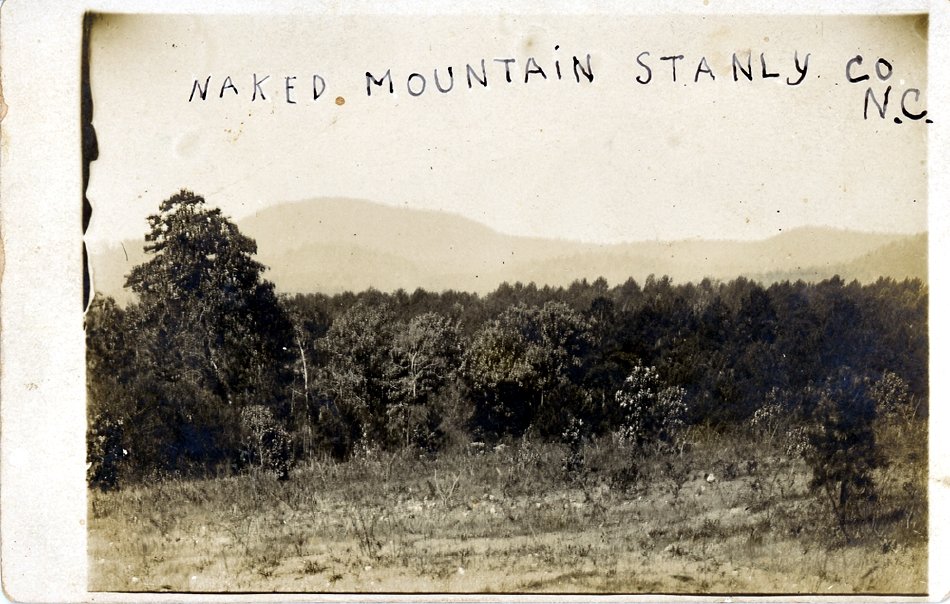 |
| A view of Morrow Mountain before he put on his clothes |
Vashi's father Job Calloway wrote his will in 1837 and mentioned Vashti. He mentions first his beloved wife, Susannah, but doesn't name her. He names his oldest daughter, Mary McLester. Then:
"I give to my second eldest daughter Vashti Morton property to the amount of seventy dollars which property she has got.." This is the same phrase he used for Mary and then in the 5th line, for his oldest son Isaac. He states that the "above children" were not to recieve anything more until the other children recieve value of at least $70. He requested 70 acres of land on the Yadkin River be sold and then "400 acres at home" be priced at $2 an acres and that " my four boys younger than Isaac", buy the same and pay the estate as they come to 21. He names the 4 younger sons " viz- Elmore, John, Agrippa and Alfred." He goes on to mention all of his younger children to participate in the division of the remainder of the estate, but did not name the younger, unmarried daughters, Martisha, Sarah, and Kassandra.
| Name: | Danl P Morton [Saml P Morton] |
|---|---|
| Home in 1840 (City, County, State): | West Pee Dee River, Montgomery, North Carolina |
| Free White Persons - Males - 15 thru 19: | 1 Steven |
| Free White Persons - Males - 20 thru 29: | 1 Unknown, Farm hand perhaps |
| Free White Persons - Males - 30 thru 39: | 1 Sammy |
| Free White Persons - Females - Under 5: | 2 Adeline, Susan Jane |
| Free White Persons - Females - 30 thru 39: | 1 Vashtia |
| Persons Employed in Agriculture: | 1 |
| Free White Persons - Under 20: | 3 |
| Free White Persons - 20 thru 49: | 3 |
| Total Free White Persons: | 6 |
| Total All Persons - Free White, Free Colored, Slaves: | 6 |
By 1840, oldest son, Steven, had been joined by 2 little sisters: Adaline and Susan Jane. Vashti would have been heavily pregnant with Wincy Elizabeth, my 3rd Great Grandmother, or either she was just missed being a newborn.
Wincy would be followed by 3 more siblings, 1841 - George Arnold, 1842 - Mary and 1846 - Sarah.
Vashti would die at the young age of 33, supposedly in childbirth. She was one month from her 34th birthday and the date was Oct 27, 1846. According to family legend, the child was buried with her.
 |
| Photo of Graveyard Island Graves from Find-a-Grave |
Vashti was originally buried in a cemetery that no longer exists. Around 1917, during the daming of the Yadkin River, several cemeteries that were lying in areas that were going to be flooded during the creation of Badin Lake , were moved to higher ground. "Higher Ground" became an island. Over 400 of the graves are unidentifiable. Vashti's is one that is.
The book, "These Hallowed Grounds", published by the Stanly County Genealogical Society, has the following to report about Graveyard Island.
"Graveyard Island or Big Cut Cemetery is a cemetery located on an island in Badin Lake between Palmerville and Old Whitney. This cemetery was made by Alcoa to use for the transfer of bodies from cemeteries that would be covered by water after Badin Dam was built. The island is set up in three sections.Cemeteries moved from Stanly Co. were Kirk-Nash Cemetery, Locke Cemetery, Narrows Cemetery, Pennington Cemetery,Vashti Morton Cemetery, and Jones or Locust Cemetery. Cemeteries moved from Montgomery County were: Coggin Cemetery, Chisholm Cemetery, Forney Cemetery, Cranford Cemetery, Sammy Talbert Cemetery, James Elliott Cemetery and Simmons Cemetery. Grave were also moved from these cemeteries from other counties: Arey, Bruner, Jonathan Conger, Black cemetery (unknown name), Ebony, Elliots Grove, Elliott James, Ellis Family, Elliott-Taylor, Gideon Bean, Samuel Hall, Samuel Hall (black) Holmes, Mears, Pear Tree Hill, and Samuel Taylor. .....
24 marked stones 99 unmarked stones 7 other possible graves......
*Note: Graves 1 - 6 moved from Locke Cemetery Graves 7-13 moved from Kirk - Nash Cemetery
Graves 14- 17 moved from Morton Cemetery Graves 18 - 20 moved from Pennington Cemetery
Grave 21 moved from Simmons Cemetery."
That was the first section, there are 3. The second section has 10 rows and 30 to 38 graves in each row totalling 409 graves. The third section holds only one identifiable grave.
After Vashti's death, her widower would marry Lucy Ingram in 1848, and father two more sons, Louis and James W. I don't know a great deal about Lucy, but most people have her as the daughter of Kinchen Martin and Chloe Hough Martin, and a widow of a Samuel Ingram. As there are several Ingrams mentioned in the early records of Ebenezer Church, it may have been that set of Ingrams Lucy was from, or married into.
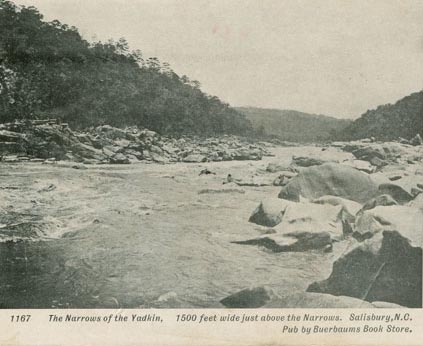 |
| A Lower View of the Narrows
Excerpt from 'The History of Anson County" by Mary Louise Medley
'A contemporary of Freeman and the Ratliff preachers was Samuel P. Morton known as 'Crying Sammy Morton'. An emotional type, he was given to shedding tears from the pulpit. Deacon Uriah Staton, large landowner of the Rocky River section and a leader in both the first church there and a later one at Red Hill, usually went to sleep when Uncle Sammy preached. When asked about this he is said to have replied, "I know I can trust Uncle Sammy, but a stranger I have to watch'. Morton was born in Stanly County in 1805 and lived near Badin. He was an earnest, good man and filled with the spirit, and lived a meager life, bordering on poverty. He requested that the words on his tombstone be 'S. P. Morton A Sinner Saved by Grace.' What he lacked in colorful revival tactics, he made up in sincere good work. He converted and baptized many people during his ministry. '
Note: The present town of Badin did not exist during the lifetime of Sammy Morton. What the author meant was he lived in the area of the present town. Ebenezer Baptist Church, now Badin Baptist, did exist and in it's cemetary is buried the father of Sammy Morton's first wife, Vashti Calloway, Job Calloway. Vashita Calloway Morton's grave and the homestead of Samuel P. Morton at the time was in the path of the expanding waters of Badin lake during the Dam construction era. Vashti's grave, with many others, was relocated to one of the Graveyard Islands near Tuckertown Dam. Sammy and his second wife, Lucy Ingram Morton, are buried at Red Hill Baptist Church in northern Anson County.
Posted by Myself, on ancestry.com, some years ago.
|
In a World of Mary's and Sarah's, let's all be a Vashti!
The name Vashti is a girl's name of Persian origin meaning "lovely". This Persian name with an Old Testament pedigree has a warm Sasha-like feel. The Biblical Vashti was a queen who refused her husband's orders to appear naked in front of his party guests and so was deposed in favor of Esther.
From Google Search


